Abraham
Called from his country, given covenant promises, visited by heavenly messengers, and promised a son when Abraham and Sarah were advanced in age. Isaac's birth becomes a central sign of the promised line.
Archoseum
Museum Exhibition
Preparing the exhibition
0%Gallery VII · Section 01
From the call of Moses to the threshold of the Promised Land
Fire that did not consume. Signs before Pharaoh. A sea divided. A visible presence guiding Israel. Food appearing in the wilderness. Water from rock. A mountain covered in fire and smoke. This section follows the extraordinary events surrounding Israel's deliverance from Egypt and journey through the wilderness.
Research Room Orientation
This room follows a continuous biblical arc. The promises given to Abraham, Isaac and Jacob become the family history behind Israel's descent into Egypt. Joseph's preservation of his family sets the stage for Exodus. Moses then leads a nation out of bondage through a concentrated sequence of signs, judgments, provision and covenant revelation.
Called from his country, given covenant promises, visited by heavenly messengers, and promised a son when Abraham and Sarah were advanced in age. Isaac's birth becomes a central sign of the promised line.
The promised son survives the binding on Moriah and carries forward the covenant. Genesis presents divine appearances, protection and providential guidance surrounding his household.
Jacob sees the ladder at Bethel, receives covenant promises, wrestles through the night and is renamed Israel. His twelve sons become the tribal fathers of the nation.
Dreams, reversals and famine carry Joseph from slavery to authority in Egypt. His preservation of Jacob's household explains how Israel enters Egypt generations before the Exodus.
Geographic Orientation
A visual guide to the principal locations connected with the Exodus and wilderness miracles. Several ancient sites remain subjects of geographic study, so the route is presented as a best-known museum orientation rather than a surveyed itinerary.
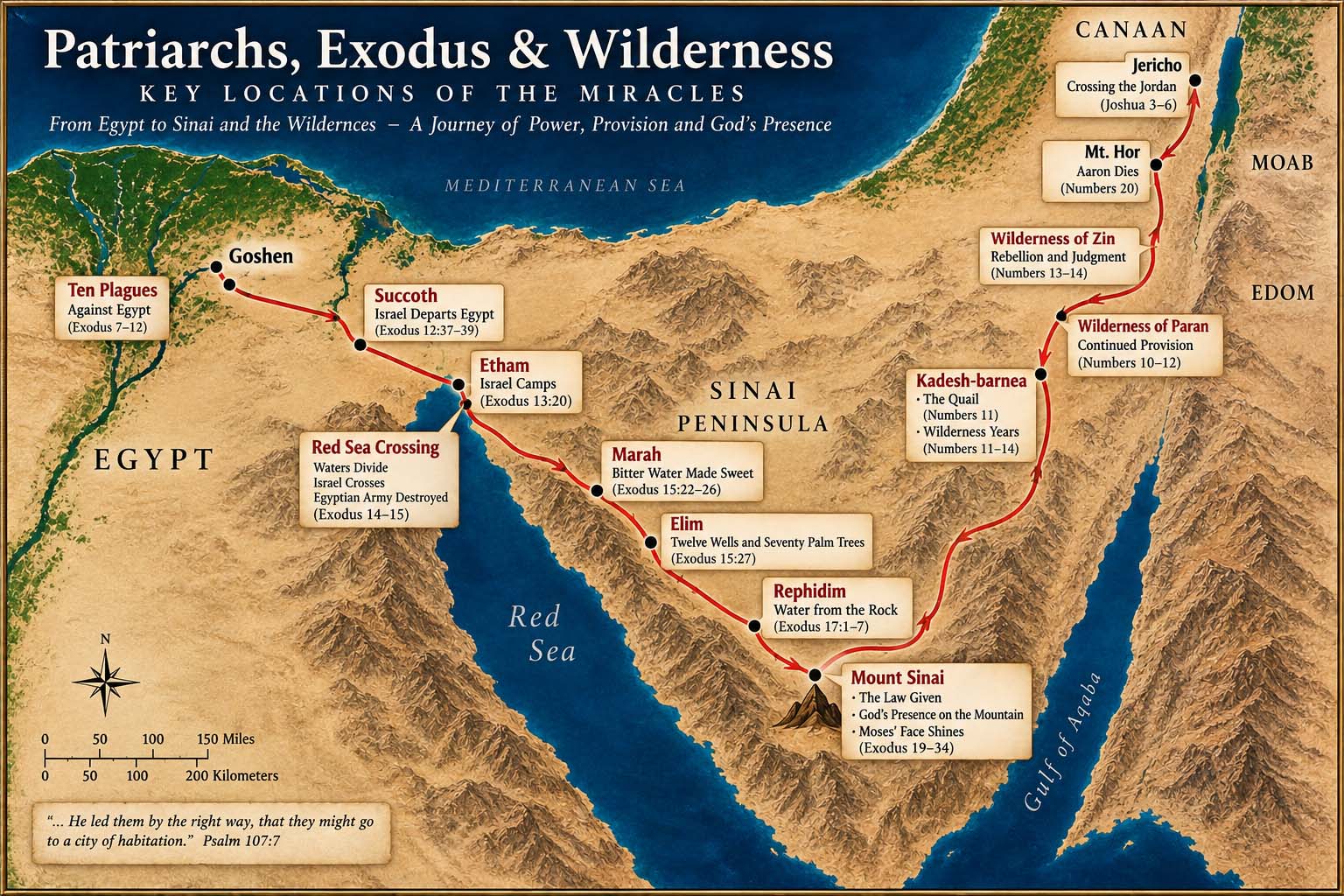
Map locations are approximate where the ancient geography continues to be studied. The labels identify the miracle or biblical event associated with each principal stop.
The Biblical Record
Open each record as a complete museum exhibit. Each room now brings together the KJV account, geography, sequence, physical details, ancient Jewish testimony, interpretive boundaries and cross-references to related exhibits.
Moses encounters one of Scripture's most visually striking signs while tending the flock of Jethro near Horeb. A bush is burning, yet the plant is not consumed. Moses turns aside specifically because the sight violates what he expects fire to do.
“And the angel of the LORD appeared unto him in a flame of fire out of the midst of a bush: and he looked, and, behold, the bush burned with fire, and the bush was not consumed.”Exodus 3:2 · KJV
The miracle centers on the extraordinary character of the fire. The extraordinary feature identified by the text is that the bush continues burning without being consumed. From this place God calls Moses by name and commissions him to return to Egypt.
| Detail | What happened | KJV Reference |
|---|---|---|
| Place | Horeb, the mountain of God | Exodus 3:1 |
| Sign | The bush burned with fire and remained unconsumed | Exodus 3:2-3 |
| Presence | God called Moses by name from the bush | Exodus 3:4 |
| Holy ground | Moses removed his shoes | Exodus 3:5 |
| Commission | Moses was sent to bring Israel out of Egypt | Exodus 3:7-10 |
| Divine name | I AM THAT I AM | Exodus 3:13-15 |
Moses is tending Jethro’s flock beyond the settled country when he turns aside to investigate the flame.
The text focuses attention on a bush visibly burning while remaining unconsumed.
The sign becomes the setting for the divine name, Moses’ calling and the promise of Israel’s deliverance.
Josephus retells Moses’ approach to the divine encounter in his account of Moses’ return from Midian, placing the calling within a larger narrative of deliverance.
Josephus, Antiquities, Book IIWhen Moses asks how Israel will believe that God has appeared to him, he is given signs that can be demonstrated before others. His staff becomes a serpent and then returns to a staff. His hand becomes leprous and is restored. A third sign involving water from the river is also promised.
“And he cast it on the ground, and it became a serpent; and Moses fled from before it.”Exodus 4:3 · KJV
These signs are important because they are presented as repeatable demonstrations attached to Moses' commission, not merely as a private experience in the wilderness.
| Detail | What happened | KJV Reference |
|---|---|---|
| Rod | The rod became a serpent and returned to a rod | Exodus 4:2-4 |
| Hand | Moses' hand became leprous and was restored | Exodus 4:6-7 |
| Water | River water was appointed to become blood on dry land | Exodus 4:9 |
| Purpose | The signs authenticated Moses' commission | Exodus 4:29-31 |
Moses is told to cast down the staff, then take the serpent by the tail as it becomes a staff again.
His hand becomes leprous and is then restored, giving a second visible sign.
A third sign is promised if the first two do not persuade the hearers.
The confrontation with Pharaoh unfolds through a sequence of escalating signs and judgments: water turned to blood, frogs, lice, flies, livestock pestilence, boils, hail, locusts, darkness, and finally the death of the firstborn.
“And the Egyptians shall know that I am the LORD, when I stretch forth mine hand upon Egypt...”Exodus 7:5 · KJV
Several plagues involve phenomena known in nature, but Exodus presents their timing, intensity, prediction, geographic distinction, and cessation as acts under divine command. At points the land of Goshen is specifically distinguished from the rest of Egypt.
The sequence moves through the Nile, frogs, lice, flies, livestock, boils, hail, locusts and darkness.
Several judgments explicitly distinguish Israel’s territory or people from Egypt.
The final judgment immediately precedes Pharaoh’s release of Israel and the institution of Passover.
| Plague | What Happened | KJV Record |
|---|---|---|
| 1 · Water Turned to Blood | Moses struck the waters with the rod. The river became blood, the fish died, the river stank, and the Egyptians dug around the Nile seeking water to drink. | Exodus 7:17-24 |
| 2 · Frogs | Frogs came up abundantly and spread across Egypt, entering houses, bedchambers, ovens and kneading troughs. Pharaoh appealed to Moses for their removal. | Exodus 8:1-15 |
| 3 · Lice | Aaron struck the dust of the land, and it became lice upon people and animals. Pharaoh's magicians answered, “This is the finger of God.” | Exodus 8:16-19 |
| 4 · Flies | Grievous swarms filled Egyptian houses and corrupted the land. Goshen was set apart, making a visible distinction between Egypt and the people of Israel. | Exodus 8:20-32 |
| 5 · Livestock Pestilence | A severe pestilence struck the cattle, horses, asses, camels, oxen and sheep of Egypt. The livestock of Israel were preserved. | Exodus 9:1-7 |
| 6 · Boils | Moses and Aaron cast furnace ashes toward heaven. The resulting dust produced boils breaking forth with blains upon people and animals throughout Egypt. | Exodus 9:8-12 |
| 7 · Hail and Fire | A devastating storm brought hail and fire upon Egypt. People, animals, crops and trees in the field were struck, while the land of Goshen was preserved. | Exodus 9:13-35 |
| 8 · Locusts | An east wind brought locusts over Egypt in immense numbers. They covered the face of the earth and consumed the vegetation that remained after the hail. | Exodus 10:1-20 |
| 9 · Darkness | Thick darkness covered Egypt for three days. The Egyptians remained in their places, while the children of Israel had light in their dwellings. | Exodus 10:21-29 |
| 10 · Death of the Firstborn | At midnight the firstborn throughout Egypt died, from Pharaoh's household to the captive in the dungeon. A great cry arose throughout the land, and Pharaoh called for Israel to depart. | Exodus 11:4-10; 12:29-33 |
Josephus devotes a full chapter to the plagues and emphasizes both their unprecedented severity and Moses’ foretelling of them.
Josephus, Antiquities II.14The final plague is accompanied by a specific act of obedience. Israelite households are instructed to mark their doorposts with the blood of the Passover lamb. The judgment passes through Egypt, while the marked households are spared.
“And the blood shall be to you for a token upon the houses where ye are: and when I see the blood, I will pass over you...”Exodus 12:13 · KJV
The event becomes foundational to Israel's national memory. Passover is commanded as a memorial to be observed in succeeding generations.
| Passover Element | Meaning within the Exodus Record | KJV Record |
|---|---|---|
| The Lamb | A lamb without blemish was selected for the household and kept until the appointed day. | Exodus 12:3-6 |
| The Blood | The blood was placed on the two side posts and upper doorpost as the divinely appointed token upon the house. | Exodus 12:7, 13 |
| Hyssop | A bunch of hyssop was dipped in the blood and used to strike the lintel and doorposts. | Exodus 12:22 |
| The Meal | The lamb was eaten with unleavened bread and bitter herbs, with the household prepared for immediate departure. | Exodus 12:8-11 |
| Memorial | Passover was established as a feast and memorial for succeeding generations. | Exodus 12:14, 24-27 |
| Detail | What happened | KJV Reference |
|---|---|---|
| Lamb | A male of the first year without blemish | Exodus 12:3-5 |
| Timing | Kept until the fourteenth day and killed in the evening | Exodus 12:6 |
| Blood | Placed on both side posts and the upper doorpost | Exodus 12:7 |
| Meal | Roasted flesh, unleavened bread, and bitter herbs | Exodus 12:8-11 |
| Token | The blood marked the household during judgment | Exodus 12:12-13 |
| Memorial | Passover established for succeeding generations | Exodus 12:14, 24-27 |
The prescribed mark identifies the houses that are to be passed over.
The household meal is eaten in readiness for departure.
The event becomes a recurring feast through which later generations rehearse the deliverance.
After leaving Egypt, Israel is led by a visible phenomenon described as a pillar of cloud by day and a pillar of fire by night. It provides direction and light, and the biblical record later describes Israel's movements as governed by its rising and resting.
“And the LORD went before them by day in a pillar of a cloud, to lead them the way; and by night in a pillar of fire, to give them light...”Exodus 13:21 · KJV
At the Red Sea the phenomenon changes position, moving between Israel and the Egyptian force. Numbers later describes the cloud remaining over the tabernacle for varying periods. When it was taken up, Israel traveled. When it remained, Israel camped.
| Detail | What happened | KJV Reference |
|---|---|---|
| Day | Pillar of cloud led the way | Exodus 13:21 |
| Night | Pillar of fire gave light | Exodus 13:21 |
| Protection | The pillar stood between Israel and Egypt | Exodus 14:19-20 |
| Sinai | The cloud later covered the mountain | Exodus 24:15-18 |
The visible presence leads the route and provides a communal point of guidance.
The night manifestation gives light and continues the pattern of guidance.
At the sea, the pillar moves between the two camps during the crisis.
Pharaoh's army overtook Israel at the sea after the people had left Egypt. The crisis involved an entire migrating nation with children, livestock, possessions, and a mixed multitude, while Egypt's mobile military force closed from behind. The pillar moved between the camps, Moses stretched out his hand, the LORD sent a strong east wind through the night, the waters divided, and a passage of dry ground opened through the sea.
“And the children of Israel went into the midst of the sea upon the dry ground: and the waters were a wall unto them on their right hand, and on their left.”Exodus 14:22 · KJV
Exodus 12:37 records about six hundred thousand men on foot, beside children. A mixed multitude and very much cattle also departed.
Pharaoh took six hundred chosen chariots plus the other chariots of Egypt, with captains, horses, horsemen, and his army.
The east wind acted all night. The Egyptian force was overwhelmed as morning appeared.
Israel reached the opposite side while the pursuing chariots and horsemen were overtaken by the returning waters.
| Question | Museum Detail | KJV Record |
|---|---|---|
| How many people crossed? | The departure count gives about 600,000 men on foot, beside children. Adding women, children, households, and the mixed multitude produces a moving population well above the adult-male figure. Large-population reconstructions often approach or exceed two million people, so the opened corridor would have needed to accommodate a vast host. | Exodus 12:37-38 |
| How deep was the sea? | The biblical physical picture is water standing as a wall on Israel's right and left with dry ground beneath them. The precise depth depends upon the crossing location. Proposed locations range from Egypt's ancient eastern lake district to deeper Gulf settings, making depth an important geographic research question. | Exodus 14:21-22, 29 |
| How long did the crossing take? | The separation developed through the night. Israel crossed before the climax of the morning watch, and the sea returned as morning appeared. The narrative therefore presents a massive nighttime movement completed before daybreak. | Exodus 14:20-27 |
| How large was Pharaoh's army? | The text explicitly names 600 chosen chariots and then adds all the chariots of Egypt, together with horses, horsemen, captains, and the army. The 600 were the selected chariot force, not the complete pursuing host. | Exodus 14:6-9 |
| How far did Egypt pursue? | The Egyptians pursued until they overtook Israel encamped by the sea near Pi-hahiroth, before Baal-zephon. The final pursuit continued directly into the opened sea passage after Israel. | Exodus 14:2, 8-9, 23 |
| What happened to the chariots? | During the morning watch the Egyptian host was troubled and the chariot wheels were taken off or hindered so that they “drave them heavily.” The Egyptians recognized that the LORD was fighting for Israel and attempted to flee. | Exodus 14:24-25 |
| How did the army perish? | At God's command Moses stretched out his hand again. The sea returned to its strength as morning appeared and covered the chariots, horsemen, and the host that had followed Israel into the sea. Israel then saw the Egyptians dead upon the seashore. | Exodus 14:26-30 |
A host containing hundreds of thousands of adult men, families, livestock, and possessions requires a broad traversable corridor rather than a narrow footpath. The repeated description of dry ground is therefore a major physical detail of the account.
The angel of God and the pillar moved from Israel's front to the rear and stood between Israel and Egypt. The two camps remained separated through the night while the passage was prepared.
| Stage | What happened |
|---|---|
| 1 · Israel encamped | Israel camped by the sea near Pi-hahiroth, between Migdol and the sea, over against Baal-zephon. |
| 2 · Pharaoh overtook them | Horses, chariots, horsemen, and the Egyptian army approached the camp. |
| 3 · The pillar moved | The divine presence stood between the two camps and separated them through the night. |
| 4 · The sea divided | Moses stretched out his hand and a strong east wind acted through the night, producing dry ground. |
| 5 · Israel crossed | The people entered the sea with water forming a wall on the right and left. |
| 6 · Egypt followed | Pharaoh's horses, chariots, and horsemen pursued into the passage. |
| 7 · Chariot movement failed | During the morning watch the Egyptian host was troubled and the chariot wheels drove heavily. |
| 8 · The waters returned | Moses stretched out his hand again and the sea returned as morning appeared. |
| 9 · Israel witnessed the victory | The people saw the Egyptians upon the shore, feared the LORD, and believed the LORD and Moses. |
| 10 · Israel sang | Exodus 15 follows immediately with the Song of Moses and Miriam's celebration with timbrels and dancing. |
Josephus retells the crossing as a great deliverance, describing the opened road, Israel's passage, the Egyptian pursuit, and the destruction of the pursuing force when the waters returned.
Josephus, Antiquities II.16Three days into the wilderness, the people reach water at Marah but cannot drink it because it is bitter. Moses cries to the LORD, is shown a tree, and casts it into the waters. The text says the waters are made sweet.
“...and the LORD shewed him a tree, which when he had cast into the waters, the waters were made sweet...”Exodus 15:25 · KJV
The episode is small compared with the Red Sea, yet it addresses the most immediate problem facing a migrating population in an arid environment: drinkable water.
| Detail | What happened | KJV Reference |
|---|---|---|
| Crisis | After three days in Shur the people reached bitter water | Exodus 15:22-23 |
| Name | The place was called Marah | Exodus 15:23 |
| Action | Moses cast the tree shown by the LORD into the waters | Exodus 15:25 |
| Result | The waters were made sweet | Exodus 15:25 |
| Next station | Elim had twelve wells and seventy palm trees | Exodus 15:27 |
After three days in the wilderness, the discovered water cannot be drunk.
Moses casts the indicated tree into the waters.
The episode becomes an early wilderness lesson in dependence and obedience.
Israel's food supply becomes a crisis in the wilderness. Exodus describes a fine substance appearing with the morning dew, which the people call manna. They gather it according to household need.
“And when the children of Israel saw it, they said one to another, It is manna: for they wist not what it was. And Moses said unto them, This is the bread which the LORD hath given you to eat.”Exodus 16:15 · KJV
The account includes unusual behavior connected with the Sabbath cycle. Ordinary stored portions spoil, while the portion gathered in preparation for the Sabbath is preserved.
| Detail | What happened | KJV Reference |
|---|---|---|
| Appearance | Small and round upon the wilderness surface after the dew | Exodus 16:13-15 |
| Description | Like coriander seed, white, tasting like wafers with honey | Exodus 16:31 |
| Measure | An omer was named as the daily measure | Exodus 16:16-18 |
| Sabbath | A double portion was gathered on the sixth day | Exodus 16:22-26 |
| Duration | Israel ate manna forty years | Exodus 16:35 |
| Memorial | An omer was preserved for future generations | Exodus 16:32-34 |
It appears with the morning layer after the dew and is initially unknown to Israel.
Households gather measured portions, with a double provision before the Sabbath.
The biblical record says Israel ate manna through the wilderness years until reaching inhabited land.
Josephus describes the wilderness shortage and manna as food sent from heaven, connecting its name with Israel’s question about the unknown substance.
Josephus, Antiquities III.1At Rephidim, Israel again faces a water crisis. Moses is instructed to strike the rock at Horeb with the rod previously used at the Nile, and water comes from it for the people to drink.
“...thou shalt smite the rock, and there shall come water out of it, that the people may drink.”Exodus 17:6 · KJV
A later wilderness episode in Numbers 20 also involves water coming from a rock, although the circumstances and Moses' actions differ. The two accounts should not be casually collapsed into a single event.
| Detail | What happened | KJV Reference |
|---|---|---|
| Crisis | The camp at Rephidim had no water | Exodus 17:1-3 |
| Rock | The LORD directed Moses to the rock in Horeb | Exodus 17:6 |
| Rod | Moses carried the rod associated with the Nile signs | Exodus 17:5 |
| Action | Moses struck the rock before Israel's elders | Exodus 17:5-6 |
| Result | Water came out for the people | Exodus 17:6 |
| Names | Massah and Meribah memorialized the event | Exodus 17:7 |
The difference becomes severe enough that Moses fears the people may stone him.
Moses is commanded to strike the rock with the rod before elders of Israel.
The place-name preserves the testing and contention surrounding the event.
At Sinai, the extraordinary moves from provision to manifestation. Thunder, lightning, a thick cloud, a powerful trumpet sound, smoke, fire, and trembling accompany the LORD's descent upon the mountain.
“And mount Sinai was altogether on a smoke, because the LORD descended upon it in fire: and the smoke thereof ascended as the smoke of a furnace, and the whole mount quaked greatly.”Exodus 19:18 · KJV
The account is communal. The people are gathered at the base of the mountain and warned not to cross the boundary established around it. The event introduces the giving of the commandments and the covenant at Sinai.
| Detail | What happened | KJV Reference |
|---|---|---|
| Preparation | Israel sanctified themselves and washed their clothes | Exodus 19:10-11 |
| Boundary | Limits were set around the mountain | Exodus 19:12-13 |
| Sight | Thunder, lightning, thick cloud, smoke, and fire | Exodus 19:16-18 |
| Sound | The trumpet became exceedingly loud | Exodus 19:16, 19 |
| Mountain | Sinai quaked greatly | Exodus 19:18 |
| Covenant | The manifestation frames the giving of the commandments | Exodus 19-20 |
The people are commanded not to break through the prescribed limits.
The narrative presents a multisensory public event before the assembled nation.
Sinai becomes the setting for covenant obligations, the tablets and instructions for worship.
Josephus places the giving of the law at Sinai within the same chain of divine acts that includes Egypt, the sea, manna and water from the rock.
Josephus, Antiquities III.5After Moses descends from Sinai with the tables of testimony, the skin of his face shines. Aaron and the children of Israel are afraid to approach him until he calls them near.
“And when Aaron and all the children of Israel saw Moses, behold, the skin of his face shone; and they were afraid to come nigh him.”Exodus 34:30 · KJV
Moses subsequently uses a veil after speaking with the people. The event is presented as an observable effect associated with his encounter with God.
| Detail | What happened | KJV Reference |
|---|---|---|
| Cause | Moses' face shone after speaking with the LORD | Exodus 34:29 |
| Witnesses | Aaron and Israel saw the radiance | Exodus 34:30 |
| Message | Moses delivered the commandments received on Sinai | Exodus 34:31-32 |
| Veil | Moses placed a veil over his face after speaking | Exodus 34:33 |
| Before the LORD | He removed the veil when entering to speak with the LORD | Exodus 34:34-35 |
The shining is associated with Moses’ descent from the divine presence.
The visible change causes fear among those who approach him.
Moses covers his face after speaking, removing the veil when entering before the LORD.
Israel's wilderness journey contains two distinct quail events. The first comes in the Wilderness of Sin, where the LORD answers the congregation's hunger with flesh in the evening and manna in the morning. The second comes later in Numbers 11, after the people demand flesh and look back longingly toward the foods of Egypt. That second event unfolds on a far greater scale.
“And there went forth a wind from the LORD, and brought quails from the sea, and let them fall by the camp...”Numbers 11:31 · KJV
| Detail | What happened | KJV Reference |
|---|---|---|
| First event | Quails covered the camp in the evening | Exodus 16:11-13 |
| Later demand | The people again demanded flesh | Numbers 11:4-6, 18-20 |
| Wind | A wind from the LORD brought quails from the sea | Numbers 11:31 |
| Extent | They spread about a day's journey around the camp | Numbers 11:31 |
| Gathering | The least gathered ten homers | Numbers 11:32 |
| Kibroth-hattaavah | The episode ended in judgment and burial | Numbers 11:33-34 |
Quails came up and covered the camp. The next morning Israel encountered manna, joining the evening provision of flesh with bread from heaven.
A wind from the LORD brought quail from the sea and spread them around the camp in extraordinary abundance.
The event became a solemn memorial of Israel's craving. The place received the name Kibroth-hattaavah, associated with the graves of those who lusted.
| Record | What Happened | Key Detail |
|---|---|---|
| Exodus 16:11-13 | Quails came up in the evening and covered the camp as God provided flesh for Israel. | The following morning manna lay upon the wilderness. |
| Numbers 11:18-20 | The LORD announced that Israel would eat flesh after the people wept and demanded meat. | The response addressed the people's craving and their remembrance of Egypt. |
| Numbers 11:31-32 | A wind from the LORD brought quail from the sea. The people gathered all day, all night, and all the next day. | The least gathering recorded was ten homers. |
| Numbers 11:33-34 | Judgment followed while the flesh was still being eaten. | The place was called Kibroth-hattaavah. |
The wilderness record contains numerous additional extraordinary events that should not disappear simply because they are less famous than the Red Sea or Sinai. Numbers records quail provided in extraordinary abundance, Miriam's sudden leprosy and restoration, the rebellion of Korah, the earth opening beneath the rebels, Aaron's rod budding, water again coming from the rock, and the bronze serpent associated with healing.
“And it came to pass, that on the morrow Moses went into the tabernacle of witness; and, behold, the rod of Aaron for the house of Levi was budded...”Numbers 17:8 · KJV
These events serve several purposes. Some provide food or water. Some confirm authority. Some are acts of judgment. Others provide deliverance. Together they portray the wilderness period as one of the most concentrated eras of miraculous activity in the Old Testament.
| Detail | What happened | KJV Reference |
|---|---|---|
| Duration | Forty years characterize the wilderness generation | Numbers 14:33-34 |
| Provision | Manna, water, quail, guidance, and preservation | Exodus 16-17; Numbers 11 |
| Clothing | Their raiment did not wax old | Deuteronomy 8:4 |
| Guidance | Cloud and fire governed movement and rest | Numbers 9:15-23 |
| Itinerary | Numbers preserves the encampments station by station | Numbers 33 |
| Purpose | Testing, instruction, covenant identity, and preparation | Deuteronomy 8:2-6 |
The journey repeatedly returns to the problem of sustaining a large mobile population.
The budding rod functions as a sign confirming the chosen priestly house.
Numbers records dramatic judgment as well as a divinely appointed means of deliverance from the fiery serpents.
| Record | Event | Museum Note |
|---|---|---|
| Numbers 11:4-34 | Quail in Extraordinary Abundance | After the people cried for flesh, a wind from the LORD brought quail from the sea and spread them around the camp. Israel gathered them all that day, through the night and throughout the following day. The least gathering was ten homers. The event ended at Kibroth-hattaavah, “the graves of lust,” where judgment followed the people’s craving. |
| Numbers 12 | Miriam | Leprosy and restoration |
| Numbers 16 | Korah | Rebellion and the earth opening |
| Numbers 17 | Aaron’s rod | Budding, blossoms and almonds |
| Numbers 20 | Rock at Meribah | Water for the congregation |
| Numbers 21 | Bronze serpent | Healing after the fiery serpents |
| Event | What Happened | Record |
|---|---|---|
| Quail at the Wilderness of Sin | In the evening quails came up and covered the camp. The following morning manna appeared, joining flesh in the evening with bread from heaven in the morning. | Exodus 16:11-13 |
| Quail at Kibroth-hattaavah | A wind from the LORD brought quail from the sea in overwhelming abundance. The people gathered for two days and a night, and the episode became both provision and judgment. | Numbers 11:18-34 |
Josephus separately recounts the long wilderness period, including differences over authority and the consequences of rebellion.
Josephus, Antiquities IV.4 to IV.5Explore Extraordinary Biblical Miracles
Gallery VII Home →