Archoseum

Museum Exhibition

Preparing the exhibition

0%
← Museum Home ← Main Galleries

The Flood · Fifteen Moments

From warning to a world made new

Follow the Flood account in sequence. The colors move from warning and preparation into the storm-dark period of judgment, then return to gold at the first sign of preservation. Select a moment to open its synopsis.

The Flood did not begin when the first rain fell. Before the fountains of the great deep were broken open, before Noah entered the Ark, and before the waters began to rise, the biblical account describes a world that had reached a terrible threshold. Humanity had multiplied. Violence had spread. Corruption had become pervasive. According to Genesis, God looked upon what mankind had become.

“And GOD saw that the wickedness of man was great in the earth, and that every imagination of the thoughts of his heart was only evil continually.”
Genesis 6:5 · KJV

The language is unusually severe. Genesis does not describe an isolated war, a corrupt city, or the wickedness of a single ruler. It describes a condition that had spread through the human world. The final word of Genesis 6:5 is especially striking: continually.

The biblical indictment

The Three Charges

Wickedness Was GreatGenesis 6:5 focuses on the moral condition of mankind and the continual direction of human thought.
The Earth Was Filled With ViolenceGenesis 6:11 moves outward from the human heart to a world characterized by widespread violence.
All Flesh Had Corrupted His WayGenesis 6:12 describes corruption as pervasive rather than isolated.
“The earth also was corrupt before God, and the earth was filled with violence. And God looked upon the earth, and, behold, it was corrupt; for all flesh had corrupted his way upon the earth.”
Genesis 6:11–12 · KJV
The verdict

Judgment Is Announced Before Judgment Is Executed

Then the narrative changes. God tells Noah what is coming. The Flood is therefore presented first as an announced judgment, not as an unexplained catastrophe.

“And God said unto Noah, The end of all flesh is come before me; for the earth is filled with violence through them; and, behold, I will destroy them with the earth.”
Genesis 6:13 · KJV

Noah is informed. Noah is instructed. Noah is given specifications. He is told who will survive with him and commanded to prepare provisions. Eventually an enormous vessel begins to take shape. The warning would not remain an invisible idea. It would become something that could be seen.

A measured limit

The 120 Years

“And the LORD said, My spirit shall not always strive with man, for that he also is flesh: yet his days shall be an hundred and twenty years.”
Genesis 6:3 · KJV

This passage has been understood in more than one way. One interpretation reads the 120 years as a remaining period before the Flood. Another understands the statement primarily as a limitation associated with human longevity. Because this question deserves careful treatment, the chronology and competing interpretations are examined separately in 04 · The Final 120 Years.

New Testament witness

Noah Was More Than a Builder

The New Testament adds an important description of Noah. Second Peter calls him a “preacher of righteousness.” Scripture does not preserve a transcript of Noah addressing crowds, nor does it tell us precisely how often, where, or to whom he preached. But the title itself means the biblical picture should not be reduced to a silent construction project.

“And spared not the old world, but saved Noah the eighth person, a preacher of righteousness, bringing in the flood upon the world of the ungodly;”
2 Peter 2:5 · KJV
The patience before judgment

While the Ark Was Preparing

First Peter describes the days of Noah as a period in which the longsuffering of God waited while the Ark was being prepared. That gives the construction period a theological dimension beyond engineering. Preparation and patience existed before the catastrophe.

“…when once the longsuffering of God waited in the days of Noah, while the ark was a preparing…”
1 Peter 3:20 · KJV
The days before the Flood

Life Continued as Normal

Jesus later described the generation before the Flood as eating, drinking, marrying, and giving in marriage until Noah entered the Ark. The picture is unsettling because ordinary human life continued while judgment approached.

“But as the days of Noe were, so shall also the coming of the Son of man be. For as in the days that were before the flood they were eating and drinking, marrying and giving in marriage, until the day that Noe entered into the ark, And knew not until the flood came, and took them all away…”
Matthew 24:37–39 · KJV

People ate. People drank. Families formed. Plans were made. Daily life continued. Meanwhile Noah, whom Peter calls a preacher of righteousness, was preparing for a judgment that had not yet arrived.

The danger of an ordinary day

They Went On Living

The final days before the Flood are not presented as a civilization frozen in terror, staring at the horizon and waiting for destruction. Jesus describes something more unsettling: ordinary life continued. People ate and drank. Men and women married. Families formed. Plans were made. Tomorrow was treated as though it would arrive much like yesterday.

A wedding could be planned for another season. A field could be planted for another harvest. A house could be built for children expected to grow old in it. Nothing about an ordinary morning necessarily announced that the First World was approaching its final days.

And somewhere within that ordinary world, Noah continued preparing.

FamiliesMarrying and giving in marriage
MealsEating and drinking
WorkDaily life and preparation continued
The ArkA visible preparation for something not yet seen

The continued normality of the world could easily have been interpreted as evidence that nothing was going to happen. Another day passed without catastrophe. Then another. Yet from the perspective of the biblical narrative, every passing day did not make the warning less true. It brought the world one day closer to its fulfillment.

Hebrews 11:7
“Things not seen as yet”

Hebrews gives the warning an emotional dimension that Genesis does not state in the same words: Noah was “moved with fear” after being warned about something that had not yet been seen.

“By faith Noah, being warned of God of things not seen as yet, moved with fear, prepared an ark to the saving of his house…”
Hebrews 11:7 · KJV

Noah was therefore organizing his life around a future event for which the present world offered no completed example. The Ark was being prepared before the catastrophe provided visible proof that such preparation had been necessary.

What does a warning look like before the thing being warned about actually happens? Often, it looks like nothing has happened yet.

Research question · Reconstruction, not stated biblical fact

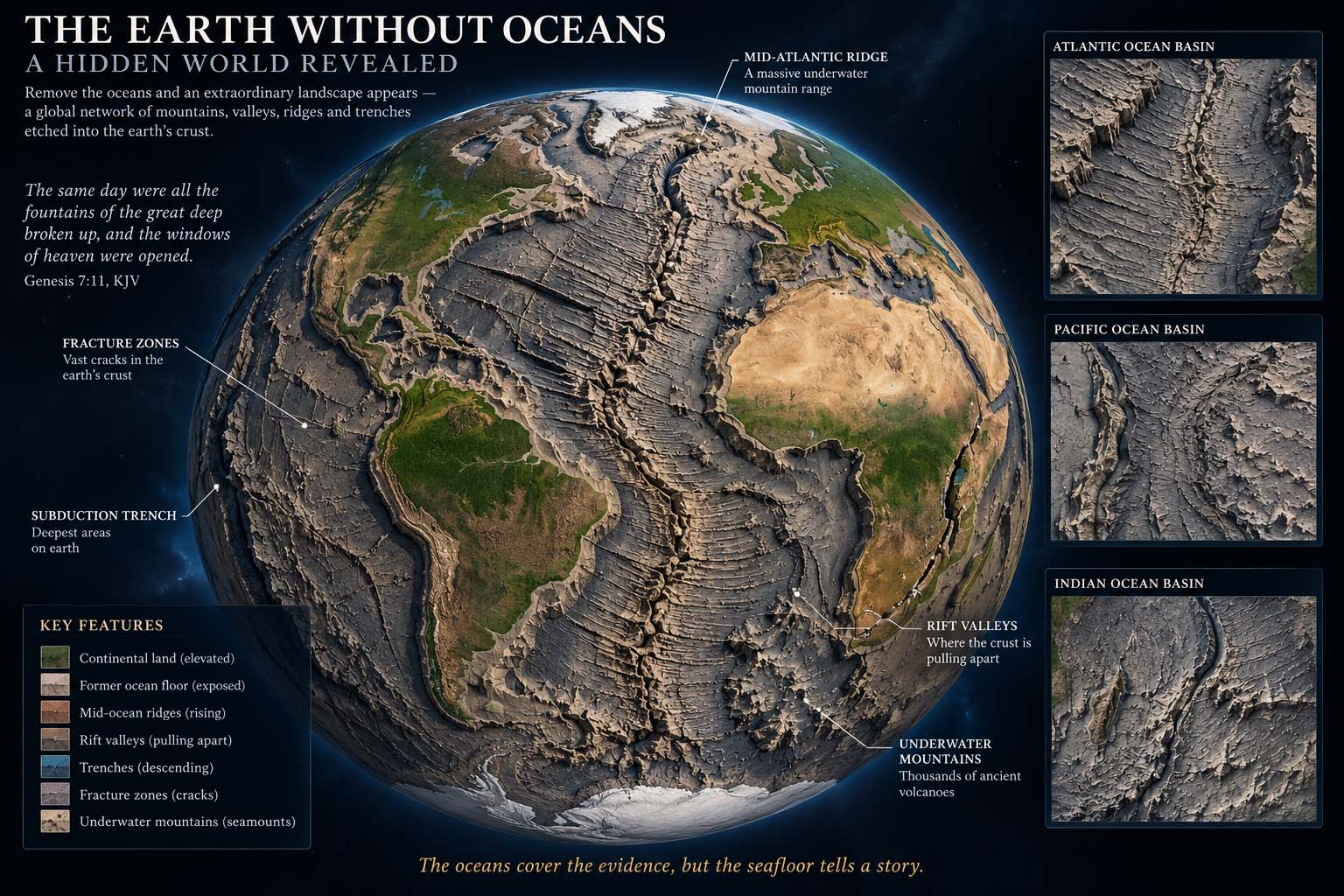
Could the First World Have Looked Geographically Different?

Genesis does not provide a map of the pre-Flood earth and does not state what percentage of its surface was covered by oceans. The museum therefore does not present a nearly oceanless pre-Flood world as established Scripture. It remains a reconstruction question.

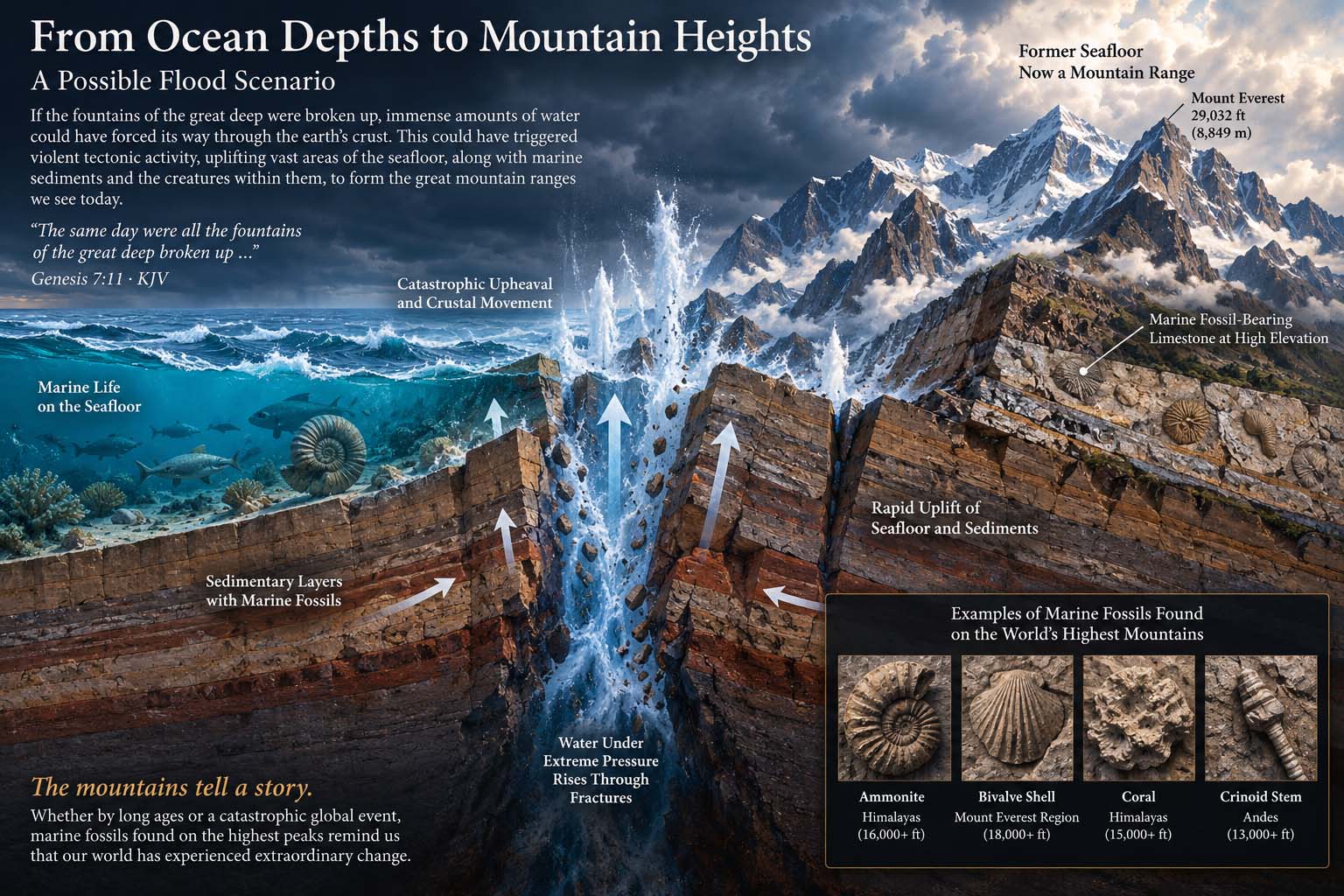
Nevertheless, the Flood account describes more than rain. When the catastrophe begins, Genesis says that “all the fountains of the great deep” were broken up and that the “windows of heaven” were opened. If the event involved major changes to the earth itself, the geography familiar to Noah may have differed substantially from the geography inherited by later civilizations.

From AboveThe windows of heaven were opened
+
From BelowThe fountains of the great deep were broken up
“…the same day were all the fountains of the great deep broken up, and the windows of heaven were opened.”
Genesis 7:11 · KJV

This possibility also raises a migration question explored elsewhere in the museum. If large regions now divided by oceans were once connected, more accessible, or separated by smaller bodies of water, some movements that appear formidable on a modern map might have occurred under very different geographical conditions. That remains a hypothesis, not a conclusion supplied directly by Genesis.

For the people receiving Noah's warning, however, the theological point is even more immediate: if the coming event had no adequate counterpart in their experience, the warning may have sounded impossible precisely because the world around them still appeared stable.

Put yourself in the First World

At What Point Would You Have Believed?

Imagine that no catastrophe had yet occurred. The sky still looked familiar. Daily life continued. The warning concerned something Hebrews calls “not seen as yet.” At what point would the warning have become convincing to you?

  1. When Noah first spoke?
  2. When construction of the Ark began?
  3. When the enormous vessel took recognizable shape?
  4. When provisions were gathered?
  5. When the animals came?
  6. When seven days remained?
  7. When Noah and his family entered?
  8. When the door was shut?
  9. Or only when the rain began?

The Flood gallery will now move through those moments one by one. With each step, another opportunity to dismiss the warning disappears.

The warning existed before the evidence of catastrophe. The rain had not yet begun.
Warning across generations

The Flood Was Not Introduced as a Meaningless Disaster

Within Genesis, Noah stands inside a genealogy reaching backward through Lamech and Methuselah toward the earliest generations. The ancient Enochic tradition expands that idea even further by portraying knowledge of coming judgment as something communicated before Noah's generation reached the Ark.

This does not make every detail of 1 Enoch equivalent to Genesis. It does, however, show that ancient Jewish tradition remembered the pre-Flood catastrophe within a larger story of transgression, warning, judgment, and preservation.
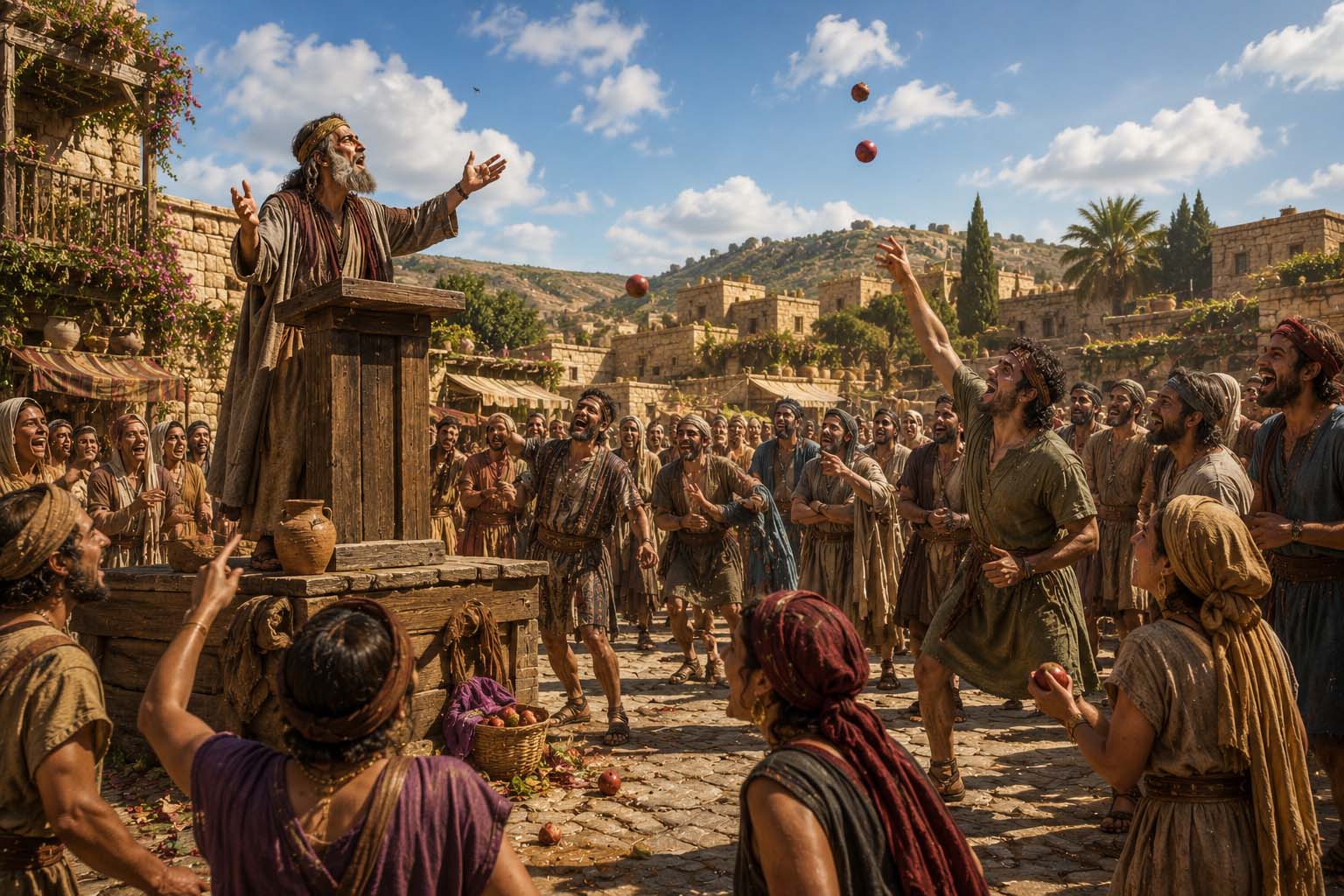
An earlier pre-Flood preacher warns a sunlit crowd of coming judgment while people laugh, mock him, and throw fruit.
A depiction of Enoch warning his generation of approaching judgment, as preserved in the ancient Enochic tradition.
Ancient witness · Non-canonical

1 Enoch: Judgment Before the Waters

1 Enoch is not part of the Protestant biblical canon. It is presented here as an important ancient Jewish witness to how the mysterious pre-Flood world was interpreted and expanded beyond the shorter account preserved in Genesis.

In 1 Enoch 6–8, the crisis is connected with the descent and transgression of the Watchers. They take human wives, giant offspring appear, and forbidden forms of knowledge spread. The narrative associates this period with violence, bloodshed, exploitation, weapons, occult practices, enchantments, and heavenly knowledge taught outside its proper boundary.

By 1 Enoch 9, the suffering of the earth has become a matter brought before heaven. Heavenly beings observe the bloodshed and corruption and appeal to God. This creates a striking literary parallel with Genesis 6, where God sees an earth that has become corrupt and filled with violence.

Enoch Becomes a Messenger of Judgment

In 1 Enoch 12–16, the Watchers themselves learn that judgment has been pronounced. They ask Enoch to present a petition on their behalf. Their request is not granted. Enoch instead becomes the bearer of the judgment back to them, including the destruction that will overtake their giant offspring and punishment that awaits the rebellious Watchers.

The beings portrayed as teachers of forbidden knowledge now receive a warning themselves. Knowledge does not save them from judgment.

Noah Enters the Enochic Tradition

In 1 Enoch 106–107, Noah's unusual birth alarms his father Lamech. Lamech approaches Methuselah, who seeks Enoch's understanding. Enoch identifies Noah as Lamech's son and connects Noah with the coming destruction and preservation that will follow. In this tradition, knowledge of the approaching catastrophe is therefore portrayed as reaching across generations.

EnochMethuselahLamechNoahFlood
Ancient witness · Non-canonical

Jubilees: A World Unraveling

Jubilees is also non-canonical in the Protestant tradition. Jubilees 5 retells the pre-Flood crisis by connecting Watcher transgression, giant violence, bloodshed, human corruption, judgment, and Noah's preservation. The Flood is not reduced to punishment for a single offense. The picture is cumulative.

StageThe pre-Flood picture in Jubilees
Boundary ViolatedThe Watchers transgress the boundary associated with their mission and human women.
Abnormal OffspringGiant offspring become part of the expanding crisis.
Violence SpreadsBloodshed, destruction, and conflict intensify.
Human CorruptionThe wrongdoing is not confined to the Watchers. Humanity itself becomes implicated in the corruption.
Creation AffectedThe narrative portrays disorder spreading through the created world.
Judgment PronouncedDestruction is decreed against the corrupted pre-Flood order.
Noah DistinguishedNoah is preserved as the world around him comes under judgment.

That final distinction closely echoes the turning point in Genesis: “But Noah found grace in the eyes of the LORD.” (Genesis 6:8, KJV)

Jubilees later continues the story beyond the Flood. Jubilees 10 preserves a tradition in which destructive spirits associated with the dead giants trouble Noah's descendants. That later tradition belongs principally to the post-Flood story and will be cross-referenced in The New World rather than treated as part of the canonical Flood account.

From earlier warning to Noah's generation

The Warning Moves From Prophecy to Preparation

The Enochic and Jubilees traditions place warnings of judgment within generations that precede Noah's final preparations. By Noah's lifetime, the warning takes on another dimension. According to the New Testament, Noah is remembered as a “preacher of righteousness,” and Genesis presents him carrying out the extraordinary command to prepare the Ark.

The sequence is therefore deliberate in this exhibit: Enoch first, then Noah. Earlier warnings establish the approaching judgment. Noah's generation then sees preparation for that judgment becoming physically visible.

The warning becomes visible

The Ark Was Rising in Plain Sight

For Noah's generation, the warning was no longer only a message about something that might someday occur. A massive vessel was taking shape before their eyes. Timber was being cut, joined, raised, and assembled. The work continued long enough for the Ark itself to become a visible declaration that Noah believed the judgment was real.

The New Testament calls Noah a “preacher of righteousness.” Scripture does not preserve the words of his sermons, so the museum does not invent them. But the combination of Noah's preaching and the construction of the Ark creates a powerful biblical picture: warning was being spoken while preparation was being made.
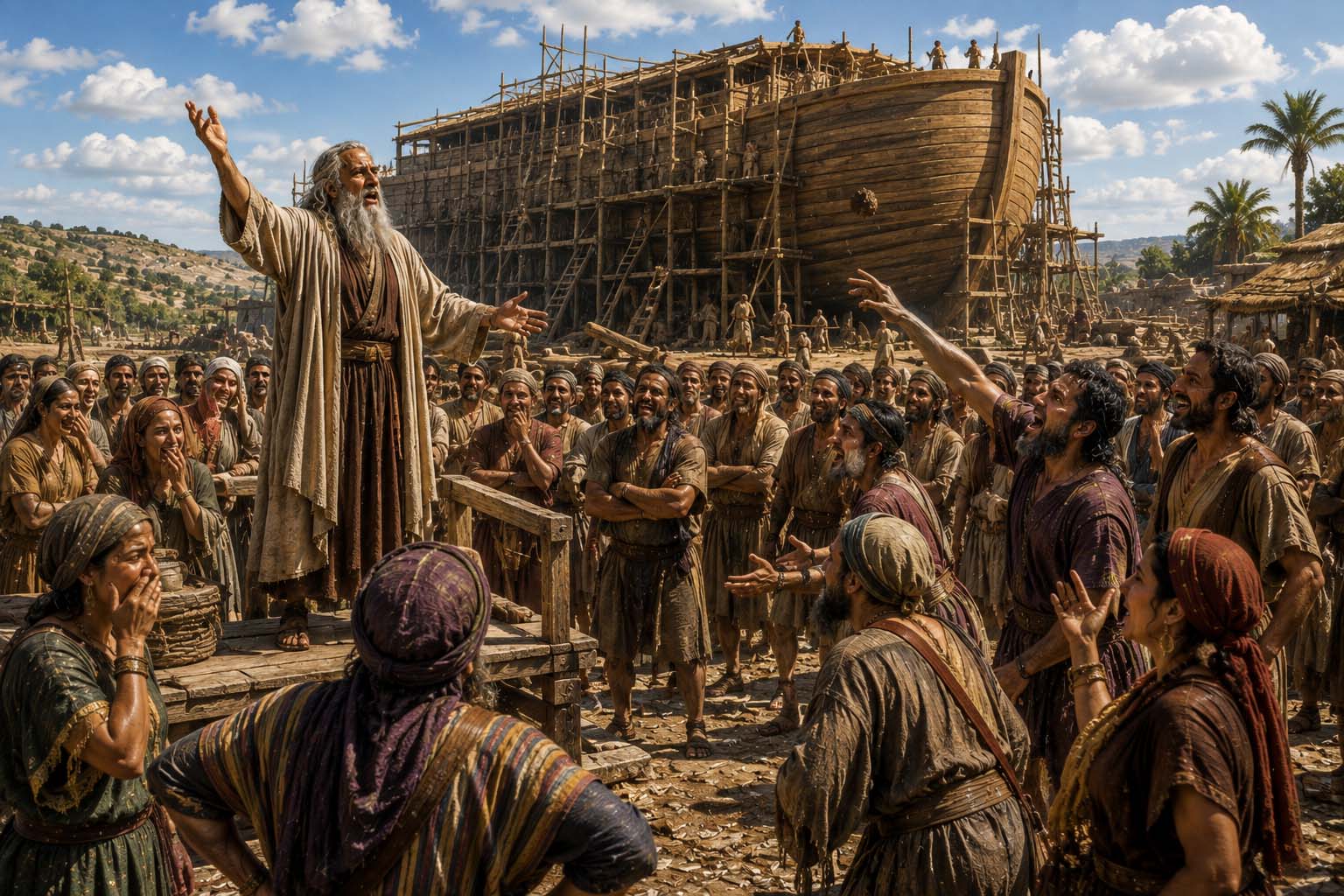
Noah warns a questioning and mocking crowd while a massive wooden Ark is visibly under construction behind him under a bright blue sky.
A depiction of Noah, the “preacher of righteousness,” warning his generation while the Ark rises behind him.
A visible warning in an ordinary world

The Ark Was Being Built in a World That Still Looked Safe

Imagine the contrast. The sky is clear. Families are gathering. Children are growing. Work continues. People plan marriages, harvests, journeys, and futures. Nothing in the ordinary appearance of the day seems to demand panic.

Yet nearby, an enormous Ark continues to rise.

Every beam placed into position makes Noah's warning more visible. Every completed section turns an unseen future judgment into a physical object standing in the present. The structure itself becomes difficult to ignore, even if its meaning is dismissed.

And still, another sunrise comes without rain.

That delay could easily have strengthened ridicule rather than belief. To those who rejected the warning, the continued beauty and stability of the world may have seemed to prove Noah wrong. But within the biblical narrative, the absence of immediate judgment did not cancel the warning. It meant the appointed time had not yet arrived.

The Ark was not proof that the Flood had already begun. It was evidence that Noah believed the warning before the world around him changed.
The question becomes harder

What Would You Have Seen?

You would not yet have seen a flooded world. You would have seen ordinary life, a beautiful sky, a man preaching righteousness, and an enormous vessel being built for a catastrophe that had not yet arrived.

Would the Ark have looked like evidence of judgment, or evidence of one man's foolishness?

Panel of distinction

What These Writings Do, and Do Not, Establish

GenesisGod sees widespread wickedness, corruption, and violence. Judgment is pronounced. Noah is warned and instructed. Noah finds grace. The Flood comes.
New TestamentNoah is called a preacher of righteousness. God's longsuffering waits while the Ark is prepared. Jesus describes ordinary life continuing until Noah enters the Ark.
1 EnochExpands the tradition with the Watchers, giants, forbidden knowledge, heavenly appeals concerning bloodshed, Enoch's warning to the Watchers, and traditions surrounding Noah and the approaching catastrophe.
JubileesExpands the tradition through Watcher transgression, giant violence, corruption, judgment, Noah's preservation, and later traditions concerning destructive spirits after the Flood.

Museum distinction: Genesis and the canonical biblical texts establish the scriptural record presented here. 1 Enoch and Jubilees are displayed as ancient Jewish witnesses that preserve expanded traditions surrounding the pre-Flood world. They are not used here to replace Genesis or to blur the distinction between canonical Scripture and later ancient literature.

A question for the visitor

What Would a Warning Look Like Before the First Raindrop?

If the Flood had not yet begun, what evidence would the surrounding population have had that Noah's warning was true? There would have been no flooded cities, no submerged mountains, and no waters covering the landscape. There was a warning, a man later called a preacher of righteousness, and eventually an enormous Ark under construction.

At what point does a warning become evidence?

The rain had not begun.

The deep had not broken open.

The door had not closed.

There was still time.

The absence of judgment did not mean the warning had failed. It meant the warning period had not yet ended.
The warning now becomes personal. Genesis does not portray Noah gradually discovering that something terrible might happen. God tells him directly that the corrupted world has reached its end, that a flood of waters is coming, and that Noah must prepare for what follows.

The announcement

The End Has Come Before Me

The first words spoken to Noah in this part of the account are not instructions about lumber or dimensions. They are a verdict.

“And God said unto Noah, The end of all flesh is come before me; for the earth is filled with violence through them; and, behold, I will destroy them with the earth.”
Genesis 6:13 · KJV

The phrase “the end of all flesh is come before me” marks a decisive threshold. The corruption and violence described earlier in Genesis 6 have not merely been observed. Judgment has now been announced.

God also gives Noah the reason: “the earth is filled with violence through them.” The Flood is therefore presented within Genesis as a response to a world already described as morally corrupt and violent, not as an unexplained catastrophe descending upon an innocent civilization.

The means of judgment

A Flood of Waters

Then Noah is told something more specific. The coming judgment will not be war, famine, disease, or the destruction of a single city. Water itself will become the instrument of judgment.

“And, behold, I, even I, do bring a flood of waters upon the earth, to destroy all flesh, wherein is the breath of life, from under heaven; and every thing that is in the earth shall die.”
Genesis 6:17 · KJV

The wording is emphatic: “I, even I, do bring...” The text identifies the coming Flood as a deliberate act of judgment.

For Noah, this announcement would have defined the scale of what was coming before any visible evidence of the catastrophe existed. The world around him still stood. The waters had not yet risen. Yet Noah had now been told what would happen.

The announced scale

How Large Was the Judgment Noah Was Told to Expect?

Genesis 6:17 uses a series of increasingly expansive expressions. Whatever Noah understood about the geography of his world, the announcement itself describes destruction on a scale far beyond an ordinary local disaster.

“All flesh”The language reaches beyond one family, settlement, or political territory.
“Breath of life”The judgment is described in terms of living creatures, not property alone.
“Under heaven”The wording broadens the frame beyond a single city or valley.
“Shall die”The outcome announced to Noah is not temporary disruption but death.

Genesis does not tell us exactly what Noah imagined when he first heard these words. It does not preserve his questions, facial expression, or emotional response at this moment. The museum should therefore resist inventing a reaction that Scripture does not provide.

But the silence is striking. God speaks. Noah receives the warning. And the narrative moves directly toward preparation.

The turning word
But.

Judgment Is Announced, Then Preservation

Immediately after announcing destruction, God introduces another part of the plan. Noah is not merely being told how the old world will end. He is being told that life will continue beyond it.

“But with thee will I establish my covenant; and thou shalt come into the ark, thou, and thy sons, and thy wife, and thy sons' wives with thee.”
Genesis 6:18 · KJV

That single word “But” changes the emotional direction of the passage. Destruction is coming, but Noah will be preserved. His wife will be preserved. His sons will be preserved. Their wives will be preserved.

Through this family, the human story will continue beyond the Flood.

A unique burden

Noah Now Knows About Two Worlds

Noah is still standing in the First World, surrounded by the people, landscapes, animals, fields, settlements, and memories of the civilization in which he was born. But he has now been told that this world is approaching judgment.

At the same time, Noah is given a promise of preservation. He therefore becomes the man who must prepare within one world for life in another.

Nothing has yet been submerged. The Ark has not yet floated. The fountains of the great deep have not yet opened. Yet Noah now carries knowledge that will shape every decision that follows.

One man stands in a world that is still functioning.

Homes remain occupied. Families continue living. Animals still move across the land. The sky has not yet opened.

But Noah now knows what almost everyone around him does not.

The world they know is approaching its end, and God has told him to prepare for what comes afterward.

Next → 03 · Build an Ark

The announcement of judgment is immediately followed by a command to build. Before the first waters appear, Noah must construct the vessel through which his household and representatives of animal life will pass from the First World into the world that follows.

The command

“Make Thee an Ark”

God has told Noah that a flood of waters is coming. The narrative now turns from the reason for judgment to the practical means of preservation.

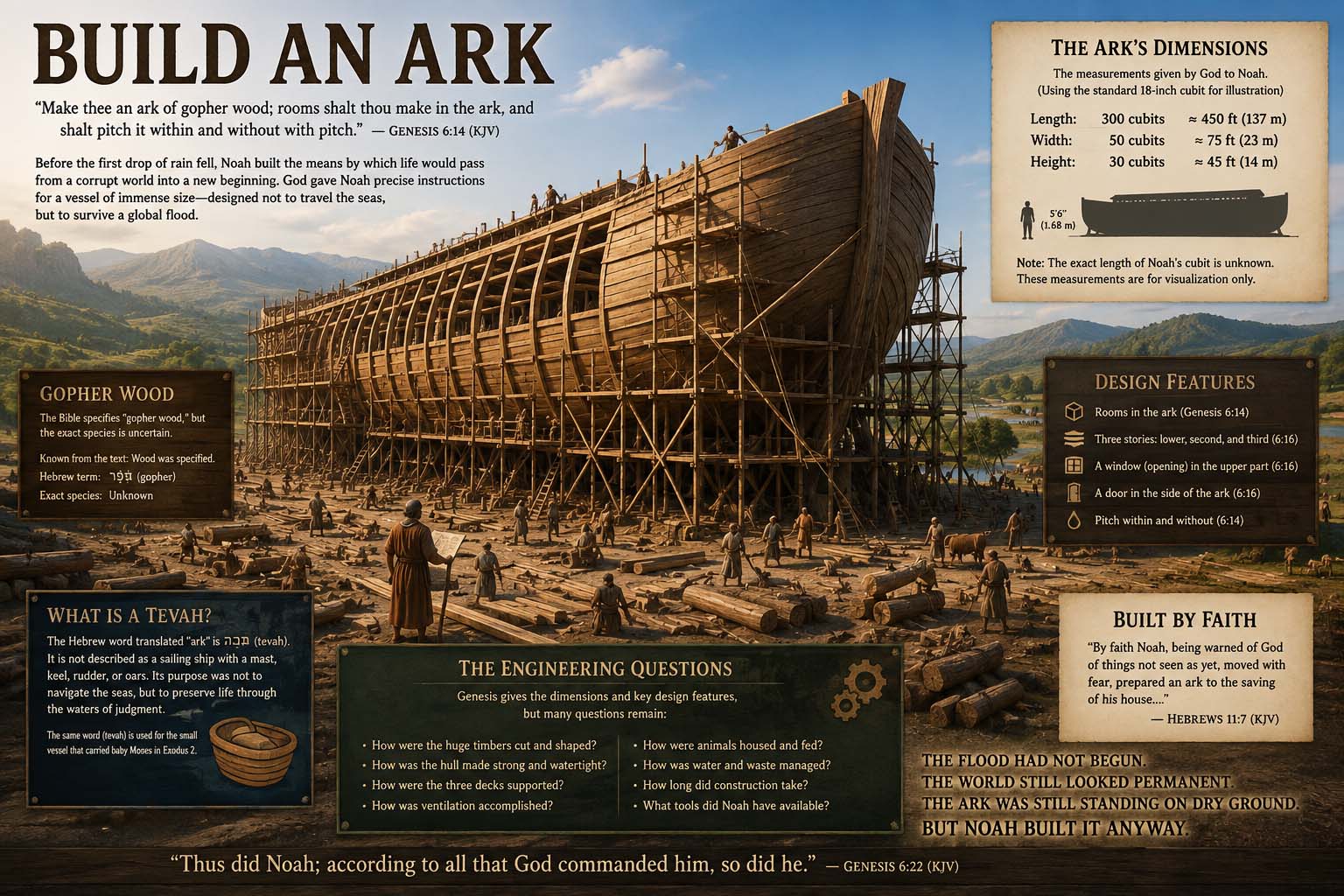
“Make thee an ark of gopher wood; rooms shalt thou make in the ark, and shalt pitch it within and without with pitch.”
Genesis 6:14 · KJV

Noah is not first given a detailed explanation of the mechanics of the coming catastrophe. He is given work to do. Wood must be obtained. Rooms must be constructed. The vessel must be coated. Preparation begins while the world around him is still functioning normally.

Illustrated Build an Ark exhibit showing Noah's Ark under construction with biblical dimensions, materials, design features, engineering questions, and scripture.
An illustrated reconstruction of the Ark under construction, combining the measurements and construction details recorded in Genesis with clearly identified visualization notes and open engineering questions.
A vessel for preservation

What Was the Ark?

The Hebrew word traditionally translated ark, tevah, is not the ordinary biblical term for a sailing ship. Genesis describes no mast, sail, oars, rudder, or other means of propulsion.

Its purpose in the narrative is preservation. Noah is not instructed to steer toward a destination. He is instructed to construct a vessel capable of carrying life through the coming waters.

The Ark did not need to navigate the Flood.
It needed to survive it.

The same Hebrew word is also used for the small vessel in which the infant Moses is placed in Exodus 2. In both accounts, the object carries life through dangerous waters.

The dimensions

Three Hundred Cubits Long

“And this is the fashion which thou shalt make it of: The length of the ark shall be three hundred cubits, the breadth of it fifty cubits, and the height of it thirty cubits.”
Genesis 6:15 · KJV
DimensionBiblical measure18-inch cubit reference
Length300 cubitsapproximately 450 ft
Width50 cubitsapproximately 75 ft
Height30 cubitsapproximately 45 ft

Museum note: the modern measurements above use an 18-inch cubit only as a visualization reference. Genesis does not specify the exact modern length of the cubit used by Noah.

Even with that conservative reference, the Ark is presented as an enormous structure. Later artwork in this exhibit can use the museum's 5'6" reference figure to make that scale immediately visible.

What Genesis actually specifies

Rooms, Three Stories, an Opening and a Door

“A window shalt thou make to the ark, and in a cubit shalt thou finish it above; and the door of the ark shalt thou set in the side thereof; with lower, second, and third stories shalt thou make it.”
Genesis 6:16 · KJV
RoomsInternal spaces are explicitly required.
Three levelsLower, second and third stories.
OpeningAn upper opening or window is specified.
Side doorA door is placed in the side of the Ark.
PitchThe vessel is coated within and without.

The door is only a construction detail here. Later in the Flood narrative it becomes one of the most consequential objects in the entire account: “and the LORD shut him in.” The museum will return to that moment when the warning period ends.

Material question

What Was Gopher Wood?

Genesis specifically names gopher wood, but the exact identification of the Hebrew term is under study. Various identifications have been proposed, but the text does not allow the museum to state confidently that it was a particular modern tree species.

Known from the text: wood was specified. Hebrew term: gopher. Exact species: under continued study.

This is an important example of the museum's evidence standard: where the biblical record is precise, we can be precise. Where it leaves a question open, the exhibit should leave it open as well.

Waterproofing

“Pitch It Within and Without”

The Ark was not simply an untreated wooden structure. Genesis explicitly requires Noah to coat it inside and outside with pitch, providing a practical barrier between the wooden vessel and the water it was being prepared to encounter.

A linguistic note is also worth preserving carefully. The Hebrew terminology for coating and pitch is associated with the root k-p-r, a root used elsewhere in Hebrew with the sense of covering and, in other contexts, atonement. This is an interesting word relationship, but the museum should not account that Genesis 6:14 explicitly teaches a doctrine of atonement through the Ark's waterproofing.

What the text does not tell us

The Engineering Questions

Genesis gives dimensions and several important structural characteristics, but it does not provide a complete set of architectural drawings. That leaves legitimate questions about the actual construction.

  • How was a hull of this length kept structurally rigid?
  • How were the three internal decks supported?
  • How were animals and provisions distributed?
  • How was ventilation managed throughout the vessel?
  • How were water, drainage and waste handled?
  • What tools and lifting methods were used?
  • How large was Noah's construction workforce?
  • Exactly how long did the building process take?

The Ark should therefore not be presented as though a complete modern blueprint survives. We possess dimensions and selected design characteristics, not every construction detail.

Hebrews looks back

Noah Builds Before Noah Sees

“By faith Noah, being warned of God of things not seen as yet, moved with fear, prepared an ark to the saving of his house...”
Hebrews 11:7 · KJV

No floodwater surrounds the construction site. The fountains of the great deep have not opened. The rain has not begun. Yet Noah cuts, shapes, joins, builds and prepares for an event that has not yet provided visible proof of itself.

Every timber placed into position represents preparation for “things not seen as yet.”

The Flood had not begun.

The world still looked permanent.

The Ark was still standing on dry ground.

But Noah built it anyway.

Next → 04 · Who Enters the Ark?

Judgment has been announced, yet judgment does not fall immediately. Genesis records a statement associated with 120 years. While the world continues to look ordinary, the biblical narrative now carries a sense of measured time moving toward a fixed boundary.

The measured limit

A Clock Has Begun

“And the LORD said, My spirit shall not always strive with man, for that he also is flesh: yet his days shall be an hundred and twenty years.”
Genesis 6:3 · KJV

The sky has not yet changed. Fields can still be planted. Families continue to form. Children are born. Work, trade, travel, marriages, and ordinary plans continue. But within the biblical narrative, something has changed: time is now limited.

The extraordinary thing about the final period before the Flood is how ordinary it could still have looked.

Interpretive distinction

What Do the 120 Years Mean?

Genesis 6:3 has commonly been understood in two principal ways. The museum should show both rather than quietly turning one interpretation into an explicit statement of Scripture.

Countdown InterpretationThe 120 years represent a period remaining before the Flood, a divinely established interval before judgment.
Lifespan InterpretationThe statement is understood as referring to a limitation associated with future human longevity.

The immediate Flood setting makes the countdown interpretation especially relevant to this gallery, but Genesis never says in so many words, “Noah spent exactly 120 years building the Ark.” The duration of Ark construction should therefore not be presented as a stated biblical fact.

Ordinary life under a warning

Life Continued

“For as in the days that were before the flood they were eating and drinking, marrying and giving in marriage, until the day that Noe entered into the ark...”
Matthew 24:38 · KJV

Jesus' description emphasizes normal human activity. Eating, drinking, marriage, and family life are not presented as the crime. Their power in the passage is their normality. People continued living while judgment approached.

Another year without a Flood could have made Noah's warning easier to dismiss. Another harvest could have seemed to confirm that tomorrow would resemble yesterday. Yet every ordinary day was also one day closer to the boundary Genesis says had been set.

Illustrative chronology

Year After Year

If the 120 years are understood as a countdown toward the Flood, the passage creates an extraordinary narrative tension. The following milestones are illustrative only. Scripture does not provide these intermediate construction dates.

120The warning stands
90The world still looks normal
60Preparation continues
30The warning has not changed
10Tomorrow still seems certain
1The final year arrives

Whether or not these exact milestones corresponded to Ark construction, the dramatic idea remains: a warning may remain true for a long time before the event being warned about becomes visible.

Genesis genealogy comparison

Human Lifespans Before and After the Flood

Genesis records exceptionally long lifespans before the Flood. After the Flood, the ages recorded in Genesis 11 and the patriarchal narratives decline dramatically across successive generations. The table below follows the ages explicitly recorded in the biblical text.

EraPersonLifespanBiblical reference
Before FloodAdam930 yearsGenesis 5:5
Before FloodSeth912 yearsGenesis 5:8
Before FloodEnos905 yearsGenesis 5:11
Before FloodCainan910 yearsGenesis 5:14
Before FloodMahalaleel895 yearsGenesis 5:17
Before FloodJared962 yearsGenesis 5:20
Before FloodEnoch365 years*Genesis 5:23–24
Before FloodMethuselah969 yearsGenesis 5:27
Before FloodLamech777 yearsGenesis 5:31
Spans FloodNoah950 yearsGenesis 9:29
After FloodShem600 yearsGenesis 11:10–11
After FloodArphaxad438 yearsGenesis 11:12–13
After FloodSalah433 yearsGenesis 11:14–15
After FloodEber464 yearsGenesis 11:16–17
After FloodPeleg239 yearsGenesis 11:18–19
After FloodReu239 yearsGenesis 11:20–21
After FloodSerug230 yearsGenesis 11:22–23
After FloodNahor148 yearsGenesis 11:24–25
After FloodTerah205 yearsGenesis 11:32
Patriarchal EraAbraham175 yearsGenesis 25:7
Patriarchal EraIsaac180 yearsGenesis 35:28
Patriarchal EraJacob147 yearsGenesis 47:28
Patriarchal EraJoseph110 yearsGenesis 50:26

*Enoch is exceptional in Genesis 5 because the text says, “Enoch walked with God: and he was not; for God took him.” His 365 years should not be treated as an ordinary pre-Flood death age. Noah is listed separately because his life spans both sides of the Flood.

The Pattern Is Difficult to Miss

Before the Flood, Genesis repeatedly records lives approaching nine centuries. After the Flood, the recorded ages descend through hundreds of years and eventually toward the much shorter lifespans familiar in the patriarchal narratives.

Genesis records the decline. It does not give a biological mechanism explaining exactly why it occurred. Proposed explanations involving environment, genetics, atmospheric change, diet, or other post-Flood conditions therefore belong in interpretation or research panels, not in the biblical-fact column.

This decline also makes Genesis 6:3 especially interesting. Whatever interpretation is adopted for the 120 years, the generations following the Flood do in fact show a pronounced reduction in recorded longevity.

A warning still standing

Noah, the Preacher of Righteousness

“And spared not the old world, but saved Noah the eighth person, a preacher of righteousness...”
2 Peter 2:5 · KJV

Noah's construction project existed alongside his New Testament identification as a preacher of righteousness. Scripture does not preserve a transcript of his preaching or specify the precise number of years he publicly warned others, but the Ark and Noah's obedience together form an increasingly visible contrast with the surrounding world.

Noah Was More Than an Ark Builder

The New Testament preserves an important description of Noah that Genesis itself does not state in those words: Peter calls him a “preacher of righteousness.” This places Noah's role in the generation before the Flood in a public moral context, not merely a private construction project.

Canonical Scripture · 2 Peter 2:5 · KJV
“And spared not the old world, but saved Noah the eighth person, a preacher of righteousness, bringing in the flood upon the world of the ungodly;”

Josephus expands this tradition. In Antiquities of the Jews, Book I, he says Noah was distressed by the conduct of his contemporaries and attempted to persuade them to change their behavior. Josephus then says they refused and that Noah feared violence against himself and his family. This is later historical testimony, not wording found in Genesis, but it shows how a first-century AD Jewish historian understood Noah's relationship to his generation.

Research significance: Genesis emphasizes Noah's righteousness and obedience. 2 Peter identifies him as a preacher. Josephus supplies a later narrative tradition of active warning. Together they explain why the museum treats the Ark as both a vessel of preservation and a visible warning to Noah's world.

For years, the warning could be ignored.

The Ark could be mocked.

The ordinary appearance of the world could be mistaken for permanence.

Then something changed: the animals began to come.

Next → 05 · The Animals Come

For years, Noah could be dismissed as one man building an enormous vessel. Then Genesis records something different. The animals begin coming to him according to their kinds. What had been a warning expressed through Noah's words and construction now becomes visible in the behavior of the living world around him.

The approach to the Ark

Something Changes

The Ark could stand on dry ground for years. People could walk past it, mock Noah, continue working, marry, raise children, and plan for tomorrow. Then the biblical narrative introduces a development Noah could not produce simply by continuing to build.

“Of fowls after their kind, and of cattle after their kind, of every creeping thing of the earth after his kind, two of every sort shall come unto thee, to keep them alive.”
Genesis 6:20 · KJV
“Shall come unto thee.”

Genesis does not simply portray Noah traveling across the world to hunt down every creature. The text says that representatives of the animals would come to Noah.

Two sides of the instruction

Noah Receives Them, Yet They Come to Him

“And of every living thing of all flesh, two of every sort shalt thou bring into the ark, to keep them alive with thee; they shall be male and female.”
Genesis 6:19 · KJV
Noah's responsibilityHe is commanded to bring the animals into the Ark and preserve them.
The animals' arrivalThe following verse says that representatives “shall come unto thee.”

The two statements belong together. Noah is responsible for receiving, organizing, and preserving them. Genesis portrays their coming to him as something already included within God's instructions.

Reconstruction based on the text

A World of Animals Begins to Move

Genesis does not tell us exactly how long their arrival took, which routes they followed, whether they came simultaneously, or what surrounding people saw. Those details should remain reconstruction rather than biblical fact.

But the basic scene is remarkable enough. Birds, cattle, creeping things, and other living creatures arrive according to the categories given in the text. Animals that would not normally gather at one human construction project are now associated with the same destination.

The museum can depict this movement visually while clearly identifying the artwork as a reconstruction of the event described in Genesis.

Biblical terminology

What Does “After Their Kind” Mean?

The phrase “after their kind” reaches back to the Creation account and appears again in the Ark instructions.

“And God made the beast of the earth after his kind, and cattle after their kind, and every thing that creepeth upon the earth after his kind...”
Genesis 1:25 · KJV

The biblical text does not define kind using modern biological ranks such as species, genus, or family. It would therefore be misleading to account that the Hebrew category maps perfectly onto a modern taxonomic level.

Biblical term: kind. Exact modern biological equivalent: not explicitly defined by Scripture.

Research question

Did Noah Need Every Modern Species?

Genesis requires representatives “after their kind.” It does not say that every modern breed, variety, or separately named modern species had to be represented as a distinct Ark category.

How broadly the biblical “kind” should be understood remains an interpretive question. The museum should distinguish the text itself from later attempts to map biblical kinds onto modern taxonomy.

A commonly missed detail

Not Every Category Was Represented Only by Two

The familiar phrase “two of every animal” summarizes only part of the account. Genesis 7 distinguishes clean animals and birds from the ordinary pair arrangement.

“Of every clean beast thou shalt take to thee by sevens, the male and his female: and of beasts that are not clean by two, the male and his female. Of fowls also of the air by sevens, the male and the female; to keep seed alive upon the face of all the earth.”
Genesis 7:2–3 · KJV
CategoryGenesis instructionPurpose or note
Unclean animalsBy two, male and femalePreservation of the kind
Clean animals“By sevens,” male and femaleRepresented in greater number
Birds“By sevens,” male and female“To keep seed alive upon the face of all the earth”

The exact numerical interpretation of the KJV phrase “by sevens” has been discussed by interpreters. The distinction in the text is clear: clean animals and birds are represented in greater number than the ordinary male-female pair.

A detail explained later

Why Were More Clean Animals Preserved?

Genesis later records that Noah offered clean animals and clean birds after leaving the Ark.

“And Noah builded an altar unto the LORD; and took of every clean beast, and of every clean fowl, and offered burnt offerings on the altar.”
Genesis 8:20 · KJV

The greater number of clean animals therefore has an immediate narrative significance after the Flood. Sacrifice can take place without eliminating the preserved population.

Provision inside the Ark

Who Fed Them?

“And take thou unto thee of all food that is eaten, and thou shalt gather it to thee; and it shall be for food for thee, and for them.”
Genesis 6:21 · KJV
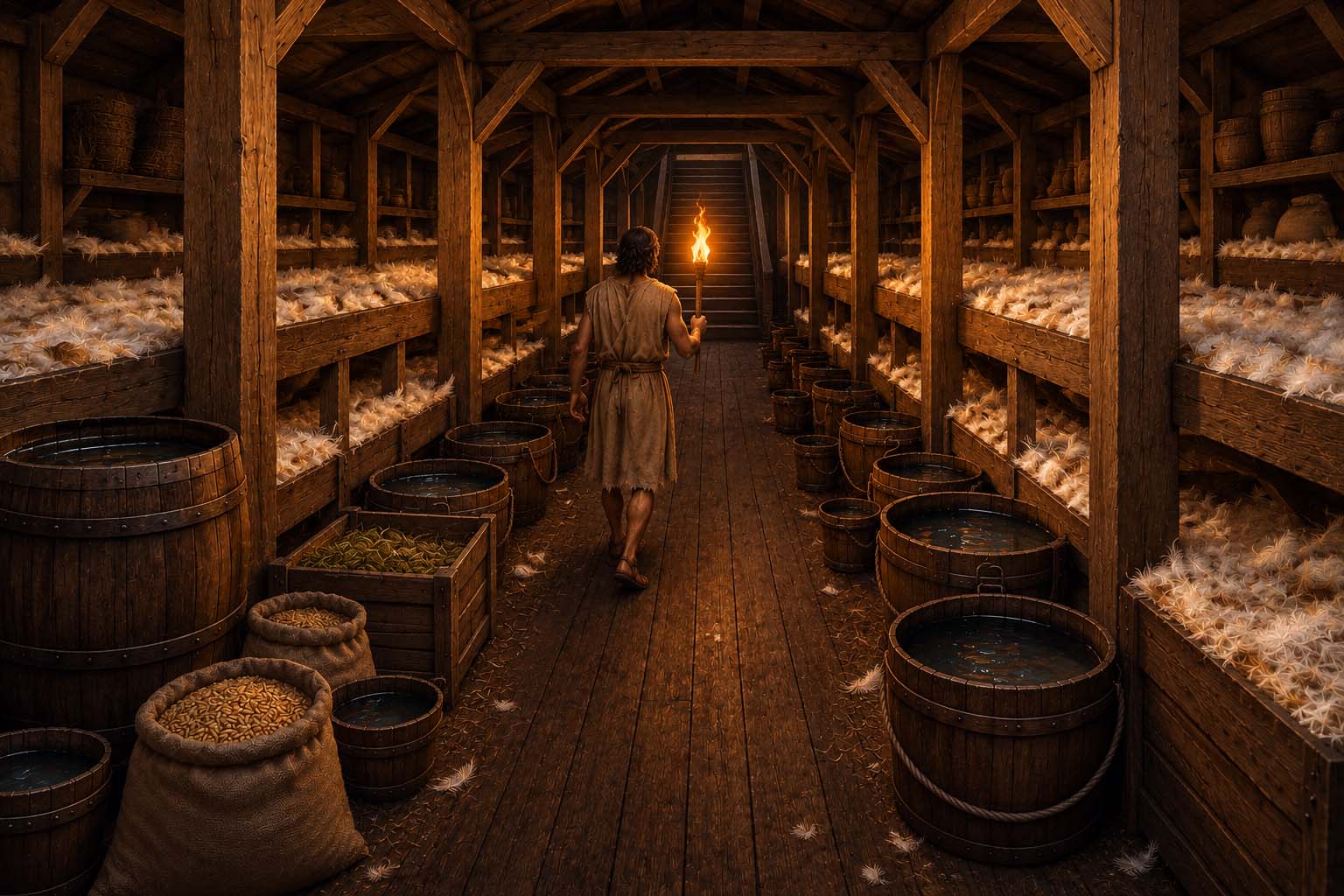
Artistic depiction of Shem inspecting prepared animal holding bins inside Noah's Ark
A depiction of Shem making a final inspection of the animal holding bins aboard the Ark before the Flood.

The biblical account does not portray animal survival as requiring no preparation. Noah is specifically commanded to gather food for his household and for the animals.

The Ark therefore contains more than people and animals. It requires food, storage, living space, organization, and continuing care. These practical demands connect directly to the engineering questions raised in 03 · Build an Ark.

area for further study

Did the Animals Hibernate?

Genesis does not say that the animals hibernated. It does not describe sedation, reduced metabolism, feeding schedules, or the daily routine of animal care aboard the Ark.

What We Know

Food was intentionally gathered for both Noah's household and the animals.

Areas for Further Study

How frequently individual animals ate, how active they remained, or whether unusual biological behavior occurred during the voyage.

The warning becomes harder to dismiss

Would the Animals Have Changed Your Mind?

For years, Noah could be dismissed as one man building a strange structure. But if people near the Ark saw animals arriving in an unusual pattern, the visual character of the warning would have changed.

Scripture does not tell us that crowds gathered to watch, nor does it record their reactions. That should not be invented as historical fact.

But the visitor can still ask a legitimate question: If you had ignored Noah for years, would the arrival of the animals have made you reconsider?

Preservation within judgment

The Flood Is About Destruction, but the Ark Is About Continuity

The animals are not coming to cause destruction. They are coming because life will continue afterward.

“two of every sort shall come unto thee, to keep them alive.”
Genesis 6:20 · KJV

Inside the Ark are the beginnings of the world that will follow: Noah's family, animals, birds, food, and the preserved lineages from which populations can continue.

The First World is approaching judgment. The New World is already being prepared inside the Ark.

A mystery the text leaves under continued study

How Did the Animals Know Where to Go?

Genesis tells us that the animals came. It does not explain the mechanism by which they knew where to go.

Instinct, direct divine direction, or some other extraordinary behavior may be proposed, but the passage itself does not specify the mechanism. It simply tells Noah that representatives of the animals “shall come unto thee.”

For years, Noah had prepared.

The Ark had risen.

Food had been gathered.

The warning remained.

Then living creatures began arriving at the place of preservation.

The preparations were almost complete. Only seven days remained.

Next → 06 · Seven Days Remain

The Ark is prepared, the animals have come, and Noah receives one final measure of time. Seven days remain before the rain begins.

The final week

Seven More Days

“For yet seven days, and I will cause it to rain upon the earth forty days and forty nights...”
Genesis 7:4 · KJV

Whatever ongoing study may surround the interpretation of the earlier 120 years, there is no ambiguity here. The event now has a stated interval.

Seven days.

The Ark is no longer preparation for something that will happen someday. The animals have arrived. Food has been gathered. Noah's household is ready. The countdown has entered its final week.

Illustrative passage of time

The Final Week

Genesis gives the seven-day interval but does not provide a day-by-day account of what happened during that week. The sequence below represents the passage of the stated period, not reconstructed events.

7Seven days remain
6The world still stands
5No rain yet
4Preparation is nearly finished
3Ordinary life continues
2The boundary approaches
1The final day arrives
No last-minute reversal

The Response Is Obedience

“And Noah did according unto all that the LORD commanded him.”
Genesis 7:5 · KJV

There is no recorded argument, request for more time, or change of plans. The great construction project has reached its final stage, and Noah continues to do what he has been instructed to do.

The warning had been given. The Ark had been built. Provisions had been gathered. The animals had come. Now there was nothing left to redesign.

Chronological marker

Noah Was 600 Years Old

“And Noah was six hundred years old when the flood of waters was upon the earth.”
Genesis 7:6 · KJV

A few verses later the narrative becomes even more precise:

“In the six hundredth year of Noah's life, in the second month, the seventeenth day of the month...”
Genesis 7:11 · KJV
MarkerGenesis record
Noah's age600 years
Year600th year of Noah's life
MonthSecond month
DaySeventeenth day
EventThe fountains of the great deep are broken up and the windows of heaven are opened

These markers connect directly ahead to 09 · The Heavens Open and 10 · Fountains of the Great Deep.

The Date Is Tied to Noah's Own Life

Genesis does not leave the beginning of the Flood as an undated event. It first tells us that Noah was six hundred years old, then gives the year of his life, month, and day on which the fountains of the great deep were broken up and the windows of heaven opened.

Canonical Scripture · Genesis 7:6 · KJV
“And Noah was six hundred years old when the flood of waters was upon the earth.”

Genesis 7:11 narrows the chronology further to the six hundredth year, second month, seventeenth day. Genesis 8 later continues dating the recession by Noah's age. This internal chronological framework is one reason the Flood narrative reads differently from a brief undated flood legend: its author repeatedly locates stages of the catastrophe within a continuous calendar.

Life still looks normal

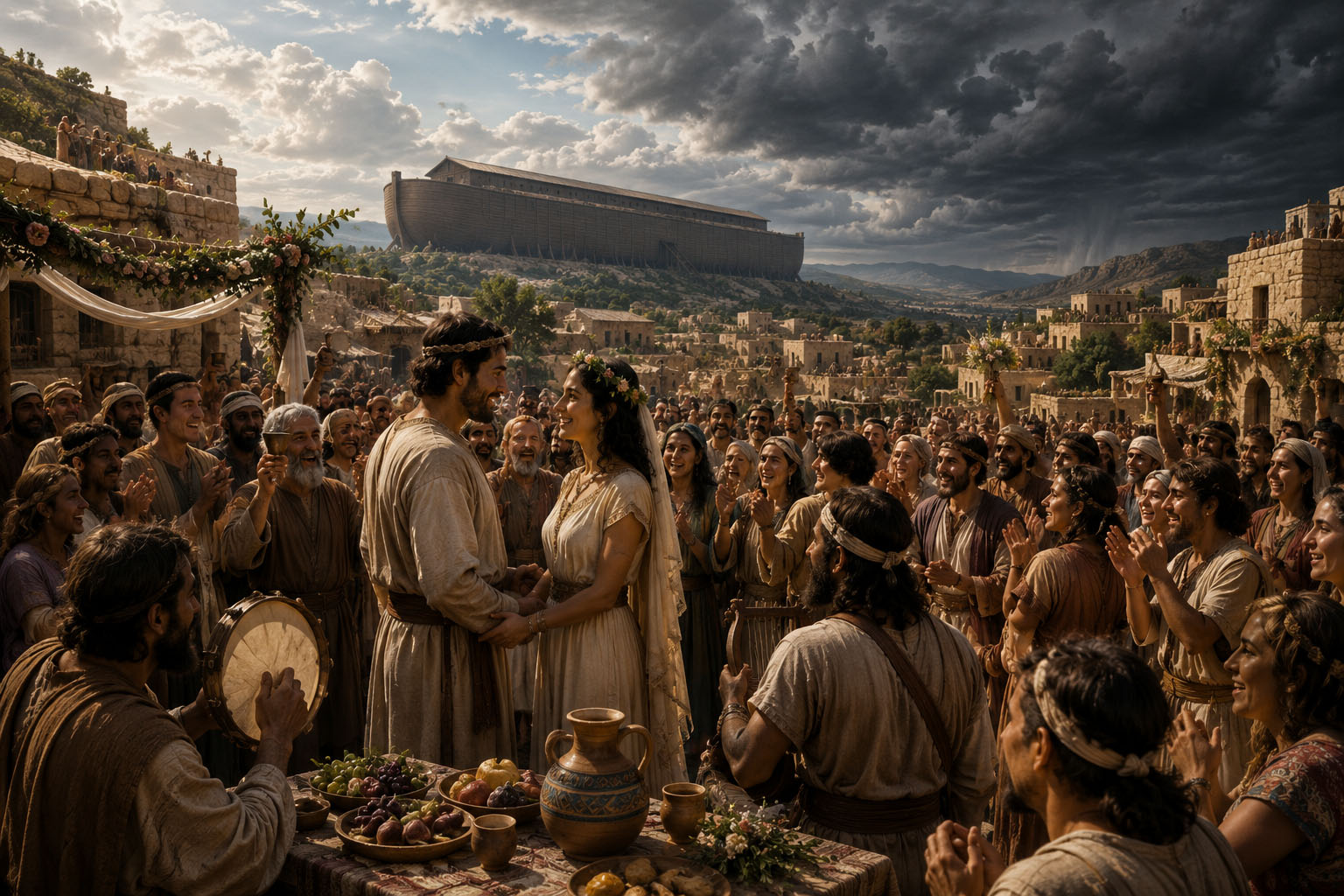
Seven Days From Destruction, Ordinary Life Continues

“They did eat, they drank, they married wives, they were given in marriage, until the day that Noe entered into the ark...”
Luke 17:27 · KJV

Meals were eaten. Marriages occurred. Plans were made. People expected another morning.

Nothing had happened yesterday. Nothing had happened today. Why should tomorrow be different?

But eventually tomorrow had a number.

A depiction of a joyful pre-Flood wedding celebration in a town while Noah's completed Ark stands in the distance and storm clouds begin gathering.
A depiction of ordinary life continuing during the final days before the Flood: a wedding celebration proceeds while the Ark stands in the distance and the sky begins to change.
area for further study

Did Anyone Else Know There Were Seven Days Left?

Genesis specifically records God speaking the seven-day warning to Noah. It does not tell us whether Noah publicly announced that precise countdown to the surrounding population.

What the Text Says

Noah knew that seven days remained.

What the Text Does Not Tell Us

Whether the surrounding population knew the exact seven-day deadline.

The distinction is important. The people outside may have continued ordinary life while Noah possessed knowledge of the exact interval remaining.

The threshold narrows

The Animals Are Now Part of the Final Sequence

“Of clean beasts, and of beasts that are not clean, and of fowls, and of every thing that creepeth upon the earth, There went in two and two unto Noah into the ark...”
Genesis 7:8–9 · KJV
“And it came to pass after seven days, that the waters of the flood were upon the earth.”
Genesis 7:10 · KJV

The animal gathering and entry belong directly at the threshold of the Flood. The progression of the gallery is deliberate: the animals come, seven days remain, Noah's household enters, the door is shut.

Reflective reconstruction

The Last Ordinary Sunset

Genesis does not describe the weather during those seven days, nor does it give us a scene-by-scene account of the final evenings. We should not invent those details as biblical fact.

But the stated interval forces a haunting question: What does the last normal day before catastrophe look like?

A final sunset occurred. A final evening meal was eaten. A final night of ordinary sleep passed. A final morning arrived in which the world people had always known still existed.

If Genesis 7 is read as historical narrative, those moments necessarily occurred, even though Scripture does not describe them individually.

Museum evidence standard

Recorded by Scripture vs Reflective Reconstruction

Recorded by Scripture

Seven days were announced. Noah obeyed. Noah was 600 years old. Animals entered the Ark. After seven days, the Flood came.

Reflective Reconstruction

What individual people did during each day, what the weather looked like, whether Noah publicly announced the countdown, and what occurred during the final evening.

Seven days became six.

Six became five.

Five became four.

Four became three.

Three became two.

Two became one.

Then there were no days left.

“And it came to pass after seven days, that the waters of the flood were upon the earth.” — Genesis 7:10, KJV

Next → 07 · Enter the Ark

The final preparations are complete. Noah, his wife, his sons, their wives, and the animals now cross the threshold into the Ark. Eight people leave the First World behind.

The command changes

“Come Thou and All Thy House Into the Ark”

“And the LORD said unto Noah, Come thou and all thy house into the ark; for thee have I seen righteous before me in this generation.”
Genesis 7:1 · KJV

Earlier, Noah was told to build. Now he is told to enter. The years of construction are over. The gathering of provisions is over. The warning period has reached its final threshold.

Noah is no longer being told what to construct. He is being told to cross the threshold.

The human household

Eight People Enter

8 souls preserved
“...wherein few, that is, eight souls were saved by water.”
1 Peter 3:20 · KJV
NoahHead of the household entering the Ark.
Noah's wifeNamed as entering, but not named personally in Genesis.
Shem, Ham, JaphethNoah's three sons.
Their three wivesThe wives of Noah's sons enter with them.

Genesis records one household entering the vessel of preservation. The post-Flood human story presented in Genesis continues through these eight survivors.

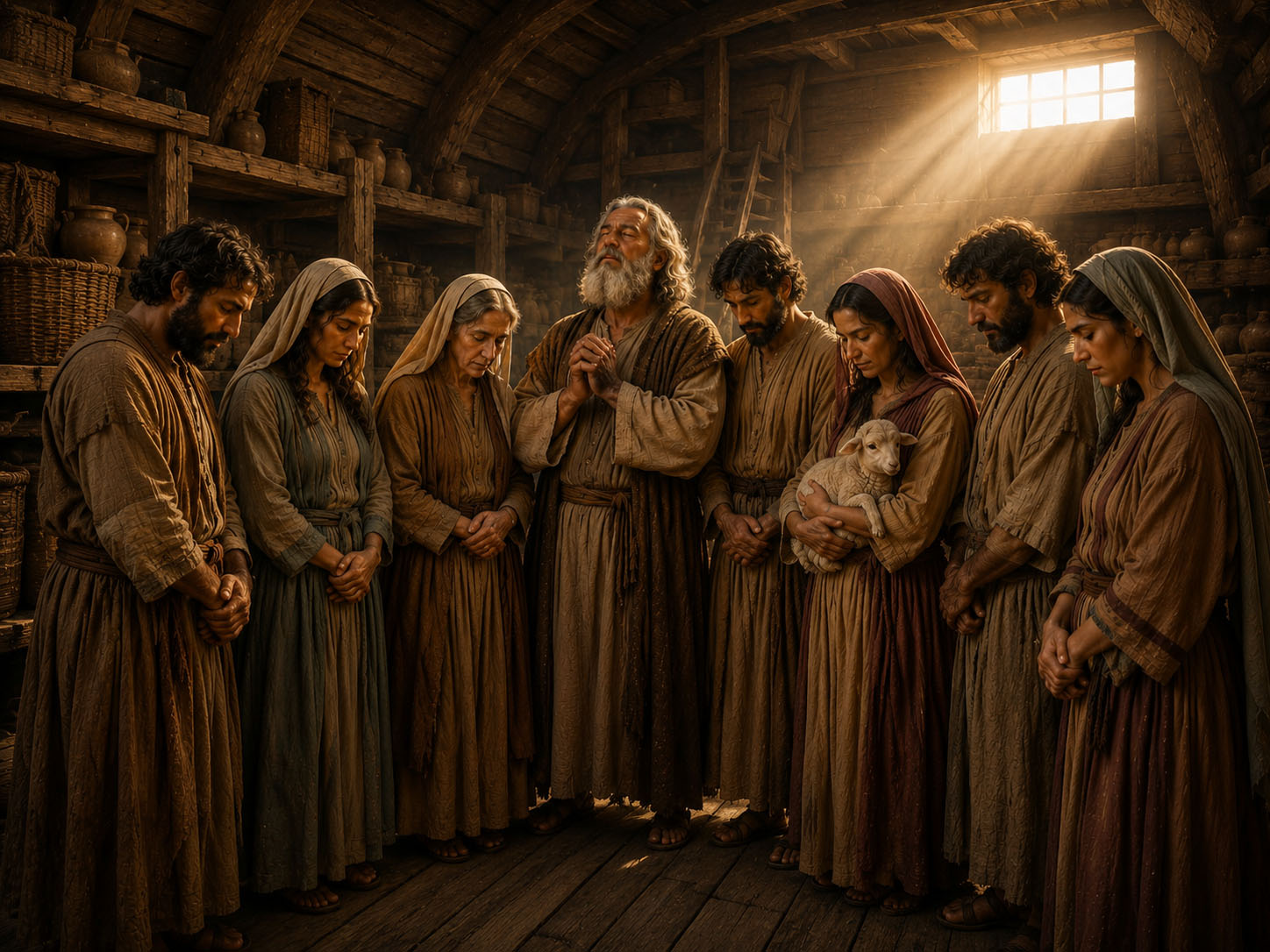
Artistic depiction of Noah and the seven members of his household gathered in prayer inside the Ark, with one of the women holding a young lamb and light entering from an upper side window.
A depiction of Noah and the seven members of his household gathered in prayer inside the Ark. One of the women holds a young lamb while light enters through an upper side opening. Genesis records the eight people who entered the Ark, but does not describe this specific prayer scene.
The human cost of entering

They Were Not Going Home Again

Noah's family could carry provisions into the Ark. They could not carry their world with them.

Homes, familiar roads, fields, possessions left outside, landscapes, and places connected to an entire lifetime would remain beyond the doorway.

Scripture does not preserve individual farewell scenes or tell us that Noah's wife wept, that his sons looked back at specific homes, or that the family spoke certain words before entering. Those details must not be invented as recorded history.

But the consequence is unavoidable: when they crossed into the Ark, they were leaving a world they would never encounter in the same form again.

The family line continues

Noah's Sons and Their Wives

“In the selfsame day entered Noah, and Shem, and Ham, and Japheth, the sons of Noah, and Noah's wife, and the three wives of his sons with them, into the ark...”
Genesis 7:13 · KJV

This verse becomes foundational for everything that follows in the museum. The post-Flood population described in Genesis proceeds from this household.

Future cross-references can return here from Gallery V · The New World, Babel, the Table of Nations, post-Flood migration, and population dispersal.

Canonical record vs later tradition

The Wives We Know Almost Nothing About

Genesis tells us that Noah had a wife and that each of his three sons had a wife. The canonical Genesis account does not provide their personal names.

Canonical Record

Four women enter the Ark: Noah's wife and the wives of Shem, Ham, and Japheth.

Later Traditions

Various later writings preserve names and additional traditions concerning these women. Those names should not be presented as though Genesis supplied them.

Human and animal preservation converge

The Animals Enter With Them

“They, and every beast after his kind, and all the cattle after their kind, and every creeping thing that creepeth upon the earth after his kind, and every fowl after his kind, every bird of every sort.”
Genesis 7:14 · KJV
“And they went in unto Noah into the ark, two and two of all flesh, wherein is the breath of life.”
Genesis 7:15 · KJV

The animals have not merely arrived. Now they enter. This closes the movement begun in 05 · The Animals Come.

Reflective reconstruction

What Would Entering the Ark Have Been Like?

The biblical text does not tell us which family member entered first, how long loading took, which deck each animal occupied, how provisions were distributed, what sounds filled the interior, or what Noah's family said to one another.

Physically, however, this was an enormous transition. Outside were daylight, open land, and familiar surroundings. Inside were timber beams, compartments, stored food, animals, passageways, and limited openings.

The animal holding areas shown earlier can be revisited at Shem's Final Inspection.

A reflective question

The Last Look Outside

Genesis does not say that Noah stopped at the doorway and looked back. It does not tell us that his wife cried or what Shem, Ham, Japheth, or their wives felt.

But they were human beings, and they knew why they were entering.

What would you think as you crossed that threshold knowing you might never walk back into the world outside?

What Genesis records and does not record

Was Anyone Else Allowed to Enter?

Genesis identifies the people God commands into the Ark: Noah and his household.

What Genesis Records

Eight people enter the Ark.

What Genesis Does Not Record

A last-minute crowd asking Noah for admission before the door closes, or Noah personally rejecting individual outsiders at the entrance.

This distinction matters because later artistic reconstructions may depict panic at the sealed Ark. Those scenes belong to the interpretive and reflective material surrounding 08 · The Door Is Shut, not to the explicit record of Section 07.

Chronological precision

“In the Selfsame Day”

Genesis uses the striking phrase “In the selfsame day entered Noah...” while Genesis 7:11 identifies the date on which the catastrophic events begin.

600th yearNoah's age
2nd monthCalendar marker
17th daySpecific day
Household entersGenesis 7:13
Deep breaks openGenesis 7:11
Heaven opensGenesis 7:11

The doorway of the Ark becomes more than an entrance.

On one side is the First World.

On the other is preservation.

Noah's family crosses from one to the other.

The door is still open.

“And they that went in, went in male and female of all flesh, as God had commanded him...”
Genesis 7:16 · KJV

The verse continues with the words reserved for the next exhibit: “...and the LORD shut him in.”

Next → 08 · The Door Is Shut

Noah's household and the animals are inside. The entrance connecting the Ark with the First World is closed. Genesis attributes that final act directly to God.

Canonical foundation

God Shut the Door

“And they that went in, went in male and female of all flesh, as God had commanded him: and the LORD shut him in.”
Genesis 7:16 · KJV

Genesis does not describe Noah performing the final closing. The text attributes the act to the LORD.

Noah built the Ark. Noah gathered the food. Noah entered. But God shut the door.

area for further study

Could Noah Have Opened It Again?

Genesis does not explicitly say that Noah was physically incapable of reopening the entrance. What it emphasizes is that the closing is an act of God, not Noah. The narrative has crossed from human preparation into divine judgment.

The threshold is crossed

The Moment the Warning Period Ended

Earlier in this gallery we observed that the absence of judgment did not mean the warning had failed. It meant the warning period had not yet ended.
For years the Ark could be seen. During the final seven days ordinary life could continue. People could eat, marry, work, plan, and expect another morning.

But eventually the warning period became the judgment period. The door closed.

Cross-reference: 01 · The Warning and 06 · Seven Days Remain.

One boundary · two conditions

Inside # Outside

# Inside

Eight people
Animals
Stored food and provisions
The structure God commanded Noah to build

# Outside

The First World
Homes and settlements
Fields and possessions
Everyone not aboard

At this threshold, a closed entrance separates the two. Narratively, that boundary means everything.

Ancient witnesses

Genesis · Jubilees · Jasher · Enoch

These sources are not presented with equal authority. Genesis is the canonical foundation. Jubilees, Jasher, and 1 Enoch are identified as non-canonical witnesses or traditions.

SourceReferenceContributionClassification
Genesis7:16The LORD shuts Noah in.Canonical Scripture
Jubilees5:23–25The Lord closes the Ark “from without” on the seventeenth evening, followed by the opening of the floodgates and fountains.Non-canonical ancient witness
Jasher6:15–25The Lord shuts Noah in; a multitude later gathers, pleads for entry, and attempts to break into the Ark as the rain intensifies.Non-canonical textual tradition
1 EnochFlood traditionsUseful for the broader judgment and Flood tradition, but no specific closed-door crowd episode is accounted here.Non-canonical ancient witness

Museum note: Details found only in non-canonical writings are identified as such and are not presented as statements made by Genesis.

Ancient witness · Jubilees

“The Lord Closed It From Without”

Jubilees 5:23 places the closing on the seventeenth evening and says the Lord closed the Ark “from without.” Its next verses move directly to seven floodgates of heaven and seven openings of the great deep, creating a striking literary bridge to Sections 09 and 10.

Ancient witness · Jasher

The Crowd Comes to the Ark

Jasher 6 preserves a much more dramatic tradition than Genesis. After Noah's household enters and the Lord shuts him in, the text describes a great multitude gathering at the Ark as the Flood intensifies.

They plead for Noah to open the Ark. Noah answers from within and recalls the long warning period. Jasher then says people approach in an attempt to break into the Ark because they cannot bear the rain.

Jasher gives the extraordinary figure of about 700,000 men and women. Because Genesis supplies no such number, the museum records it only as a source-specific account within Jasher's expanded tradition.

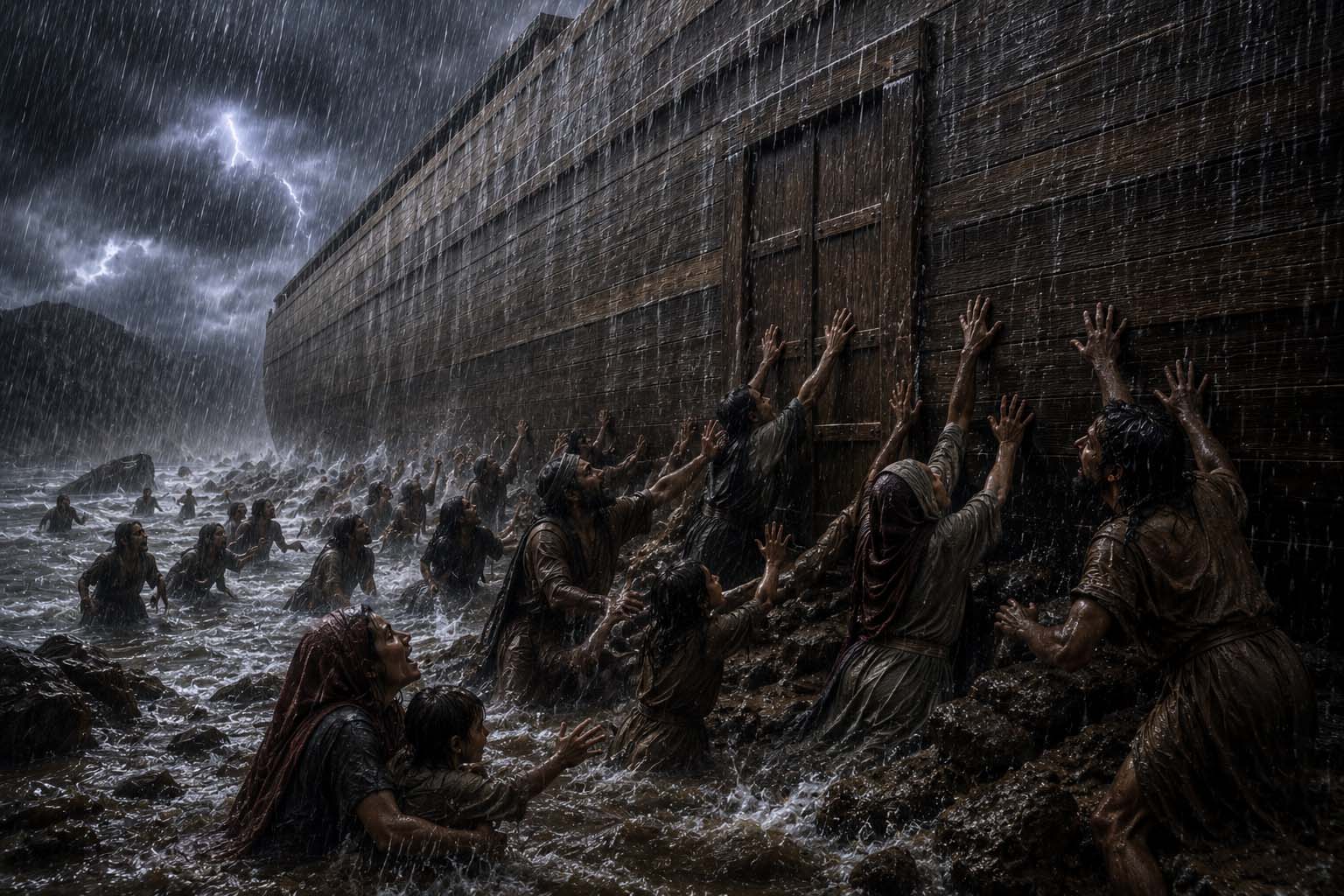
Artistic reconstruction of desperate people outside the closed Ark during the beginning of the Flood, inspired by Jasher chapter 6.
An artistic reconstruction inspired by Jasher 6:17–25, which describes people gathering at the Ark after the Flood begins, pleading for entry, and eventually attempting to force their way inside. Genesis records that “the LORD shut him in” (Genesis 7:16), but does not describe this confrontation.
Evidence distinction

Did the People Outside Know What Had Happened?

Genesis does not tell us that a crowd stood beside the Ark when the door closed, watched God close it, or pounded on the sealed entrance. Jasher supplies an expanded confrontation after the Flood begins. The illustration therefore belongs to that textual tradition, not to the explicit Genesis account.

Do not outrun the text

Then... Nothing?

Genesis does not provide a minute-by-minute cinematic account surrounding entry, closure, and catastrophe. We should not automatically portray the sequence as door shuts → immediate thunder → immediate rain unless an illustration is identified as reconstruction.

The household is inside, the entrance has been closed, and then the narrative gives an extraordinarily precise date.

The date arrives

600th Year # Second Month # Seventeenth Day

“In the six hundredth year of Noah's life, in the second month, the seventeenth day of the month...”
Genesis 7:11 · KJV

The verse then moves into the two catastrophic mechanisms receiving their own exhibits: 09 · The Heavens Open and 10 · Fountains of the Great Deep.

The last barrier

The Ark is sealed.

The warning has been given.

The Ark has been built.

The animals have come.

Eight people have entered.

The door has been shut.

Outside, the First World remains.

Inside, eight people wait.

And the sky begins to change.

Next → 09 · The Heavens Open

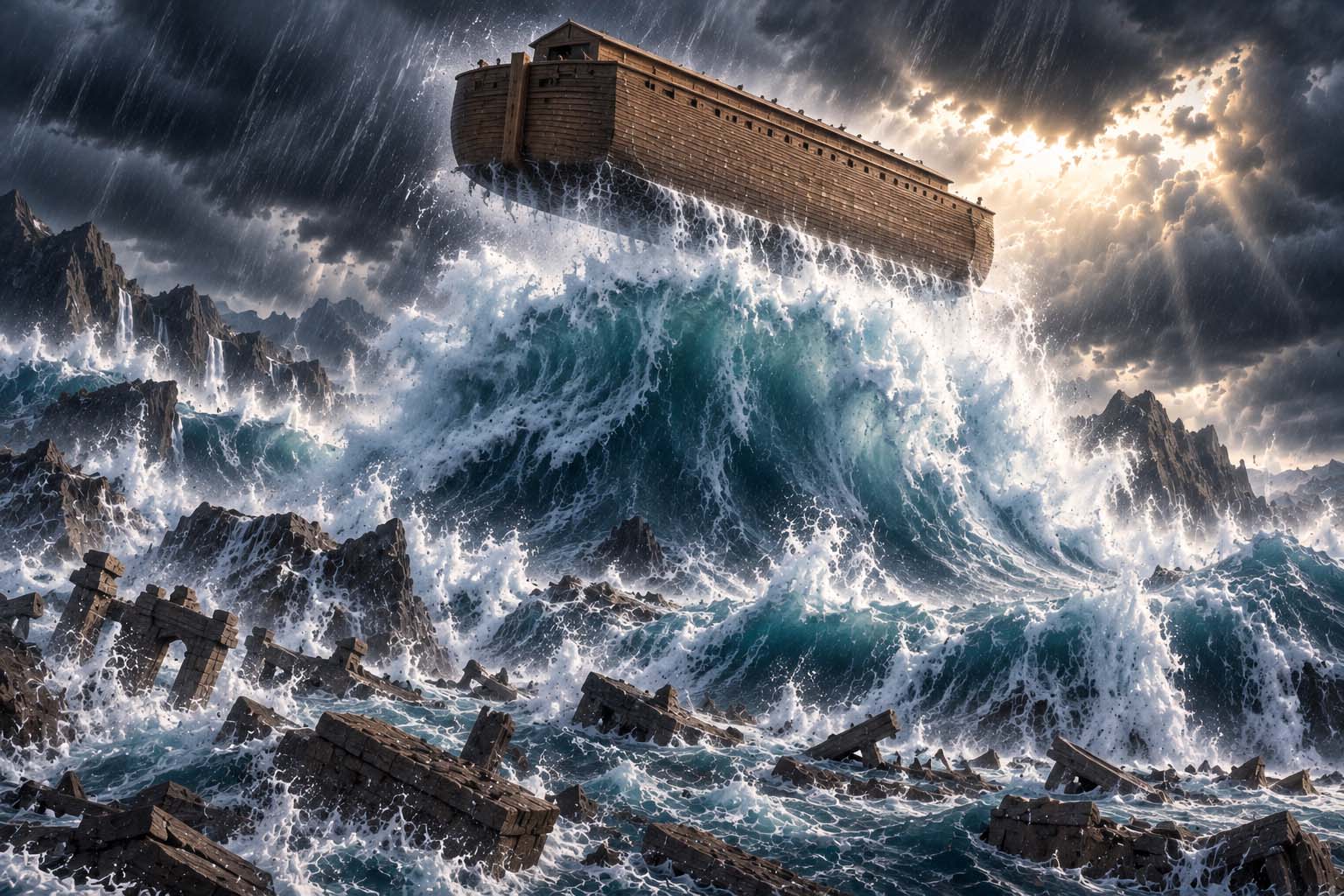
The waiting ends. Genesis now describes the catastrophe itself. Water is not presented as coming from the sky alone. The narrative opens the heavens above while the great deep breaks open below.

Canonical foundation

The Windows of Heaven Are Opened

“...the same day were all the fountains of the great deep broken up, and the windows of heaven were opened.”
Genesis 7:11 · KJV

The KJV wording is striking. The Hebrew expression commonly translated “windows” or “floodgates” of heaven presents an extraordinary release of water from above. Genesis gives us the event, but does not provide a modern meteorological diagram explaining its physical mechanism.

Duration of the rain

Forty Days and Forty Nights

“And the rain was upon the earth forty days and forty nights.”
Genesis 7:12 · KJV
MarkerBiblical record
BeginningNoah's 600th year, second month, seventeenth day
RainForty days and forty nights
Source aboveWindows of heaven opened
Source belowFountains of the great deep broken up
ResultThe waters increasingly prevail upon the earth

This was not merely a forty-day Flood. Forty days and forty nights describes the period of rain. The broader Flood chronology continues beyond those forty days.

Evidence distinction

Had It Ever Rained Before?

“...for the LORD God had not caused it to rain upon the earth...”
Genesis 2:5 · KJV

Genesis 2:5–6 describes an early period in which rain had not yet occurred and a mist watered the ground. Some readers therefore interpret the pre-Flood world as having experienced no rain before Noah.

But Genesis does not explicitly state that no rain ever fell anywhere on Earth between that early Creation setting and the Flood. The museum therefore presents “Noah's generation had never seen rain” as an interpretation, not as an explicit statement of Scripture.

Accounts of the opening heavens

Genesis, 1 Enoch, Jubilees, Jasher, Josephus, and Later Tradition

WitnessDescriptionDistinctive detailClassification
Genesis 7:11–12Windows of heaven open while the fountains of the great deep break up.Rain for forty days and forty nights.Canonical Scripture
1 Enoch 89:2–4A symbolic Flood vision portrays heavenly sluices pouring water while openings or springs appear below.Seven heavenly sluices; darkness and mist increase.Non-canonical ancient witness
Jubilees 5:24–27Heavenly floodgates and mouths of the deep release water.Seven openings above and seven below.Non-canonical ancient witness
Jasher 6:11–14A violent onset accompanies the Flood.Earth shaking, darkened sun, lightning, thunder, fountains, then rain.Non-canonical textual tradition
Josephus, Antiquities I.3Josephus retells the Flood as rain pouring down after God's appointed signal.Forty days of rain and the overwhelming rise of the waters.First-century AD Jewish historian
Sibylline Oracles IA later dramatic retelling describes clouds, thunder, lightning, winds, heavenly waters, and waters from below.Highly developed catastrophic imagery.Later literary tradition
Museum note: These witnesses are displayed side by side so visitors can compare them. Details belonging to Enoch, Jubilees, Jasher, Josephus, or the Sibylline tradition are not attributed to Genesis.
Ancient witness · 1 Enoch 89

Seven Sluices Above

In the symbolic Animal Apocalypse, 1 Enoch 89 portrays seven sluices associated with a lofty structure above pouring down great quantities of water. Openings or springs also appear in the earth below, while water, darkness, and mist increase.

7SLUICES ABOVE ↓
↑SPRINGS / OPENINGS BELOW

Because this passage belongs to a symbolic vision, it should not be read as though it were written in the same narrative form as Genesis.

Ancient witness · Jubilees 5

Seven Above # Seven Below

7FLOODGATES OF HEAVEN ↓
7↑ MOUTHS OF THE DEEP

Jubilees expands the Genesis description numerically: seven floodgates above and seven mouths associated with the deep below. The correspondence with 1 Enoch's seven heavenly sluices is worth displaying, while preserving the literary differences between the texts.

Textual tradition · Jasher 6

The Foundations of the World Are Moved

Jasher's expanded Flood tradition does not portray the beginning of the catastrophe as an unusually severe rainstorm. Its description begins with the earth itself. The ground shakes, the sun darkens, the foundations of the world are disturbed, the whole earth is moved violently, lightning flashes, thunder roars, and the fountains within the earth break open.

EARTH SHAKES SUN DARKENS FOUNDATIONS RAGE LIGHTNING THUNDER FOUNTAINS BREAK OPEN WINDOWS OF HEAVEN OPEN
“...the whole earth was moved violently, and the lightning flashed, and the thunder roared, and all the fountains in the earth were broken up...”
Jasher 6:11 · Non-Canonical Tradition

Only after describing this terrestrial upheaval does Jasher move into the full Flood sequence. At the end of the seven days, it says the waters of the Flood were upon the earth; the fountains of the deep were broken up; the windows of heaven were opened; and the rain continued for forty days and forty nights.

This ordering is important. In Jasher's version, the catastrophe is not presented simply as water falling from clouds. The account depicts disturbance below, disturbance across the surface, and water from above. Read beside Genesis 7:11, it raises one of the central physical questions of this gallery: what did the ancient writers understand by the “fountains of the great deep”?

Source Context: Genesis 7:11 explicitly records the breaking up of the fountains of the great deep and the opening of the windows of heaven. The additional details of a darkened sun, violent shaking, lightning, thunder, and raging foundations belong to the Jasher tradition and are not attributed here to Genesis.

The Canopy Theory

The pre-Flood world described in the opening chapters of Genesis contains features that have generated centuries of discussion. One modern proposal, commonly called the Canopy Theory or Vapor Canopy Theory, attempts to connect the “waters which were above the firmament” in Genesis 1 with the extraordinary rainfall described at the beginning of Noah's Flood.

“And God said, Let there be a firmament in the midst of the waters, and let it divide the waters from the waters. And God made the firmament, and divided the waters which were under the firmament from the waters which were above the firmament: and it was so. And God called the firmament Heaven.”
Genesis 1:6–8 · KJV

The biblical text clearly distinguishes waters below from waters above. What Genesis does not explain is the physical form, precise location, thickness, temperature, or atmospheric behavior of those upper waters. The Canopy Theory attempts to fill that unanswered physical question with a model.

Proposed pre-Flood model

What Does the Theory Propose?

In its best-known twentieth-century form, the theory proposes that the pre-Flood Earth possessed a substantial layer of water, usually envisioned as water vapor, suspended above or associated with the atmosphere. This canopy would have existed from Creation until the Flood.

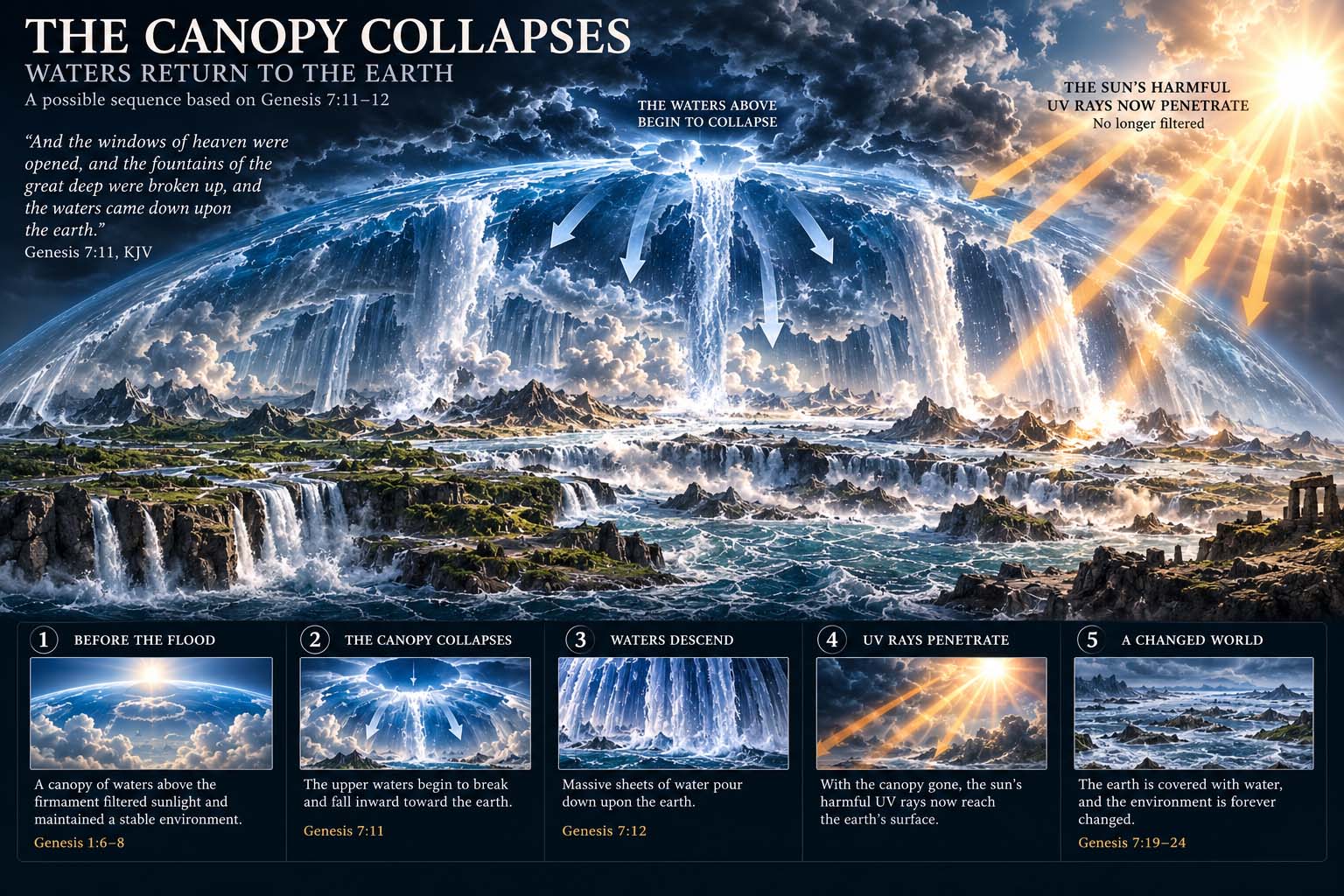
When the “windows of heaven” opened, proponents suggested that some or all of this stored water condensed or collapsed, contributing to the forty days and forty nights of rain.

The model became especially influential after John C. Whitcomb and Henry M. Morris published The Genesis Flood in 1961. Later canopy models varied considerably, so the term does not describe one universally agreed physical mechanism.

Why people proposed it

A Different Pre-Flood Environment?

The theory became attractive because it appeared capable of connecting several unusual features of the early Genesis narrative. Advocates wondered whether a radically different atmospheric environment could help explain the “waters above,” the extraordinary longevity recorded before and immediately after the Flood, the apparent climatic differences imagined for the First World, and the tremendous quantity of rain associated with the Flood.

Some versions proposed that a canopy could have moderated global temperatures, increased atmospheric pressure, altered the distribution of sunlight, or reduced certain forms of radiation reaching the surface. Others connected it with the traditional idea that rain may have been unknown before the Flood.

These are proposed consequences of the model, not things Genesis explicitly says the upper waters accomplished.

QuestionWhat the biblical text saysWhat the canopy model proposes
Waters aboveGenesis 1:6–8 says waters were above the firmament.They may have formed a substantial atmospheric or near-atmospheric water layer.
Rain before the FloodGenesis 2:5 describes an early time when God had not caused it to rain; Genesis does not explicitly say rain never occurred afterward before Noah.Some canopy models propose a world without ordinary rainfall before the Flood.
Flood rainfallGenesis 7:11–12 says the windows of heaven opened and rain continued forty days and nights.The canopy collapses or condenses and contributes water to the rainfall.
Long lifespansGenesis records exceptionally long lives but does not identify an atmospheric cause.Some advocates proposed that the canopy produced environmental conditions favorable to longevity.
Post-Flood changeGenesis records a dramatically changed world after the Flood in several respects.The loss of the canopy is proposed as one possible environmental change.
Why many creation researchers moved away from it

The Model Has Serious Problems

Even among researchers who accept a recent Creation and a global Genesis Flood, the classic vapor-canopy model is no longer widely favored. The principal difficulty is physical: a canopy containing enough water to contribute substantially to a global Flood creates severe heat problems.

Large quantities of atmospheric water vapor produce a powerful greenhouse effect. In addition, condensing enormous quantities of vapor into rain releases latent heat. Modeling performed within creationist research itself led many researchers to conclude that a canopy massive enough to supply a major portion of the Flood water would make the surface environment unacceptably hot.

There are also textual questions. Genesis never calls the waters above a vapor canopy, never says that they disappeared during the Flood, and does not explicitly connect Genesis 1:7 with the windows of heaven in Genesis 7:11. Psalm 148:4, written long after the Flood, still speaks of “waters that be above the heavens,” which some interpreters regard as another difficulty for a canopy that supposedly collapsed completely during Noah's Flood.

Deep question to ponder

What If the Pre-Flood World Was Different in Ways We Do Not Yet Understand?

Rejecting one physical model does not answer every question raised by Genesis 1–9. The text still describes waters above the firmament, a world before the Flood that is difficult to reconstruct, exceptionally long human lifespans, and a catastrophe involving both the heavens and the great deep.

The Canopy Theory may be wrong without every question that inspired it being wrong.

Could the atmosphere before the Flood have differed from the modern atmosphere in some way that is not preserved or explained in the text? Did the “waters above” have a physical relationship to the Flood, or were they something entirely different? Were climatic conditions substantially different? Were other environmental factors involved that cannot now be reconstructed?

Genesis gives us theological and historical accounts, but it does not provide a technical atmospheric model. The museum therefore leaves these questions open rather than forcing the ancient text into a scientific mechanism it does not describe.

Museum assessment

A Theory Worth Understanding, Not Declaring Proven

The Canopy Theory played an important role in twentieth-century Flood interpretation and remains familiar to many readers of Genesis. It is valuable historically because it demonstrates an attempt to ask how the unusual environmental descriptions of the early biblical world might relate to physical conditions.

But the theory should not be presented as though Genesis teaches it. The biblical text establishes the “waters above,” the opening of heaven, and the forty days and nights of rain. The canopy connecting those statements is an interpretive model.

For this museum, that distinction is the important one: preserve the mystery where the evidence remains incomplete. The First World may have differed from ours in ways we do not fully understand, but unanswered questions are not permission to turn a possibility into a fact.

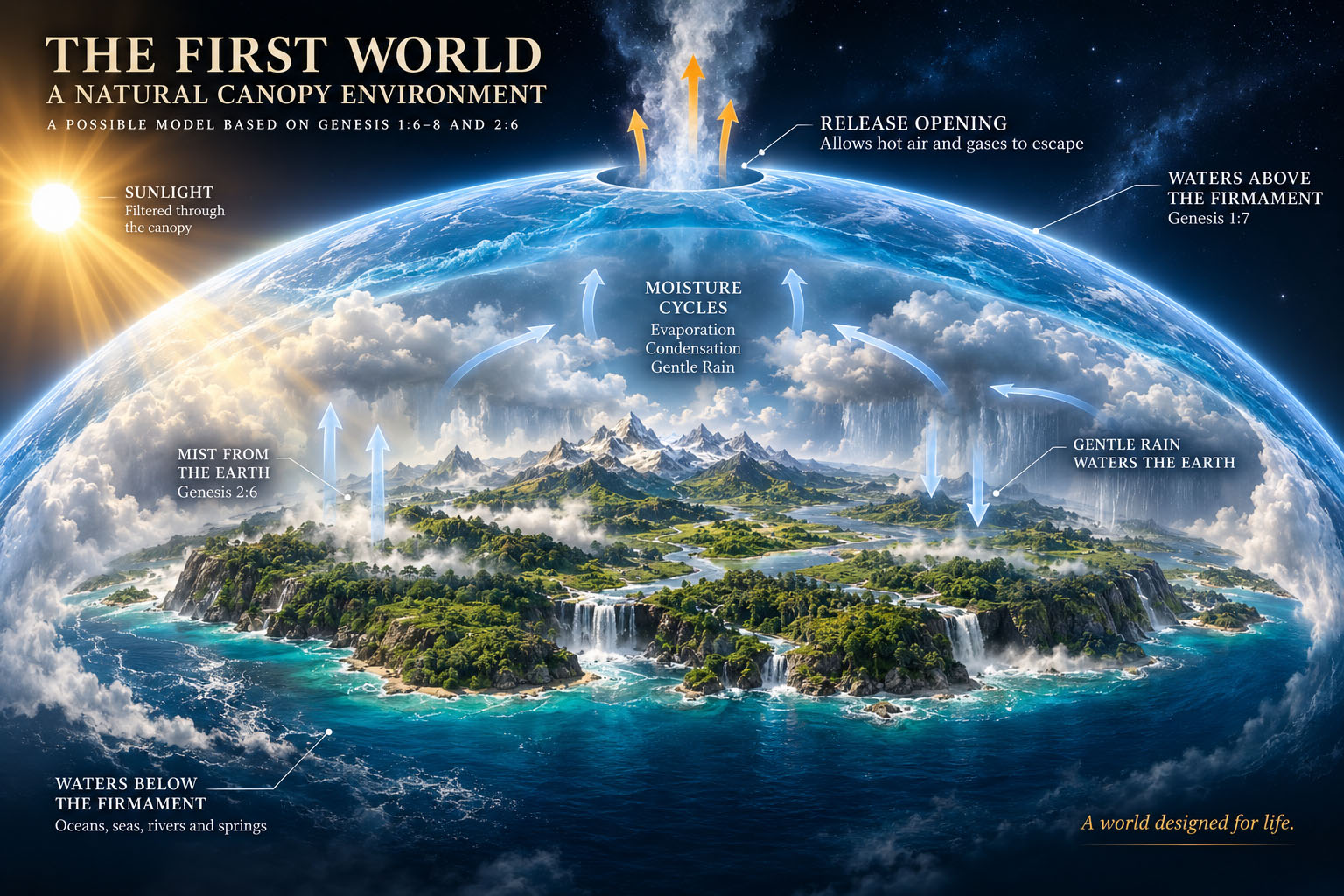
Theoretical reconstruction

The First World as a Canopy Environment?

Theoretical cutaway visualization of a proposed pre-Flood canopy environment, showing moisture cycling, waters above and below, sunlight, and an upper release opening for heat and gases.

A theoretical visualization of a possible pre-Flood environmental model inspired by Genesis 1:6–8 and Genesis 2:6. The illustration includes an upper release opening as part of the proposed model; Scripture does not describe such an opening or specify the physical structure of the waters above the firmament.

The terrarium comparison helps visualize the idea without requiring the Earth to be imagined as completely sealed. Moisture rises from the surface, circulates through the atmosphere, condenses, and returns to the land. In this proposed model, excess heat and gases are allowed to escape through an upper atmospheric opening rather than accumulating inside a perfectly closed system.

This release opening is hypothetical. It is included to illustrate the environmental model being explored, not because Genesis identifies a vent or opening above the pre-Flood atmosphere. The biblical foundation remains the distinction between waters above and waters below, together with the mist that watered the ground.

Theoretical reconstruction

The Canopy Collapses: Waters Return to the Earth

Theoretical visualization of a proposed pre-Flood canopy collapsing inward during the onset of the Flood, with immense water descending toward the earth and stronger ultraviolet radiation reaching the surface after the canopy is disrupted.

A theoretical visualization of the proposed canopy model during the onset of the Flood. In this reconstruction, the waters above collapse inward as immense quantities of water descend toward the earth. The illustration also explores a further canopy-model proposal: that removal of the former atmospheric water layer could have allowed increased ultraviolet radiation to reach the surface. Genesis records the opening of heaven and the forty days of rain, but it does not state that a vapor canopy collapsed or that ultraviolet exposure changed.

This illustration represents the proposed canopy theory at the moment of catastrophe rather than an event explicitly described in these physical terms by Scripture. It visually connects the theory's earlier protected environment with its proposed destruction during the Flood, while keeping the model separate from what the biblical text actually states.

Historical retelling · Josephus

A First-Century Jewish Historian Retells the Flood

In Antiquities of the Jews, Book I, Josephus retells Noah's story for a Greco-Roman audience. He describes Noah attempting to persuade the people to change their conduct, followed later by the divinely appointed onset of rain and forty days of pouring water.

This creates a useful historical-literary bridge back to our earlier warning material: warning, refusal, preservation, and finally catastrophe.

Later tradition · Sibylline Oracles

Clouds, Darkness, Wind, and Heavenly Cataracts

The Flood material in the Sibylline Oracles develops the scene with massing clouds, obscured celestial lights, thunder, lightning, wind, waters from heaven, and waters from the earth. Because this is later literary material, it belongs lower in the evidentiary hierarchy than Genesis, Jubilees, or 1 Enoch.

The biblical mechanism

The Catastrophe Comes From Two Directions

↓ FROM ABOVEWindows of heaven opened
Genesis 7:11
#
↑ FROM BELOWFountains of the great deep broken up
Genesis 7:11

The biblical description is not simply a prolonged rainstorm. Genesis places water entering the catastrophe from above and below.

The First World changes

The Ordinary World Begins to Disappear

Hours earlier there were fields, roads, homes, livestock, weddings, meals, and people making plans.

Then water collects in paths and low places. Streams rise. Familiar ground begins to disappear.

Morning becomes evening. Evening becomes night. Another morning comes.

And it is still raining.

Follow the evidence through the museum

Cross-References

These buttons use existing Flood exhibit anchors so the section can be cross-referenced later without changing the page structure.

The heavens have opened.

The rain continues.

But Genesis has already told us that something else is happening at the same time.

The catastrophe is not only above them.

Next → 10 · Fountains of the Great Deep

The catastrophe is not only above. Genesis says that on the same day the windows of heaven were opened, the fountains of the great deep were also broken up. Section 10 turns downward, beneath the surface, and asks what that extraordinary language may describe.

Canonical foundation

“All the Fountains of the Great Deep Were Broken Up”

“...the same day were all the fountains of the great deep broken up, and the windows of heaven were opened.”
Genesis 7:11 · KJV

The verse places two mechanisms side by side: water associated with the heavens above and water associated with the great deep below. The wording translated “broken up” presents rupture or bursting open rather than the quiet overflow of an ordinary spring.

Genesis does not tell us how many fountains existed, how large they were, whether they were localized or globally distributed, or exactly what geological structures were involved. The physical mechanism is left unexplained.

Biblical terminology

What Is “the Great Deep”?

“And the earth was without form, and void; and darkness was upon the face of the deep.”
Genesis 1:2 · KJV

The deep appears at the opening of Genesis before the separation of waters described later in Creation. By Genesis 7, the narrative speaks not merely of the deep, but of its fountains being broken open.

That wording invites a physical question: was the Flood releasing water from subterranean or ocean-associated reservoirs through catastrophic ruptures?

Ancient witnesses

How Other Flood Traditions Describe the Deep

SourceReferenceDescriptionClassification
Genesis7:11All the fountains of the great deep are broken up while the windows of heaven are opened.Canonical Scripture
Jubilees5:24–25Seven mouths associated with the fountains of the great deep are opened while seven floodgates of heaven release water above.Non-canonical ancient witness
1 Enoch89:2–4A symbolic Flood vision depicts openings or springs below while heavenly sluices pour water from above.Non-canonical ancient witness
Jasher6:11–15The earth is violently moved, fountains in the earth break open, and the Flood begins amid disturbance above and below.Non-canonical textual tradition
JosephusAntiquities I.3Retells the catastrophic Flood and overwhelming rise of the waters without the same geological expansion found in Jasher.First-century AD Jewish historian
Museum note: Details unique to Jubilees, 1 Enoch, Jasher, or Josephus remain source-specific and are not attributed to Genesis.
Textual tradition · Jasher 6

The Earth Itself Is in Convulsion

Jasher's expanded Flood account intensifies the subterranean side of the catastrophe. It describes the whole earth being moved violently, lightning and thunder accompanying the event, and fountains within the earth breaking open before the sustained Flood rain is described.

EARTH MOVED VIOLENTLYFOUNDATIONS DISTURBEDFOUNTAINS BREAK OPENLIGHTNINGTHUNDERDEEP BREAKS OPEN

This does not prove a particular geological mechanism, but it shows that this textual tradition understood the onset as involving violent disruption of the earth itself, not merely rainfall.

Deep question to ponder

Did “Broken Up” Mean the Crust Itself Was Rupturing?

The biblical text does not use modern geological vocabulary. It does not identify faults, tectonic plates, or mid-ocean ridges. But the image of all the fountains of the great deep being broken up raises an obvious physical question: could the event have involved large-scale rupture of the earth's crust?

If so, the Flood would not be imagined as rainfall slowly filling basins. Water, geological material, heat, pressure, and seismic disturbance could have been released through multiple ruptures while water simultaneously descended from above.

This remains a hypothesis. Scripture gives us the language of rupture. It does not give us the geological map.

Observed geology

What Lies Beneath the Modern Oceans?

Modern bathymetric mapping reveals an enormous hidden landscape beneath the oceans: mountain chains, central rift valleys, trenches, transform faults, fracture zones, volcanic regions, and places where heated, mineral-rich water emerges through openings in the seafloor.

The global mid-ocean ridge system extends for roughly 65,000 kilometers, or about 40,000 miles, making it the longest mountain chain on Earth. Most of it lies underwater.

These structures are measurable realities. The question for this exhibit is not whether they exist, but whether any of them could have a historical relationship to the Flood account.

Current geological model

How Mainstream Geology Explains These Structures

Standard geology interprets mid-ocean ridges, trenches, faults, and fracture zones through plate tectonics, seafloor spreading, subduction, faulting, volcanism, and crustal motion.

That interpretation should be presented plainly. Any Flood-related alternative must still account for the geometry of the ridges, earthquake and volcano distribution, ocean-crust patterns, sediments, heat flow, and other measurements.

The museum therefore distinguishes observed structures from the interpretation proposed for their origin.

CategoryWhat can be statedMuseum classification
GenesisThe fountains of the great deep were broken up.Canonical textual statement
JasherThe expanded tradition adds violent earth movement and fountains breaking open.Non-canonical textual tradition
Observed geologyThe ocean floor contains a global system of ridges, rifts, faults, trenches, volcanic regions, and hydrothermal openings.Measured physical observation
Standard modelThese features are explained through plate tectonics and related geological processes.Current scientific interpretation
Flood-fissure hypothesisSome crustal structures might be investigated as possible analogues or remnants of catastrophic rupture associated with the Flood.Interpretation / under continued study hypothesis
A modern analogue, not proof

Water Still Emerges Through the Seafloor Today

Hydrothermal vents demonstrate that water can circulate through fractured oceanic crust, become heated and chemically altered, and return through openings in the seafloor. These systems are not evidence that the Flood occurred, but they provide a modern example of water interacting dynamically with deep crustal fractures.

That makes them useful as a physical analogue while keeping the analogy separate from a account of historical identification.

area for further study

How Much of the Flood Water Came From Below?

Genesis does not divide the Flood water into percentages from above and below. It tells us that both sources were involved.

The relative contribution of rainfall, subterranean reservoirs, oceanic water, crustal disruption, or any other proposed source cannot be calculated directly from the biblical text.

The heavens are open.

The deep is broken up.

Water descends from above.

Water erupts from below.

Now the waters begin to prevail.

Next → 11 · The Waters Rise

The sources of the water have been opened. Now Genesis changes its emphasis from where the water came from to what the water does. The language escalates: the waters increase, bear up the Ark, lift it above the earth, prevail greatly, and finally carry it upon the face of the waters.

The Ark moves for the first time

The Waters Bear Up the Ark

“And the flood was forty days upon the earth; and the waters increased, and bare up the ark, and it was lift up above the earth.”
Genesis 7:17 · KJV

For years the Ark had rested on land. Genesis 7:17 records the moment that changes. The increasing waters bear up the vessel, and it is lifted above the earth.

The conventional reading is straightforward buoyancy: as the water deepens, the Ark begins to float. That reading is strongly supported by the verse itself because the waters are the grammatical agent doing the lifting.

The transition to full flotation

The Ark Goes Upon the Face of the Waters

“And the waters prevailed, and were increased greatly upon the earth; and the ark went upon the face of the waters.”
Genesis 7:18 · KJV

The sequence has now moved from lifting to floating. Whatever was happening beneath and around the vessel, Genesis describes the Ark as riding upon the waters after it had been raised from the ground.

Escalating language

The Waters Do Not Merely Rise, They “Prevail”

INCREASEGenesis 7:17
BEAR UPThe Ark is lifted
PREVAIL GREATLYGenesis 7:18
PREVAIL EXCEEDINGLYGenesis 7:19

Genesis repeats the idea of the waters becoming strong, dominant, and overwhelming. The narrative does not sound like a calm reservoir filling gradually. It presents a force increasingly mastering the landscape.

Deep question to ponder · The Pinter Theory

The Scriptural Basis for the Pinter Theory

Theoretical reconstruction

The Pinter Theory: The Ark Lifted Above the Initial Catastrophe

Theoretical museum reconstruction of the Ark elevated above enormous Flood waves during the initial catastrophic phase.

A theoretical visualization of the Pinter Theory: the Ark is shown temporarily elevated above the most violent initial water movement before returning to the surface of the Flood waters. Genesis states that the waters bore up the Ark; the extraordinary elevation depicted here is an interpretive hypothesis, not an explicit biblical statement.

The Pinter Theory begins with a small but intriguing progression in the language of Genesis.

“And the flood was forty days upon the earth; and the waters increased, and bare up the ark, and it was lift up above the earth.”
Genesis 7:17 · KJV

The verse does not merely say that the Ark floated. It first tells us that the waters “bare up the ark,” and then adds that the Ark “was lift up above the earth.”

The following verse changes the description:

“And the waters prevailed, and were increased greatly upon the earth; and the ark went upon the face of the waters.”
Genesis 7:18 · KJV

Read consecutively, the passage presents a progression:

WATERS INCREASEGenesis 7:17
ARK IS BORNE UP“bare up the ark”
ARK IS LIFTED“above the earth”
ARK GOES UPON THE WATERSGenesis 7:18

That sequence is the foundation of the Pinter Theory.

The normal interpretation is that Genesis is describing increasing buoyancy. The rising waters lifted the Ark from the ground until sufficient depth existed for it to float freely. That remains the most direct reading of the passage.

But there is another question worth asking.

“...the same day were all the fountains of the great deep broken up, and the windows of heaven were opened.”
Genesis 7:11 · KJV

Genesis has just described the beginning of an extraordinary catastrophe. If the breaking of the great deep involved enormous geological disturbance and violent displacement of water, then the Ark may have faced something far more destructive than gradually rising water.

Modern history demonstrates what comparatively localized disturbances can do. Tsunamis can cross oceans at tremendous speeds, destroy coastlines, move enormous debris, and produce extraordinary runup. Yet the Genesis account describes something potentially far greater: disruption from below occurring simultaneously with water arriving from above.

That creates the central question:

How did a massive wooden vessel survive the first moments of such an event?

The proposed interpretation

The Pinter Theory

I propose that Genesis 7:17 may leave room for a period of extraordinary divine preservation during the initial violence of the Flood.

The words “bare up the ark” and “it was lift up above the earth” could describe ordinary flotation. Scripture does not tell us otherwise. But if the initial surface conditions were catastrophically violent, it is possible that God, who designed the Ark, commanded its construction, gathered its occupants, and personally shut them inside, also supernaturally protected the vessel during the most dangerous stage of the catastrophe.

The possibility being proposed is that the Ark may have been lifted or providentially held above the worst initial upheaval, rather than being left to endure the full force of enormous breaking waves, crustal eruptions, debris, and violent water displacement.

Then comes Genesis 7:18:

“...and the ark went upon the face of the waters.”
Genesis 7:18 · KJV

This may mark a transition.

First, the Ark is lifted above the earth. Then, after the waters have “increased greatly,” the Ark is described as going “upon the face of the waters.”

Could the Ark have been extraordinarily protected during the initial catastrophic upheaval and then, when the waters had sufficiently prevailed over the landscape, been allowed to settle into ordinary flotation upon their surface?

Scripture does not say that this happened.

But neither does Scripture explain how the Ark survived the initial violence. It tells us that God commanded the vessel, preserved Noah and his family, shut them inside, and that the Ark was lifted before it traveled upon the waters.

The Pinter Theory attempts to address that unexplained interval.

Deep question to ponder

Did Preservation Require More Than Flotation?

If God intended merely to preserve Noah from rising water, the Ark needed to float.

But if the opening moments of the Flood involved forces capable of destroying virtually everything on the surface of the earth, the Ark needed to survive the catastrophe itself.

Perhaps Genesis 7:17 contains a small clue:

“...and it was lift up above the earth.”
Genesis 7:17 · KJV

And only afterward:

“...the ark went upon the face of the waters.”
Genesis 7:18 · KJV

That does not prove miraculous suspension.

But it gives us a reason to ask whether the God who shut the door also held the Ark safely above the worst of the storm until it could safely ride upon the waters.

Measured modern catastrophes · Scale and speed

What the Largest Recorded Tsunamis Show Us

Modern tsunamis demonstrate how violently water can move when enormous energy is transferred into it. These events are not models of the Genesis Flood, but they establish measurable physical benchmarks for wave height, runup, travel speed, geographic reach, and destructive force.

EventLocationHeight / runupMovement / reachWhat happened
Lituya Bay Megatsunami, 1958Alaska, USA1,720 ft (524 m) maximum runupThe wave stripped forest to 1,720 ft elevation and reached as far as 3,600 ft inland from the high-tide shoreline at Fish Lake.An earthquake-triggered rockslide plunged into the confined bay and generated the highest documented tsunami runup. This was an exceptional local megatsunami, not an ocean-basin wave.
Indian Ocean Tsunami, 2004Sumatra and the Indian Ocean basinSurveyed runup reached 51 m (167 ft) in Aceh; NOAA also reports coastal wave heights exceeding 30 m in some locations.Deep-ocean tsunami waves can move at roughly 800–1,000 km/h (500–620 mph). The tsunami struck nearby islands and Indonesia within about 20 minutes and reached Somalia roughly seven hours later.A roughly 1,200–1,300 km rupture displaced the seafloor and generated the deadliest tsunami in recorded history.
Tōhoku Tsunami, 2011Honshu, Japan and Pacific OceanObserved runup exceeded 40 m (130 ft) in parts of Japan.In the open ocean, tsunami waves can travel up to about 800 km/h (500 mph). The wave reached Hawaii about eight hours later and the U.S. West Coast about 9.5 hours after the event.A massive offshore megathrust rupture generated a Pacific-wide tsunami and catastrophic coastal inundation in Japan.
Krakatau Tsunamis, 1883Sunda Strait, IndonesiaEnormous destructive waves struck Java and Sumatra.Larger waves were detected by tide gauges more than 7,000 km from Krakatau.The volcanic catastrophe generated a series of tsunamis that destroyed 165 coastal villages and contributed to more than 36,000 deaths.
Important distinction: tsunami runup is the maximum vertical elevation reached by the water above sea level, and is not necessarily the height of a free-standing wall of water. Lituya Bay's 1,720-foot mark is therefore a runup measurement produced by an extraordinary landslide-driven megatsunami in a confined bay.

Speed is as important as height. A tsunami crossing deep ocean can travel at jet-airliner speeds while remaining relatively low. As it enters shallow water it slows, its wavelength compresses, and water can build dramatically in height. The 2004 Indian Ocean event demonstrates the extraordinary geographic reach of such energy: the tsunami crossed thousands of miles of ocean within hours.

Museum comparison: Even these extreme recorded disasters were geographically limited events. The Flood narrative developed in Sections 09–11 describes water arriving from above while the fountains of the great deep are broken up below. If those descriptions represent a catastrophe operating across vast portions of the earth simultaneously, the resulting water movement would be categorically different from any single modern tsunami. That proposed scale is part of the Pinter Theory investigation, not a measured geological conclusion.
Scale of the proposed catastrophe

If the Deep Broke Open on a Vast Scale...

A modern tsunami may begin with rupture along a limited fault segment. The hypothesis explored in Sections 10 and 11 asks what conditions might exist if many immense ruptures were occurring while water was also descending from above.

In that scenario, the dangers to a floating vessel could include rapid vertical displacement, extreme currents, chaotic wave trains, debris, seismic motion, changing water depth, and violent interactions between water and newly disrupted terrain.

That is the physical problem behind the Pinter Theory: if the onset was truly planetary in scale, what preserved the Ark during the transition from land to water?

Observation and Flood hypothesis

Why Are Marine Fossils Found High in Mountain Ranges?

Marine fossils occur today in rocks that stand thousands of feet above modern sea level. This observation is real and does not depend on a Flood interpretation. Marine limestone, shells, corals, crinoid remains, ammonites, brachiopods, bivalves, and other marine material occur in uplifted mountain belts around the world.

Standard geology explains these occurrences primarily through deposition in former marine environments followed by tectonic deformation and uplift. In that interpretation, sediments and organisms that once occupied ancient seas were eventually raised to mountain elevations as crustal plates collided, folded, faulted, and uplifted the rock.

The Flood scenario explored by this museum asks whether some of that deformation and uplift could instead have occurred during an exceptionally violent phase of the Flood. If the “fountains of the great deep” involved widespread crustal rupture, enormous water movement, and major displacement of the earth's surface, then marine sedimentary layers could conceivably have been heaved upward while the catastrophe was still in progress. This is an investigative Flood hypothesis, not a conclusion established by the presence of marine fossils alone.

A second possibility within the same Flood model concerns the water itself. If the Flood covered the entire earth as the Genesis account describes, the oceans would not necessarily have become calm immediately after the initial devastation. Vast currents, waves, sediment-laden water, displaced marine organisms, shells, broken reefs, and debris could have continued moving across newly forming or rising terrain. Under this hypothesis, some marine material might have been transported and deposited at high elevations as turbulent Flood waters crossed or receded from uplifted land.

The museum therefore considers two related catastrophic processes: marine strata may have been uplifted with the rock itself, and loose marine material may also have been transported by turbulent water across elevated terrain. These mechanisms are not interchangeable, and each fossil-bearing site must be examined in its actual geological context.

Critical evidence distinction: a fossil embedded within an intact marine limestone layer is different evidence from a loose shell or reworked fossil deposited on a surface. The first may indicate uplift of an entire marine sedimentary unit; the second may permit transport and redeposition. Neither observation, by itself, establishes when or how the mountain reached its present elevation.
Mountain regionMarine evidenceExamples of organisms / materialStandard geological interpretation
Himalayas / Everest regionMarine sedimentary rocks occur at very high elevations, including limestone units.Common reports include marine invertebrate fossils such as brachiopods, crinoid fragments, and other shelly remains in Himalayan marine strata.Former marine sediments uplifted during collision of the Indian and Eurasian plates.
European AlpsExtensive marine limestones and fossil-bearing strata occur high in the mountains.Ammonites, bivalves, brachiopods, corals, and other marine fossils occur in many Alpine units.Marine sedimentary basins later folded and uplifted during Alpine mountain building.
AndesMarine sedimentary rocks and marine fossils occur at high elevations in parts of the range.Ammonites, mollusks, and other marine fossils are documented in former marine strata.Marine deposits uplifted during Andean tectonism.
Rocky MountainsMarine sedimentary rocks and fossils occur in uplifted mountain regions.Shell-bearing limestones, brachiopods, crinoids, and other marine fossils occur in many Paleozoic units.Former shallow-sea deposits raised during later mountain-building episodes.
Source Context: Finding marine fossils on mountains proves that the rocks containing them formed in or received material from marine environments. By itself, it does not determine whether the elevation occurred slowly, rapidly, during one catastrophe, or through multiple geological events. The mechanism must be argued from the full geological context.
Theoretical reconstruction

From Ocean Depths to Mountain Heights

Theoretical museum reconstruction showing marine sediment layers and fossils being uplifted during a catastrophic Flood scenario, with pressurized water rising through fractured crust and high mountains forming.

A theoretical visualization of a possible Flood scenario in which marine sedimentary layers are uplifted during catastrophic crustal disturbance while turbulent waters continue to move marine material across changing terrain. The illustration combines observed marine fossils at high elevations with a proposed catastrophic mechanism; it should not be read as proof that the depicted process occurred.

The Ark has left the ground.

The waters are increasing.

The First World is disappearing beneath them.

And outside the Ark, there is nowhere left to go but higher.

Next → 12 · The World Outside the Ark

The waters are already rising. We have examined the heavens opening, the fountains of the great deep, the violence of the waters, and the Ark being borne upward. We now remain outside the Ark and follow the final disappearance of the First World in one continuous section.

Jesus recalls the Flood

Ordinary Life Continued Until the Flood Came

“For as in the days that were before the flood they were eating and drinking, marrying and giving in marriage, until the day that Noe entered into the ark, And knew not until the flood came, and took them all away...”
Matthew 24:38–39 · KJV

Jesus' description is striking because the activities are ordinary. Meals continued. Marriages continued. People maintained the patterns of everyday life. The catastrophe did not become real merely because it had been warned about. The turning point came when the Flood itself arrived.

Canonical foundation

The Biblical Record Is Stark

“And all flesh died that moved upon the earth, both of fowl, and of cattle, and of beast, and of every creeping thing that creepeth upon the earth, and every man:”
Genesis 7:21 · KJV
“All in whose nostrils was the breath of life, of all that was in the dry land, died.”
Genesis 7:22 · KJV
“...and Noah only remained alive, and they that were with him in the ark.”
Genesis 7:23 · KJV

Genesis gives the outcome with very little individual detail. It does not narrate the last hours of particular families, settlements, animals, or cities. The result, however, is explicit: terrestrial life outside the Ark did not survive.

Reconstruction · The text gives the outcome, not every moment

When the Water Entered the Settlements

If the waters rose rapidly, the familiar world would have changed by the hour. Roads and paths could become channels. Low ground would disappear. Animals would break from enclosures. Timber, roofs, trees, possessions, and debris could be carried into violent moving water.

People would naturally seek whatever ground remained above them. Objects that had mattered only hours before would become useless if carrying them slowed escape.

This is reconstruction, not quotation. Scripture gives us the rising waters and the final loss of life. The detailed human experience must be inferred cautiously.

The landscape shrinks

The Highest Ground Becomes the Last Ground

As lowlands disappeared, surviving people and animals would naturally move upward. Hills that had once overlooked valleys could become islands. Those islands would then shrink as the waters continued to prevail.

Lowlands disappear

Fields, roads, settlements, and river valleys are overtaken.

Hills become islands

Remaining life is pushed toward increasingly limited high ground.

High ground crowds

People, animals, and debris converge wherever elevation remains.

The last elevations vanish

The biblical account says even the high hills under the whole heaven were covered.

Former Section 13 · Combined into Section 12

All the High Hills Are Covered

“And the waters prevailed exceedingly upon the earth; and all the high hills, that were under the whole heaven, were covered.”
Genesis 7:19 · KJV
“Fifteen cubits upward did the waters prevail; and the mountains were covered.”
Genesis 7:20 · KJV

The narrative now removes the last possible refuge outside the Ark. It moves beyond flooded settlements and valleys to the covering of the high hills and mountains. Whatever the exact relationship of the fifteen cubits to the surrounding terrain, Genesis uses the statement to emphasize the sufficiency of the water to cover the mountains described in the account.

The repeated expressions “under the whole heaven,” “all flesh,” and “every living substance” are central to why the museum presents the Genesis narrative as describing a world-engulfing judgment rather than an ordinary regional flood.

Deep question to ponder

Could Anyone Still Reach the Ark?

Genesis does not describe crowds swimming toward the Ark or tell us whether anyone attempted to reach it after the waters began rising.

What it does tell us is that the final closing of the entrance had already occurred:

“...and the LORD shut him in.”
Genesis 7:16 · KJV

The warning period and the entry period had ended before the catastrophe reached its full force. The closed door therefore marks a boundary in the narrative between warning and judgment.

Ancient and later witnesses

How Other Sources Remember the World Outside

SourceContributionMuseum classification
Genesis 7States that life on dry land outside the Ark died, the mountains were covered, and Noah and those with him remained alive.Canonical Scripture
Matthew 24:38–39Jesus emphasizes ordinary life continuing until the Flood came and took them away.Canonical Scripture
1 Peter 3:20Explicitly identifies the preserved human number as eight souls.Canonical Scripture
Jasher 6Preserves an expanded tradition in which people gather at the Ark, plead for entry, and attempt to force their way in as the rain intensifies.Non-canonical textual tradition
1 EnochConnects Flood judgment with corruption associated with the Watchers and their offspring, and preserves the tradition concerning the spirits of the dead giants.Non-canonical ancient witness
JosephusRetells Noah's warnings, the refusal of the people to change, and their destruction in the Flood.First-century AD Jewish historian
Source Context: Genesis gives the canonical outcome. The dramatic crowd-at-the-Ark material belongs to Jasher, while the Watcher and giant-spirit material belongs to 1 Enoch. These traditions are not merged into Genesis.
A reversed perspective

The Ark From the Outside

The world outside

A World Beneath the Waters

View from high inside the Ark as one person looks through a window over a dark rain-covered ocean with floating baskets, broken wooden planks, vessels, barrels, and other debris, with no land or visible life remaining.

From high inside the Ark, one survivor looks out across a world now covered by water. Rain continues to fall across the comparatively smoother surface while baskets, broken timbers, sealed vessels, barrels, and fragments of the former world drift below. No hills remain visible. No sign of life can be seen.

The same structure that had stood visibly on the landscape during the warning period is now afloat above a disappearing world. From outside, the Ark no longer represents preparation. It represents preservation already underway.

This remains an excellent location for a later illustration from the perspective of those outside: violent rain, rising water, collapsing structures, debris, animals, diminishing high ground, and the Ark beyond their reach.

Giants Collection cross-reference

What Happened to the Giants?

Genesis 6 places the Nephilim in the world connected with the period before the Flood. If they were physically larger than ordinary humans, great size might provide only a temporary advantage in deepening water. It would provide no final refuge once even the mountains disappeared beneath the Flood.

Genesis does not separately narrate their deaths. Its language is broader: terrestrial life outside the Ark dies.

1 Enoch tradition

The Dead Giants and the Evil-Spirit Tradition

1 Enoch develops a tradition not stated in Genesis: the spirits proceeding from the dead giant offspring are described as evil spirits remaining upon the earth. This is significant to the museum's larger Nephilim investigation because, within the Enochic tradition, destruction of the giants' bodies does not end their spiritual influence.

The account belongs specifically to 1 Enoch and should not be presented as though Genesis itself explains the origin of demons this way.

Former Section 14 · Combined into Section 12

The First World Is Gone

“And every living substance was destroyed which was upon the face of the ground... and they were destroyed from the earth: and Noah only remained alive, and they that were with him in the ark.”
Genesis 7:23 · KJV

By this point in the narrative, the world Noah had known is no longer functioning as a human world. Its settlements, fields, roads, boundaries, institutions, and ordinary rhythms of life have been overtaken. Even where physical remnants may still exist beneath the water, the civilization that used them has ended.

This is the dividing line between the First World and the world that Noah's family will eventually enter. The people inside the Ark are not merely survivors of a storm. In the biblical narrative, they are the human bridge between two worlds.

The surviving human family

Eight Human Beings Remained

“...wherein few, that is, eight souls were saved by water.”
1 Peter 3:20 · KJV

Peter supplies the number explicitly: eight. Noah, his wife, their three sons, and their three wives form the complete human company preserved in the Ark.

Preservation Becomes a New Testament Example

The survival of eight people is not only a Genesis detail. Peter later uses Noah's preservation as part of a theological argument, explicitly fixing the human number at eight. This independent New Testament reference is valuable because it confirms how the early Christian text understood the size of Noah's surviving household.

The contrast is severe: Genesis describes the destruction of terrestrial life outside the Ark, while Peter draws attention to the very small number preserved within it. The Flood narrative therefore narrows the human story from a populated world to one family before expansion begins again after the waters recede.

8

An entire human world outside.
Eight human beings inside.

The First World had disappeared beneath the waters. The number of human beings who would enter the world after the Flood had already been determined.

Next → 13 · God Remembered Noah
The Ark resting on exposed rocky ground as floodwaters recede, mountains and land reappear, green growth returns, blue sky opens, and a rainbow spans the post-Flood landscape.

The direction of the narrative changes. The world outside the Ark has been judged, the waters have prevailed, and the First World has disappeared beneath them. Genesis 8 now turns back to the people and animals who have been waiting inside the Ark.

Genesis 8:1 · The turning point

“And God Remembered Noah”

“And God remembered Noah, and every living thing, and all the cattle that was with him in the ark: and God made a wind to pass over the earth, and the waters asswaged;”
Genesis 8:1 · KJV

The statement does not suggest that Noah had slipped from God's memory. Throughout Scripture, language about God “remembering” often marks the moment when He acts toward someone according to His purpose, promise, or mercy. Genesis 19:29 says God remembered Abraham; Genesis 30:22 says God remembered Rachel; Exodus 2:24 says God remembered His covenant with Abraham, Isaac, and Jacob.

Here the phrase is deeply personal. Noah, his family, and the living creatures aboard the Ark had been enclosed through a catastrophe that destroyed the world they knew. The text now tells the reader that they had never been abandoned.

The first physical action of restoration

God Makes a Wind Pass Over the Earth

Genesis does not merely say that the rain stopped. It specifically records that God made a wind to pass over the earth, and then states that the waters began to assuage.

GOD REMEMBERSGenesis 8:1
WIND PASSESOver the earth
WATERS ASSUAGETheir force diminishes
LAND REAPPEARSThe world begins emerging

The Hebrew text does not provide a meteorological explanation for the wind. It may have contributed to evaporation, atmospheric circulation, redistribution of moisture, or other processes, but Scripture does not specify the mechanism.

Deep question to ponder

What Was the Wind?

After the enormous atmospheric and geological disturbance described in the Flood account, what kind of wind would be required to move across the earth while the waters were beginning to diminish?

Could it represent ordinary post-storm circulation on an extraordinary scale? Could it have accelerated evaporation and drying? Could it have been part of a larger reorganization of the post-Flood atmosphere?

Genesis tells us that God sent the wind. It does not tell us exactly how that wind changed the physical world.

The catastrophe is shut down from both directions

The Fountains and the Windows Are Stopped

“The fountains also of the deep and the windows of heaven were stopped, and the rain from heaven was restrained;”
Genesis 8:2 · KJV

This verse deliberately recalls the two sources identified at the beginning of the Flood. The same narrative that described water coming from the great deep below and the heavens above now describes both sources being restrained.

The Same Two Sources Are Named at the End

The literary symmetry is important. Genesis 7:11 introduces the catastrophe with the breaking open of the fountains of the great deep and the opening of the windows of heaven. Genesis 8:2 names those same two sources again when the catastrophe begins to subside.

This means the biblical account does not portray the Flood as rainfall alone. Water from above and the great deep below frame both the onset and the cessation of the event. Whatever physical model a reader proposes must therefore account for both elements if it accounts to represent the Genesis description.

Textual observation: The repetition functions almost like bookends: Genesis 7:11 opens the two sources; Genesis 8:2 closes them.
Genesis 8:3 · A world re-emerging

The Waters “Returned From Off the Earth Continually”

“And the waters returned from off the earth continually: and after the end of the hundred and fifty days the waters were abated.”
Genesis 8:3 · KJV

The expression is intriguing because it emphasizes continued movement away from the land. The text does not identify a single destination or mechanism. Evaporation, drainage into newly formed or enlarged basins, movement into the oceans, infiltration, and large-scale redistribution have all been proposed in different Flood models.

What Genesis establishes is the direction of change: the waters that had prevailed over the earth were now continually diminishing.

Deep question to ponder

Where Did the Flood Water Go?

If the Flood covered the land described by Genesis, the receding phase raises a major physical question: where did such an immense quantity of water go?

Today the earth contains enormous ocean basins and high mountain systems. A Flood model may therefore ask whether major changes in basin depth, crustal elevation, drainage, evaporation, and atmospheric circulation contributed to the return of exposed land.

The biblical text records recession. It does not provide a geological engineering diagram for that recession.

Flood chronology

The Flood Was Far Longer Than Forty Days

The forty days of rain are one stage of the event, not the entire time Noah remained aboard the Ark. Genesis supplies a sequence of dated milestones that extends for many months.

MilestoneBiblical markerWhat happens
Flood begins600th year, 2nd month, 17th dayFountains of the great deep break up and the windows of heaven open. Genesis 7:11.
Forty daysGenesis 7:12, 17Rain falls and the waters increase, bearing up the Ark.
150 daysGenesis 7:24; 8:3The waters prevail, then begin to abate.
Ark rests7th month, 17th dayThe Ark rests upon the mountains of Ararat. Genesis 8:4.
Mountain tops visible10th month, 1st dayThe tops of the mountains appear. Genesis 8:5.
Ground drying601st year, 1st month, 1st dayNoah removes the covering and sees the face of the ground is dry. Genesis 8:13.
Exit from Ark601st year, 2nd month, 27th dayGod commands Noah and the occupants to leave. Genesis 8:14–17.
Museum note: The biblical chronology describes a long period of confinement, recession, waiting, and drying after the forty-day rain period.
Genesis 8:4 · The Ark stops moving

The Ark Rests Upon the Mountains of Ararat

“And the ark rested in the seventh month, on the seventeenth day of the month, upon the mountains of Ararat.”
Genesis 8:4 · KJV

The wording is important: Genesis says “the mountains of Ararat,” not specifically the modern summit called Mount Ararat. The biblical expression identifies a mountainous region rather than naming one precise peak.

This is also the first time after the Ark was lifted that the narrative again describes it as physically resting upon land.

The Mountains of Ararat and the Modern Search

The wording of Genesis has kept the search geographically broad. The text says the Ark rested upon the “mountains of Ararat”, a regional expression rather than the name of a single summit. For that reason, expeditions and proposed Ark locations have not been limited to the present-day peak of Mount Ararat itself. Researchers have examined several places in the wider Ararat region, with the best-known modern investigation centered on the Durupınar formation near Doğubayazıt in Ağrı Province, Türkiye.

Durupınar is a large boat-shaped geological formation roughly 30 kilometers south of the modern summit of Mount Ararat. It was brought to wider attention after Turkish Army Captain İlhan Durupınar recognized the feature in aerial reconnaissance imagery in 1959. Its unusual outline and location have made it one of the most under continued study proposed Ark sites of the modern period.

Canonical Scripture · Genesis 8:4 · KJV
“And the ark rested in the seventh month, on the seventeenth day of the month, upon the mountains of Ararat.”

As of 2026, the Durupınar formation is the subject of an officially authorized geological and geophysical research project directed by Prof. Dr. Cenker Atila of the Department of Archaeology at Sivas Cumhuriyet University, in cooperation with Noah's Ark Scans. The project is designed as a multi-stage investigation rather than an immediate excavation.

The current research program uses modern non-destructive and minimally invasive methods including LiDAR, Ground Penetrating Radar (GPR), Electrical Resistivity Tomography (ERT), drone photogrammetry, topographic mapping, deep geophysical imaging, and planned core drilling. These methods allow researchers to map the shape and subsurface characteristics of the formation before deciding whether targeted archaeological excavation is scientifically justified.

Method What it can reveal What it cannot prove by itself
LiDAR Produces high-resolution three-dimensional mapping of surface topography, slopes, depressions, and subtle landscape features. It cannot by itself establish that a surface form is a human-built vessel.
Ground Penetrating Radar Detects changes and anomalies beneath the surface by measuring reflected radar energy. An anomaly may have geological or human causes. Interpretation requires additional evidence.
Electrical Resistivity Tomography Maps contrasts in electrical resistance underground that can indicate changes in material, moisture, voids, or stratigraphy. Resistivity patterns alone cannot identify wood, architecture, or an ancient ship with certainty.
Core drilling Recovers physical samples of subsurface layers for geological, chemical, and chronological analysis. A core must still be interpreted in context and does not automatically establish the identity of the entire formation.

The research team itself describes the work as an evidence-first geological investigation and states that the project does not presently authenticate the Ark account. Existing radar and geophysical anomalies are therefore important subjects for continued testing, but they should not be presented as proof that Noah's Ark has been found.

Interesting fact: the current research strategy deliberately places scanning and core sampling before excavation. That sequence allows investigators to build a three-dimensional model of the formation, identify the strongest targets, and reduce unnecessary disturbance of the site.

The museum question is therefore still open: does the Ararat region preserve physical remains connected with the vessel described in Genesis, or are the proposed sites natural geological formations that acquired significance because of their shape and location? Modern LiDAR, radar, resistivity imaging, core sampling, and laboratory analysis give researchers tools earlier generations did not possess, but the final interpretation must follow the evidence.

Source Context: “Mountains of Ararat” is the biblical statement. Durupınar is a modern proposed location under active scientific investigation. The two should not be treated as identical unless physical evidence establishes the connection.
Museum map of the Mountains of Ararat region showing eastern Türkiye and neighboring countries, Greater and Lesser Ararat, Lake Van, and the Durupınar formation. Click to enlarge
The Mountains of Ararat Region. A geographic overview of the wider region associated with Genesis 8:4, including modern Mount Ararat and the Durupınar formation. Proposed Ark locations remain subjects of investigation rather than established identifications.
Genesis 8:5 · The landscape returns

The Tops of the Mountains Become Visible

“And the waters decreased continually until the tenth month: in the tenth month, on the first day of the month, were the tops of the mountains seen.”
Genesis 8:5 · KJV

After months dominated by water, the first visible sign of a stable landscape is elevation. Mountain tops emerge. Water channels begin to separate. Valleys remain flooded while higher ground appears above the surface.

This is the visual transition represented in the section artwork above: the violence has diminished, blue sky is returning, mist lies among the mountains, and land is beginning to reappear.

Genesis 8:6–12 · Testing the world outside

The Raven and the Dove

After forty more days, Noah opens the window of the Ark and begins testing conditions outside.

StageBirdResultMeaning in the narrative
FirstRavenIt goes forth “to and fro.”The text does not record its return into Noah's hand.
SecondDoveFinds no rest for the sole of her foot and returns.Suitable exposed ground is not yet available.
ThirdDoveReturns in the evening with a freshly plucked olive leaf.Noah knows the waters have diminished from the earth.
FourthDoveDoes not return.The outside world can now sustain the bird away from the Ark.

Noah Tests the Outside World in Stages

The birds are not decorative details. Noah uses them as living indicators of conditions outside the Ark. The raven goes forth to and fro, while the dove's behavior is recorded much more closely.

Canonical Scripture · Genesis 8:9 · KJV
“But the dove found no rest for the sole of her foot, and she returned unto him into the ark...”

Seven days later the dove returns with an olive leaf. After another seven days, it does not return. The progression moves from no suitable resting place, to evidence of exposed vegetation, to a landscape capable of sustaining the bird away from the Ark.

Josephus preserves a related but not identical retelling: his dove returns covered with mud and carrying an olive branch. That difference is useful in an unabridged museum because it lets the visitor distinguish the wording of Genesis from the later historical tradition instead of silently blending them.

Deep question to ponder

How Was There a Fresh Olive Leaf?

The dove's olive leaf is one of the earliest explicit signs of living vegetation after the catastrophe.

Did an established olive tree survive in a protected location? Did an olive plant regenerate from a surviving root system? Had new growth already begun on exposed terrain?

Genesis does not answer those botanical questions. It simply tells us what the leaf meant to Noah: the waters had diminished from off the earth.

Genesis 8:13 · Noah looks out

Noah Removes the Covering of the Ark

“And Noah removed the covering of the ark, and looked, and, behold, the face of the ground was dry.”
Genesis 8:13 · KJV

This small architectural detail is easy to overlook. Noah removes a covering and is able to survey the drying world outside.

The text does not tell us whether this was a removable roof section, hatch, weather covering, or another structural feature. The word is therefore valuable evidence for the Ark's design but insufficient for a confident reconstruction.

An Architectural Detail With No Complete Explanation

The “covering of the ark” is distinct from the window Noah had opened earlier in Genesis 8:6. Removing it evidently allowed Noah to look upon the drying ground, but the text does not give dimensions, materials, hinges, or a precise location.

That makes this an excellent example of responsible reconstruction. An artist may portray a removable roof section or protective covering, but the museum should label such a depiction as interpretive. The textual evidence establishes that a covering existed and that Noah removed it; it does not establish exactly what the covering looked like.

Deep question to ponder

What Did Noah See When He First Looked Outside?

Noah had entered the Ark from a populated world. When he finally looked out upon dry ground, every person he had known outside his immediate family was gone.

Familiar settlements, fields, paths, boundaries, landmarks, and perhaps much of the recognizable geography of his former life may have been altered or destroyed.

Scripture records Noah looking. It does not record what he felt.

The silence itself is powerful. The world was becoming habitable again, but it was not the world Noah had left.

Genesis 8:15–19 · The door opens into another world

Noah Waits for God to Tell Him to Leave

“And God spake unto Noah, saying, Go forth of the ark, thou, and thy wife, and thy sons, and thy sons' wives with thee.”
Genesis 8:15–16 · KJV

Noah had already seen that the ground was dry, yet the narrative does not portray him leaving on his own judgment. The God who had instructed him to enter now instructs him to leave.

The animals also leave according to their kinds, beginning the repopulation of the land.

Dry Ground Did Not Automatically Mean Departure

Genesis 8:13 says Noah saw that the face of the ground was dry. Yet Genesis 8:14–16 records additional time passing before God commands the family to leave. Noah's observation and God's command are therefore separate moments in the chronology.

This parallels the beginning of the Flood story. Noah entered because God commanded him to enter, and he left because God commanded him to go forth. The narrative portrays obedience, rather than Noah's own assessment of conditions, as the final authority governing both movements.

Genesis 8:20 · The first recorded act outside

Noah Builds an Altar

“And Noah builded an altar unto the LORD; and took of every clean beast, and of every clean fowl, and offered burnt offerings on the altar.”
Genesis 8:20 · KJV

Noah's first recorded construction after leaving the Ark is not a house. It is an altar.

The offering also gives retrospective significance to the earlier distinction between clean and unclean animals. The additional clean animals were not merely passengers. Some were preserved for sacrifice.

The Clean Animals Now Have an Additional Purpose

Genesis had already distinguished clean animals from unclean animals before the Flood. After Noah leaves the Ark, that earlier detail becomes immediately relevant because his offerings come from the clean beasts and clean fowl.

Jubilees preserves a much more elaborate post-Flood sacrificial tradition, describing Noah's offering with several kinds of animals and birds together with additional sacrificial elements. That expansion is not part of Genesis, but it demonstrates how later Jewish literature developed the brief canonical notice into a fuller account of worship and covenant observance.

Narrative pattern: Noah's first recorded post-Flood construction is an altar. The first major human act described after preservation is therefore worship rather than rebuilding a settlement.
Genesis 8:21–22 · Stability returns

Seedtime and Harvest Shall Continue

“While the earth remaineth, seedtime and harvest, and cold and heat, and summer and winter, and day and night shall not cease.”
Genesis 8:22 · KJV

The promise establishes continuity in the world Noah is entering. Seasons, agriculture, temperature cycles, and day and night will continue while the earth remains.

For a family stepping out of the Ark into an altered landscape, this is a promise that the world will again support ordinary human life.

A Promise of Continuing Order

The paired expressions in Genesis 8:22 cover agriculture, temperature, seasons, and the daily cycle: seedtime and harvest, cold and heat, summer and winter, day and night. The language promises continuity rather than an unchanging climate.

For Noah's family, this promise would have had immediate practical significance. Agriculture could begin again because sowing would again lead toward harvest; seasonal and daily rhythms would continue; the devastated landscape was not to remain permanently suspended in catastrophe.

Genesis 9:8–17 · The covenant sign

The Bow in the Cloud

“...neither shall all flesh be cut off any more by the waters of a flood; neither shall there any more be a flood to destroy the earth.”
Genesis 9:11 · KJV
“I do set my bow in the cloud, and it shall be for a token of a covenant between me and the earth.”
Genesis 9:13 · KJV

The rainbow is not merely a pleasant closing image. Genesis identifies it as the visible token of the covenant between God and the earth, Noah, his descendants, and living creatures.

The covenant does not promise that floods will never occur again. It promises that there will never again be a flood that destroys the earth in the manner of the judgment just described.

The Covenant Is Repeated for Emphasis

Genesis 9 does more than mention a rainbow once. The covenant is stated repeatedly, and its parties include Noah, his descendants, every living creature, and the earth. The bow in the cloud is then identified as the visible token of that covenant.

Canonical Scripture · Genesis 9:15 · KJV
“And I will remember my covenant, which is between me and you and every living creature of all flesh...”

This creates a deliberate connection with the opening of Genesis 8: God remembered Noah, and later God says He will remember His covenant when the bow is seen in the cloud. The rainbow therefore belongs to the theology of divine remembrance as well as to the promise concerning future floods.

Who receives the promise?

The Covenant Extends Beyond Noah

RecipientGenesis referenceScope
NoahGenesis 9:8–9The survivor through whom the post-Flood human story continues.
Noah's sons and descendantsGenesis 9:9The generations that will repopulate the earth.
Every living creatureGenesis 9:10Birds, cattle, beasts, and living creatures that came out of the Ark.
The earthGenesis 9:13The covenant sign is described as between God and the earth itself.
Ancient and later witnesses

Post-Flood Traditions Beyond Genesis

Jubilees expands Noah's sacrifices and post-Flood covenant observance, preserving a more detailed religious chronology than Genesis itself provides.

Josephus retells the resting of the Ark and reports traditions in his own day concerning the region where the Ark came to rest and reports that remains were said to be shown there.

Museum note: These details belong to their respective non-canonical or historical sources. Genesis remains the canonical foundation of the exhibit.

The rain has stopped.

The deep has been restrained.

The waters are returning from the land.

The Ark has rested.

The mountains are visible.

The door will open.

And above a world beginning again, God places His bow in the cloud.

The Eight Are Identified

Genesis names the human company rather than merely giving a number: Noah, his wife, Shem, Ham, Japheth, and the three wives of Noah's sons. The New Testament later summarizes this company as eight souls.

Canonical Scripture · Genesis 7:13 · KJV
“In the selfsame day entered Noah, and Shem, and Ham, and Japheth, the sons of Noah, and Noah's wife, and the three wives of his sons with them, into the ark;”
Canonical Scripture · 1 Peter 3:20 · KJV
“...wherein few, that is, eight souls were saved by water.”

The repeated emphasis matters to the later museum chronology. Every post-Flood human lineage in the biblical narrative proceeds from this small family group.

Genesis Describes Two Distinct Movements

Genesis 7:17 first says the increasing waters “bare up the ark” and that it “was lift up above the earth.” The following verse then describes the Ark going upon the face of the waters. The sequence is worth preserving exactly because it distinguishes the initial lifting of the vessel from its subsequent movement on the floodwaters.

Canonical Scripture · Genesis 7:17–18 · KJV
“...the waters increased, and bare up the ark, and it was lift up above the earth. And the waters prevailed, and were increased greatly upon the earth; and the ark went upon the face of the waters.”

Josephus later emphasizes the Ark's structural strength, describing firm walls, a roof, and cross-bracing sufficient, in his telling, to prevent the vessel from being overwhelmed by the force of the water. That description is Josephus' first-century AD retelling and should not be confused with additional construction specifications from Genesis.

\n\n < /body> (() => { const modal = document.getElementById('museum-info-modal'); const title = document.getElementById('museum-info-title'); const kicker = document.getElementById('museum-info-kicker'); const content = document.getElementById('museum-info-content'); if (!modal || !title || !kicker || !content) return; const panels = { 'contact-museum': { kicker: 'Visitor Services', title: 'Contact the Museum', html: `

Questions, research suggestions, corrections, exhibit inquiries, and other museum correspondence are welcome.

Thank you. Your message has been sent.
` }, 'privacy': { kicker: 'Museum Information', title: 'Privacy', html: `

Archoseum is designed as an informational digital museum. Visitors are not required to create an account in order to explore its public exhibits.

Site Analytics

The museum may use website analytics to understand general visitor activity, such as which exhibits are viewed and how visitors move through the site. This information helps improve navigation and the museum experience.

Contact Information

If a visitor voluntarily contacts the museum, information supplied in that communication is used for the purpose of responding to the inquiry.

This short museum notice can later be expanded into a complete privacy statement if additional forms, subscriptions, accounts, or visitor services are introduced.

` }, 'curator': { kicker: 'Archoseum', title: 'About the Curator', html: `

David Pinter is the creator and curator of Archoseum. His professional and creative background spans visual communication, graphic design, multimedia development, photography, education, publishing, writing, and music.

Visual Communication & Multimedia

For more than a decade at Grand Canyon University, Pinter worked as a graphic designer and multimedia developer, producing digital courseware, university publications, photography, custom illustrations, infographics, presentations, eBooks, ePubs, and other visual communications. His work included developing visual standards and transforming complex information into engaging visual presentations.

Education & Teaching

His background as an educator includes teaching at the Collins College School of Visual Arts in Tempe, Arizona, and the Alta Center for Communication Design. His instruction has included graphic design, visual communication, Photoshop, Illustrator, multimedia production, web design, portfolio development, and related creative disciplines. He also provides individualized Adobe instruction through Wyzant.

Photography & Exhibition

Pinter's photographic work spans fine art, nature, wildlife, landscape, portrait, abstract, and commercial photography. In 2013, his work was selected for exhibition at the Phoenix Sky Harbor International Airport Gallery, where a large-format black-and-white hummingbird photograph was displayed as part of a nature photography exhibition. His photography is also produced for commercial licensing through Adobe Stock and as fine-art imagery through Pictorem.

Publishing & Creative Work

He is the author of two published children's books and has worked across publishing, graphic design, photography, illustration, music, and multimedia production. His professional recognition includes awards for higher-learning content, academic design, interactive multimedia design, and teaching.

Archoseum

Archoseum brings these disciplines together in a single independent digital museum. Pinter combines Scripture, historical writings, archaeology, chronology, visual reconstruction, exhibit design, illustration, and interactive presentation to create an environment in which visitors can explore the biblical record and the ancient world.

David Pinter
Creator & Curator
Archoseum

` } }; let lastTrigger = null; function openModal(key, trigger){ const panel = panels[key]; if (!panel) return; lastTrigger = trigger || document.activeElement; kicker.textContent = panel.kicker; title.textContent = panel.title; content.innerHTML = panel.html; modal.classList.add('is-open'); modal.setAttribute('aria-hidden','false'); document.body.classList.add('museum-info-modal-open'); requestAnimationFrame(() => modal.querySelector('.museum-info-close')?.focus()); } function closeModal(){ modal.classList.remove('is-open'); modal.setAttribute('aria-hidden','true'); document.body.classList.remove('museum-info-modal-open'); if (lastTrigger && typeof lastTrigger.focus === 'function') lastTrigger.focus(); } document.querySelectorAll('[data-footer-modal]').forEach(btn => { btn.addEventListener('click', () => openModal(btn.dataset.footerModal, btn)); }); modal.querySelectorAll('[data-modal-close]').forEach(el => el.addEventListener('click', closeModal)); document.addEventListener('keydown', e => { if (e.key === 'Escape' && modal.classList.contains('is-open')) closeModal(); }); document.addEventListener('submit', async e => { const form = e.target.closest('#museum-contact-form'); if (!form) return; e.preventDefault(); const status = form.querySelector('#museum-contact-status'); const submit = form.querySelector('.museum-contact-submit'); if (!form.checkValidity()) { form.reportValidity(); return; } status.className = 'museum-contact-status'; status.textContent = 'Sending…'; submit.disabled = true; try { const response = await fetch(form.action, {method:'POST', body:new FormData(form)}); const reply = (await response.text()).trim(); if (!response.ok || reply !== 'OK') throw new Error(reply || 'Message could not be sent.'); form.reset(); const success = document.getElementById('museum-contact-success'); form.hidden = true; if (success) success.classList.add('is-visible'); } catch (err) { status.className = 'museum-contact-status is-error'; status.textContent = err.message || 'Message could not be sent. Please try again.'; } finally { submit.disabled = false; } }); })(); >