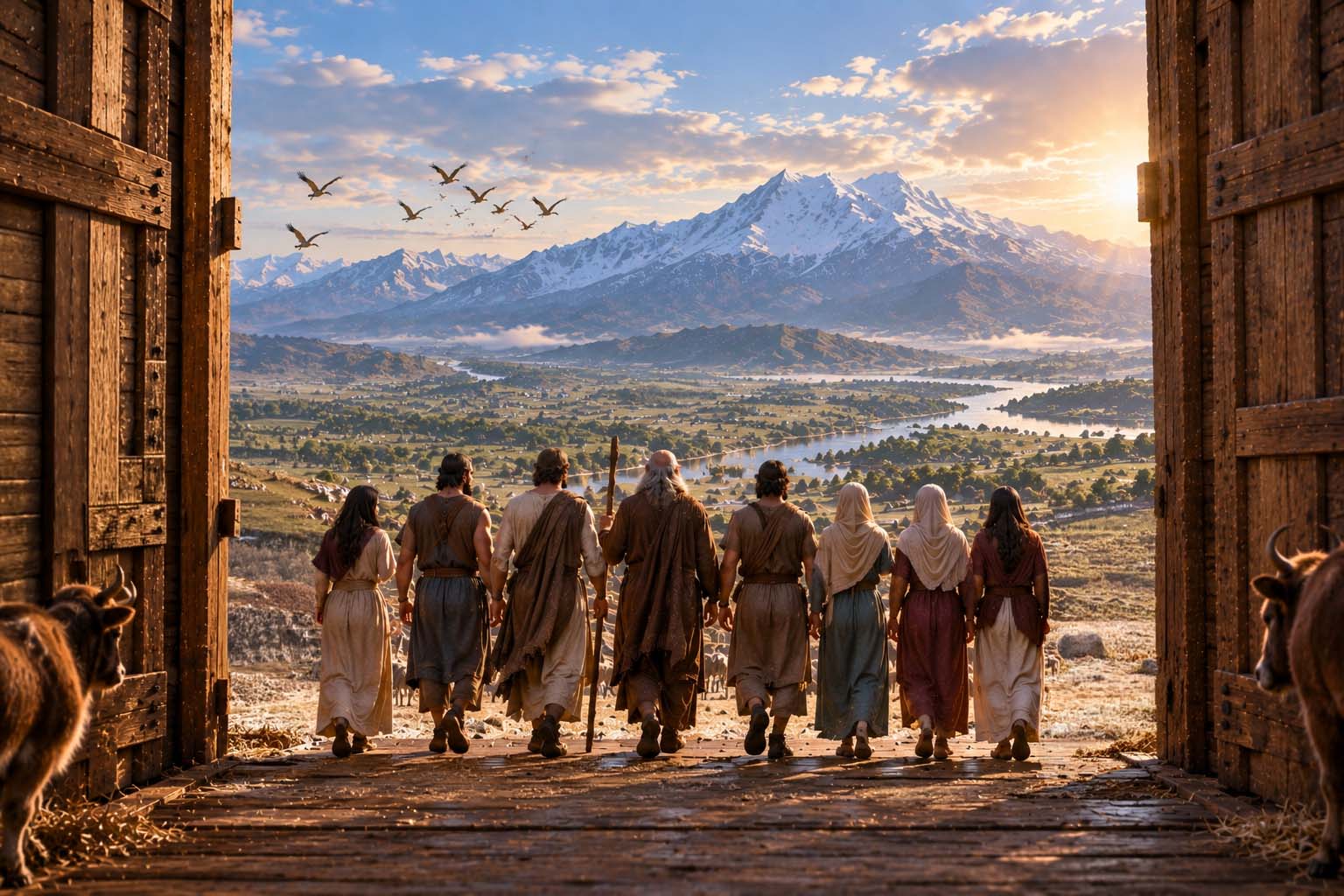
Humanity begins again. The post-Flood world moves from Ararat and covenant to expanding families, new territories, Babel, divided languages, and the dispersion of nations.
Historical PositionAfter the FloodPrimary TextGenesis 8–11StatusConcept Gallery
Before the nations, before Babel, before the migrations, there were eight survivors standing at the threshold of a world they did not know.
Before They Stepped Onto the Earth
Before imagining Noah and his family stepping from the Ark into a new world, we must first consider how long they had been inside it.
The Flood was not simply forty days and forty nights. Genesis records that the waters began in the six hundredth year of Noah's life, in the second month, on the seventeenth day. The earth was not declared dry until Noah's six hundred and first year, in the second month, on the twenty-seventh day. By the biblical calendar, Noah, his wife, their three sons, and their sons' wives had lived through more than a year aboard the Ark.
“In the six hundredth year of Noah's life, in the second month, the seventeenth day of the month, the same day were all the fountains of the great deep broken up, and the windows of heaven were opened.”
Genesis 7:11 · KJV
“And in the second month, on the seven and twentieth day of the month, was the earth dried.”
Genesis 8:14 · KJV
The forty days of rain were only the beginning. The waters prevailed. The Ark drifted. Months passed before the tops of the mountains appeared. Noah sent out the raven and then the dove. He waited seven days and sent the dove again. She returned with an olive leaf. He waited another seven days and sent her once more. Even then, Noah did not simply open the Ark and leave. He waited until God told him it was time.
“Go forth of the ark, thou, and thy wife, and thy sons, and thy sons' wives with thee.”
Genesis 8:16 · KJV
Those long months also carried an extraordinary practical burden. Before the Flood, God had instructed Noah to gather food for his family and for the creatures aboard the Ark.
“And take thou unto thee of all food that is eaten, and thou shalt gather it to thee; and it shall be for food for thee, and for them.”
Genesis 6:21 · KJV
Food had to be gathered beforehand and preserved for an extended period. Eight people had to eat. The animals had to be fed and cared for. Supplies could not simply be replaced. There was no market, neighboring settlement, or harvest outside from which to replenish their stores.
Museum Interpretation · Practical Inference
Scripture does not state that Noah imposed food rationing, nor does it describe the daily system used to manage provisions, water, animal care, or waste. Rationing should therefore not be presented as a recorded biblical fact. Nevertheless, Genesis 6:21 explicitly records that food was gathered in advance for both the people and the animals. Careful management of finite provisions during more than a year aboard the Ark is a reasonable practical inference from the circumstances described in Scripture.
Imagine the psychological weight of that existence. Day followed day inside the Ark. Rain gave way to water. Water gave way to waiting. There was nowhere else on Earth for them to go. Whatever homes, fields, workshops, roads, settlements, possessions, and familiar places had belonged to their former lives lay behind them.
Then, after more than a year, the command finally came. The door could be opened. The animals could be released. Eight people could walk out.
But what awaited them was not home.
It was a world without their former neighbors, without their former communities, without established fields waiting for harvest, and without another human family beyond their own.
Behind them was the Ark. Behind that was a world they could never return to. Before them was the earth, and they would have to begin again.
There are moments in the biblical record that can be read in only a few sentences, yet those sentences contain experiences almost beyond our ability to comprehend. The departure from the Ark is one of them.
I have often tried to imagine that moment, not to add details Scripture does not give us, but to remember the human beings inside the account.
Leaving the Ark. Eight people, Noah and his wife, Shem, Ham, and Japheth with their wives, step out from the Ark into the renewed world. Animals move out with them, birds take to the open sky, and the distant mountains of Ararat rise beyond the valley.
Eight people walked out. Noah and his wife. Shem, Ham, and Japheth. Three sons who had entered the Ark with their father, and three wives who had entered with their husbands. Eight human beings standing together beneath an open sky.
They were not simply survivors of a terrible storm. According to the biblical account, the world they had known was gone.
Every familiar road, settlement, field, and gathering place belonged to another age. The communities in which they had lived were gone. People they had known were gone. Whatever homes, possessions, and familiar landmarks had once defined ordinary life were no longer waiting for them. Even the land before them may have seemed strange after the violence of the Flood.
We naturally speak of their preservation, and rightly so. Yet survival does not erase memory. These eight people carried the first world's memories into a world whose future generations would know that world only through what they were told.
What did Noah's wife feel when she first stepped onto the ground? What did the wives of Shem, Ham, and Japheth think as they looked toward an unknown horizon? Did they remember parents, brothers, sisters, friends, childhood homes, and places they expected never to see again?
Scripture does not tell us. We should therefore resist pretending that we know their private thoughts. But the brevity of the biblical account should not make us forget that these were human beings. They had endured confinement, ongoing study, the terrifying movement of the waters, and a long period in which there was nowhere else on Earth for them to go.
Ancient Literature · Book of Jasher · Non-canonical
The Book of Jasher, used here only as non-canonical ancient literature, expands the Flood narrative by portraying Noah calling upon God from within the Ark and by emphasizing that Noah and his household did not leave until commanded. This material is not treated as equal to Scripture. It is included because it preserves an ancient reflection on waiting, dependence, and release after the Flood.
“Go forth of the ark, thou, and thy wife, and thy sons, and thy sons' wives with thee.”
Genesis 8:16 · KJV
Imagine the significance of that command. Behind them stood the vessel that had preserved their lives. Before them stood an entire world. No established human settlement waited to receive them. There were no neighboring towns to trade with, no distant relatives to visit, no human community beyond the eight people who had come through the judgment together.
They would have to build again. They would have to plant again. They would have to tend animals, make shelter, preserve food, raise children, teach skills, and pass knowledge into another generation. Children would soon be born who possessed no personal memory of the world their parents had lost.
And remarkably, the first recorded thing Noah builds is not a house. It is an altar.
“And Noah builded an altar unto the LORD; and took of every clean beast, and of every clean fowl, and offered burnt offerings on the altar.”
Genesis 8:20 · KJV
That detail has always struck me. After everything Noah had endured, and after everything that had disappeared behind him, his first recorded act upon the new earth was an act of worship.
Then the language of Genesis turns unmistakably toward the future. God speaks not merely of survival, but of continuation. The seasons will continue. The earth will yield again. Families will grow. Humanity will multiply.
“While the earth remaineth, seedtime and harvest, and cold and heat, and summer and winter, and day and night shall not cease.”
Genesis 8:22 · KJV
Think about what those words would mean to people who had just watched the old world disappear beneath the water. Seedtime. There would be another planting. Harvest. There would be another gathering. Summer and winter. There would be years ahead of them. Day and night. Life would continue.
“And God blessed Noah and his sons, and said unto them, Be fruitful, and multiply, and replenish the earth.”
Genesis 9:1 · KJV
“And you, be ye fruitful, and multiply; bring forth abundantly in the earth, and multiply therein.”
Genesis 9:7 · KJV
The responsibility placed before them was enormous. Eight people were not simply being told to endure. They were being told to become the beginning of renewed human society. Their sons and daughters would become families. Families would become clans. Clans would become peoples. Peoples would move outward into new lands.
God also gave Noah and his descendants a covenant. Genesis presents the rainbow not as a decorative ending to the Flood story, but as the visible token of a promise that such a judgment by universal flood would not again destroy all flesh.
“I do set my bow in the cloud, and it shall be for a token of a covenant between me and the earth.”
Genesis 9:13 · KJV
The Flood had been an ending, but the covenant declared that it was not the end of mankind. The earth before these survivors was not promised to be easy. Human sin had not disappeared. Hardship, conflict, death, and rebellion would remain part of the story. Yet the human story itself would continue.
That is where this gallery begins. Not with Babel. Not with Nimrod. Not with nations already spread across a map. It begins with eight people stepping from the Ark and looking outward.
From those eight would come children and grandchildren. Families would become clans. Clans would become peoples. Settlements would become cities. Kingdoms would rise. Languages would divide. Nations would spread into distant lands. Human beings would move along rivers and coasts, across plains and mountains, and eventually into lands far beyond the first post-Flood centers recorded in Genesis.
The empty horizon before Noah would not remain empty.
And so, as we enter The New World, I want us to remember that the genealogies, cities, languages, migrations, and nations we are about to examine began with something intensely personal: eight survivors.
They carried memories of a world no one born afterward would ever see. They carried the burden of loss, the knowledge preserved through the Flood, and the responsibility of beginning again. According to Genesis, they also stepped forward under the promise of God that seedtime and harvest would continue, mankind would multiply, and the earth before them would once again be filled with human life.
The old world was behind them. The new world was before them. And human history was beginning again.
The New World · Ten Movements
From eight survivors to a world of nations
Follow the New World account in sequence. Beginning with the Ark’s resting place, the story moves through survival, population, nations, cities, Babel, divided languages, and the great dispersion. Select a moment to open its synopsis.
Ararat is the geographical bridge between the Flood and the New World. Genesis records that the Ark came to rest “upon the mountains of Ararat” on the seventeenth day of the seventh month. The wording matters. Scripture names a mountainous region, not specifically the modern summit now called Mount Ararat.
At this point the Flood account has not yet reached dry ground. The Ark has stopped moving, but the waters are still receding and the tops of other mountains will not become visible until later. Ararat therefore becomes the first fixed geographical point in the post-Flood narrative, the place from which the surviving family will eventually emerge into a world that must be inhabited again.
Gallery IV examines the biblical wording, the wider Ararat region, proposed Ark locations, the Durupınar formation, modern research methods, and the limits of the physical evidence. This New World exhibit begins where that investigation leaves off: with Ararat as the starting point for renewed human history.
Genesis 8:4 · KJV · Biblical geography · Cross-reference to Gallery IV
Only eight people stepped into the post-Flood world. Genesis identifies Noah and his three sons by name: Shem, Ham, and Japheth. Their wives are present throughout the account, but Scripture does not give the names of the four women.
Canonical record
Noah and his wife
Shem and his wife
Ham and his wife
Japheth and his wife
Four men and four women stood at the beginning of renewed human history. The New Testament later summarizes this small company simply as “eight souls.”
“In the selfsame day entered Noah, and Shem, and Ham, and Japheth, the sons of Noah, and Noah's wife, and the three wives of his sons with them, into the ark;”
Genesis 7:13 · KJV
“...wherein few, that is, eight souls were saved by water.”
1 Peter 3:20 · KJV
They did not emerge into an established civilization. There were no neighboring towns waiting beyond the next hill, no cultivated fields prepared by someone else, no market, no distant human community, and no larger society from which help could come. Everything that followed would begin with this household.
Their first concerns would have been immediate and practical. Shelter had to be established. Food had to be grown. Animals had to be managed. Water had to be located and carried. Tools had to be repaired or remade. Clothing had to be maintained. Seed had to be planted. Families had to grow. These practical details are reasonable inferences from the circumstances, but Scripture does not give us a daily record of how the family organized this work.
Yet Genesis does not begin the New World with a city, a government, or a building project. It begins with worship.
“And Noah builded an altar unto the LORD; and took of every clean beast, and of every clean fowl, and offered burnt offerings on the altar.”
Genesis 8:20 · KJV
Before Scripture records a post-Flood city, kingdom, or tower, it records an altar. The first recorded act after leaving the Ark is an acknowledgment of the God who preserved them.
“While the earth remaineth, seedtime and harvest, and cold and heat, and summer and winter, and day and night shall not cease.”
Genesis 8:22 · KJV
For eight survivors facing a world that had to be inhabited again, those words carried a promise of continuity. Seedtime and harvest would continue. The ground could be planted. The seasons would come. Food could grow again. Human life would not remain suspended in the aftermath of judgment.
“And God blessed Noah and his sons, and said unto them, Be fruitful, and multiply, and replenish the earth.”
Genesis 9:1 · KJV
“And you, be ye fruitful, and multiply; bring forth abundantly in the earth, and multiply therein.”
Genesis 9:7 · KJV
Humanity was not merely preserved. Humanity was commissioned to begin again. From Noah and his wife, Shem and his wife, Ham and his wife, and Japheth and his wife would come children, grandchildren, clans, peoples, and nations.
Four of the eight survivors were women. Scripture leaves their names unrecorded, but their place in the beginning of the New World was indispensable. The biblical story of repopulation begins not with an anonymous mass of people, but with four married couples.
The Table of Nations in Genesis 10 does not begin with great empires. It begins with families. Every later city and kingdom in the biblical record stands downstream from this moment.
Eight people left the Ark. Eight people inherited an emptied human world. Eight people carried the memory of the First World. Eight people carried the responsibility for the next one.
From them, the nations would come.
Genesis 7:13; 8:20, 22; 9:1, 7 · 1 Peter 3:20 · KJV · Practical reconstruction clearly identified as inference
Genesis 10 turns eight survivors into a world of families, peoples, and nations. Often called the Table of Nations, the chapter traces the descendants of Noah's three sons, Japheth, Ham, and Shem, and repeatedly connects family lines with lands, languages, and nations.
“Now these are the generations of the sons of Noah, Shem, Ham, and Japheth: and unto them were sons born after the flood.”
Genesis 10:1 · KJV
The chapter is not simply a list of names. It describes the beginnings of population groups spreading into territories. Japheth's descendants are associated with expanding coastlands and peoples. Ham's line includes Cush, Mizraim, Phut, and Canaan. Shem's descendants continue the line that will eventually lead the biblical narrative toward Abraham.
“By these were the isles of the Gentiles divided in their lands; every one after his tongue, after their families, in their nations.”
Genesis 10:5 · KJV
Similar formulas appear for the descendants of Ham and Shem. The repeated words are important: families, tongues, lands, and nations. Genesis presents the post-Flood world as becoming organized through kinship and geography.
The ordering of Genesis 10 and 11 also raises an important literary point. Genesis 10 already speaks of different languages, while Genesis 11 returns to the event that explains how that linguistic division occurred. The Table of Nations therefore provides the broad result before the narrative takes the visitor back to Babel.
Museum evidence standard
The names and genealogical relationships in this exhibit come from the biblical text. Proposed identifications of individual Genesis 10 names with later archaeological cultures, modern ethnic groups, or specific nations are interpretations and vary in certainty. They should not be presented as though Genesis itself supplies those later identifications.
The significance of the Table of Nations is enormous. The New World is no longer represented by a single household. Family branches are multiplying, territories are being occupied, and the framework of the nations is appearing.
Eight survivors became families. Families became clans. Clans became peoples. Peoples occupied lands.
The world of nations was beginning to take shape.
Genesis 10 · KJV · Genealogy · Biblical geography · Later geographical identifications treated as interpretation
The biblical narrative moves with remarkable speed from families to organized cities. Genesis 10 names Babel, Erech, Accad, and Calneh in the land of Shinar, then continues with additional cities associated with the early post-Flood world.
“And the beginning of his kingdom was Babel, and Erech, and Accad, and Calneh, in the land of Shinar.”
Genesis 10:10 · KJV
Shinar is generally associated with southern Mesopotamia, the broad alluvial plain between and around the Tigris and Euphrates river systems. Archaeology independently confirms that this region became one of the great early centers of urban civilization, with irrigation, monumental construction, administration, trade, and densely settled cities.
That archaeological record does not by itself prove the biblical chronology or identify every city named in Genesis. It does, however, give the visitor a real geographical setting in which early urban life developed on a remarkable scale.
Erech is commonly associated with ancient Uruk. Accad, or Akkad, became famous as the name of a later Mesopotamian imperial center, although the precise archaeological location of the city of Akkad remains under study. Babel is associated in the biblical tradition with Babylon. Calneh is more difficult to identify with confidence.
Archaeology and Scripture
The museum distinguishes between a biblical identification, a widely accepted historical or geographical association, and an archaeological site that can be physically excavated. Similar names do not automatically establish that every proposed identification is certain.
The return of city life would have required much more than walls and houses. Agriculture had to support populations larger than individual households. Water had to be controlled. Labor had to be organized. Materials had to be transported. Crafts became specialized. Authority emerged. Record keeping and trade became increasingly important.
In the biblical sequence, civilization is becoming concentrated again. But one figure now rises above the growing cities and kingdoms.
Families had multiplied.
Settlements had grown.
Cities were appearing.
Power was becoming organized. And Genesis introduces Nimrod.
Nimrod is the first individual after the Flood whom Genesis directly associates with the beginning of a kingdom. He is a descendant of Ham through Cush, and the biblical description of him is brief but unusually emphatic.
“And Cush begat Nimrod: he began to be a mighty one in the earth.”
Genesis 10:8 · KJV
“He was a mighty hunter before the LORD: wherefore it is said, Even as Nimrod the mighty hunter before the LORD.”
Genesis 10:9 · KJV
Genesis then connects the beginning of his kingdom with Babel, Erech, Accad, and Calneh in Shinar. This makes Nimrod important not merely as an individual, but as part of the biblical transition from extended families to centralized political power.
The expression “mighty hunter before the LORD” has generated centuries of interpretation. Some readers understand it primarily as a description of extraordinary prowess. Others have interpreted Nimrod as a violent ruler or rebel. The canonical passage itself does not provide a detailed biography, and the museum should not make later interpretations say more than the text says.
Scripture and later tradition
Later Jewish, Christian, Islamic, and other traditions greatly expand Nimrod's story and often connect him personally with the Tower of Babel or portray him as a tyrant in rebellion against God. Genesis 10 associates his kingdom with Babel, but Genesis 11 does not name Nimrod as the builder or ruler of the Tower. That distinction is important.
What can be stated directly is striking enough. Within the generations following the Flood, Genesis describes a man becoming mighty, cities forming the beginning of a kingdom, and human authority becoming concentrated in Shinar.
That concentration of people and power prepares the setting for the next event. Humanity gathers on a plain. A city is planned. A tower is begun. And the stated goal includes a determination not to be scattered across the earth.
A family world was becoming a political world.
Cities were becoming a kingdom.
Human power was concentrating in Shinar. And Babel was at its center.
Genesis 10:8–12 · KJV · Later Nimrod traditions clearly distinguished from the canonical account
Babel begins with unity. Genesis describes humanity sharing one language and moving together until they find a plain in the land of Shinar.
“And the whole earth was of one language, and of one speech.”
Genesis 11:1 · KJV
“And it came to pass, as they journeyed from the east, that they found a plain in the land of Shinar; and they dwelt there.”
Genesis 11:2 · KJV
The account then preserves an important construction detail. The builders make brick and burn it thoroughly, using bitumen for mortar. These are technologies well suited to the Mesopotamian plain, where monumental architecture was often built largely from mud brick and fired brick rather than abundant building stone.
“And they said, Go to, let us build us a city and a tower, whose top may reach unto heaven; and let us make us a name, lest we be scattered abroad upon the face of the whole earth.”
Genesis 11:4 · KJV
The project has two components: a city and a tower. The text also gives a motive. The builders want to make a name for themselves and resist being scattered. That motive stands in tension with the post-Flood command to multiply and replenish the earth.
Ancient Mesopotamia later became famous for massive stepped temple towers called ziggurats. These structures provide useful architectural context for what monumental brick construction in the region could look like. However, no surviving ziggurat can simply be labeled the Tower of Babel on archaeological evidence alone.
What the museum can and cannot say
Scripture identifies Babel, Shinar, brick, bitumen, a city, and a tower. Archaeology documents monumental brick architecture in ancient Mesopotamia. Connecting a particular surviving ruin directly to the Genesis tower requires evidence beyond visual similarity or later tradition.
The central issue in Genesis is ultimately not the engineering achievement. It is what unified humanity intends to accomplish through it. The same common language that allows the project to advance will become the point at which God intervenes.
One people.
One language.
One plain.
One city.
One tower. Then communication itself was changed.
Genesis 11:1–5 · KJV · Shinar · Brick and bitumen · Mesopotamian monumental architecture used as archaeological context
The builders of Babel are united by something more fundamental than architecture: they can understand one another. Genesis presents a common language as the social bond that allows the city and tower project to proceed collectively.
“And the LORD said, Behold, the people is one, and they have all one language; and this they begin to do...”
Genesis 11:6 · KJV
The intervention described next does not destroy the people. It disrupts their ability to communicate.
“Go to, let us go down, and there confound their language, that they may not understand one another's speech.”
Genesis 11:7 · KJV
Imagine the immediate human effect. Instructions no longer produce the expected response. Work crews cannot coordinate. Families or groups that still understand one another would naturally gather together. A project dependent upon common communication becomes increasingly difficult to continue.
Genesis does not tell us exactly how many languages appeared at Babel, how the linguistic change sounded, or how rapidly every resulting language developed afterward. Attempts to assign a specific number of Babel languages come from later interpretive traditions, not from Genesis 11 itself.
Biblical account and linguistic research
Historical linguistics studies relationships among languages by comparing vocabulary, grammar, sound changes, and reconstructed language families. Those methods can investigate relationships within recoverable linguistic history, but they do not provide a direct archaeological recording of the event described in Genesis 11. The museum therefore presents the biblical account as Scripture and linguistic reconstruction as a separate field of evidence.
The result in the biblical narrative is immediate and geographical. The common project stops, and the people begin to separate.
“So the LORD scattered them abroad from thence upon the face of all the earth: and they left off to build the city.”
Genesis 11:8 · KJV
The tower did not need to fall for the project to fail.
The builders only needed to stop understanding one another. One people became many language communities.
And those communities began to move.
Genesis 11:5–8 · KJV · Linguistic questions distinguished from the canonical narrative
The stated fear of Babel was scattering. The stated result of Babel was scattering. What the builders sought to prevent becomes the defining movement of the next stage of the New World.
“Therefore is the name of it called Babel; because the LORD did there confound the language of all the earth: and from thence did the LORD scatter them abroad upon the face of all the earth.”
Genesis 11:9 · KJV
This dispersion provides the narrative bridge between the family lines of Genesis 10 and the increasingly separated peoples of the ancient world. Groups sharing speech, kinship, memory, skills, animals, seeds, tools, and traditions could move into different territories and establish new settlements.
Not every migration would have followed the same route or moved at the same speed. River valleys, coastlines, mountain passes, open plains, and navigable waterways all provide natural corridors of movement. Some groups could travel primarily overland. Others could move along rivers or coasts by watercraft. Later generations could continue farther than the first migrants.
Interpretive reconstruction
Genesis states that humanity was scattered. It does not provide a route map showing which named family traveled along every particular river, coast, mountain corridor, or sea lane. Reconstructing those movements requires comparison with geography, archaeology, later historical records, and traditions. Degrees of certainty must therefore be shown rather than assumed.
This distinction matters for the museum's larger migration investigation. A culture appearing far from Shinar does not require every stage of the journey to have occurred in a single generation. Population movement can occur through successive settlements, branching family groups, exploratory travel, trade, and maritime movement over many generations.
As communities separated, memories could also travel with them. Stories could be preserved, translated, reshaped, ritualized, or attached to new landscapes. That possibility becomes especially important when we encounter traditions in distant cultures that contain themes resembling Babel.
The gathering at Shinar ended.
Languages divided.
Families separated.
Routes opened into new lands. The great dispersion had begun.
Genesis 10–11 · KJV · Migration routes and mechanisms presented as geographical and historical reconstruction
If communities carried memories away from Shinar, could traces of those memories survive in later traditions? Around the world, researchers and collectors of traditional narratives have recorded stories involving divided speech, failed towers or great building projects, human dispersal, or the separation of peoples.
These parallels are intriguing, but they must be handled carefully. Not every story involving a tower is a Babel tradition, and not every account of multiple languages preserves an independent memory of Genesis 11. Similar stories can arise through cultural contact, missionary influence, translation, shared literary sources, or independent storytelling.
Comparative tradition, not automatic proof
This exhibit treats worldwide Babel-like traditions as comparative evidence. Each tradition should be evaluated by its earliest known documentation, cultural setting, date of collection, possibility of outside influence, and the specific elements it actually shares with Genesis. Similarity alone is not enough.
The strongest comparisons are not merely stories about a tall structure. More significant parallels would combine several elements: an early human population, common speech or close unity, a major construction or gathering, divine intervention, confusion of language, and subsequent dispersal.
The museum should therefore resist creating a long list simply because individual stories sound vaguely familiar. Each candidate tradition can be rated according to documentation and independence, much as we do with other circumstantial evidence in the museum.
“...because the LORD did there confound the language of all the earth: and from thence did the LORD scatter them abroad upon the face of all the earth.”
Genesis 11:9 · KJV
Viewed cautiously, the worldwide comparison raises a fascinating historical question. If Genesis describes a real dispersion of language communities, what kinds of memories might those communities have carried with them, and how much could those memories change as generations passed?
That question belongs at the intersection of Scripture, oral tradition, anthropology, linguistics, and migration history. It is worthy of investigation precisely because the museum does not need to declare every resemblance a match.
A tradition may preserve memory.
A tradition may also change.
Similarity invites investigation.
Documentation determines its weight. The question is not whether stories resemble Babel, but why.
Genesis 11:9 · KJV · Comparative tradition · Oral history · Similarities treated as evidence to evaluate, not automatic identification
After Babel, Genesis narrows its focus. The story has moved from one family aboard the Ark to nations spreading across the earth. Now the biblical record follows one particular line through Shem toward a man whose life will become central to everything that follows.
“These are the generations of Shem...”
Genesis 11:10 · KJV
The genealogy proceeds through Arphaxad, Salah, Eber, Peleg, Reu, Serug, Nahor, and Terah. The broad panorama of nations becomes a family line again.
Peleg is especially noteworthy because Genesis 10 says, “in his days was the earth divided.” The precise meaning of that statement has been under continued study. In the immediate context of Genesis 10 and 11, many readers connect it with the division of peoples associated with Babel. Other interpretations have been proposed. The text itself should remain the starting point.
“And Terah lived seventy years, and begat Abram, Nahor, and Haran.”
Genesis 11:26 · KJV
Abram first appears within a family rooted in the Mesopotamian world. Genesis identifies Ur of the Chaldees in connection with Terah's household and then describes the family's movement toward Canaan, stopping at Haran.
“And Terah took Abram his son, and Lot the son of Haran his son's son, and Sarai his daughter in law, his son Abram's wife; and they went forth with them from Ur of the Chaldees, to go into the land of Canaan...”
Genesis 11:31 · KJV
Then Genesis 12 changes the direction of the narrative. The emphasis is no longer simply on where nations came from. God calls one man and promises that through him a nation will arise and that blessing will ultimately extend beyond that nation.
“And I will make of thee a great nation, and I will bless thee, and make thy name great; and thou shalt be a blessing:”
Genesis 12:2 · KJV
“And in thee shall all families of the earth be blessed.”
Genesis 12:3 · KJV
That phrase provides a powerful conclusion to Gallery V. The New World began with eight people. Their descendants became families and nations. Babel scattered those peoples. Then, from among those nations, the biblical narrative follows the line of Shem to Abraham.
The story is becoming narrower geographically and genealogically, but its stated purpose remains worldwide: “all families of the earth.”
From Noah came the surviving family.
From the family came nations.
From the nations came dispersion.
From Shem's line came Abraham. And with Abraham, the next great movement of the biblical story begins.
Genesis 10:25; 11:10–32; 12:1–3 · KJV · Genealogy · Mesopotamian setting · Transition to Abraham