Archoseum

Museum Exhibition

Preparing the exhibition

0%
← Museum Home ← Miracles Gallery

Extraordinary Biblical Miracles · Section 04

Prophets, Kings & Exile

Fire, resurrection, heavenly armies, judgment, deliverance and exile

From Elijah on Carmel to Daniel in Babylon, this room follows a dramatic chain of signs, judgments, healings, resurrections, angelic deliverances, prophetic warnings, and historically anchored events spanning the divided monarchy, Assyrian crisis, Babylonian exile, and Persian rule.

Research Room Orientation

From Carmel to Babylon

This room follows the biblical miracle record from the northern kingdom through Judah’s Assyrian crisis and into the Babylonian and Persian worlds. Scripture remains the controlling account. Archaeology, royal inscriptions, ancient historians and later witnesses are used where they genuinely illuminate the people, places, chronology and political setting.

Canonical RecordKings, Chronicles, Isaiah, Jonah and Daniel in the KJV form the primary record.
ArchaeologySites, inscriptions, reliefs and material culture establish historical context where available.
Cross-ReferenceParallel passages are brought together rather than isolating one verse.
Ancient WitnessJosephus and other later writings are identified as later testimony, not equal to Scripture.
CherithZarephathCarmelJezreelJerichoShunemDothanJerusalemNinevehBabylonPersian Court
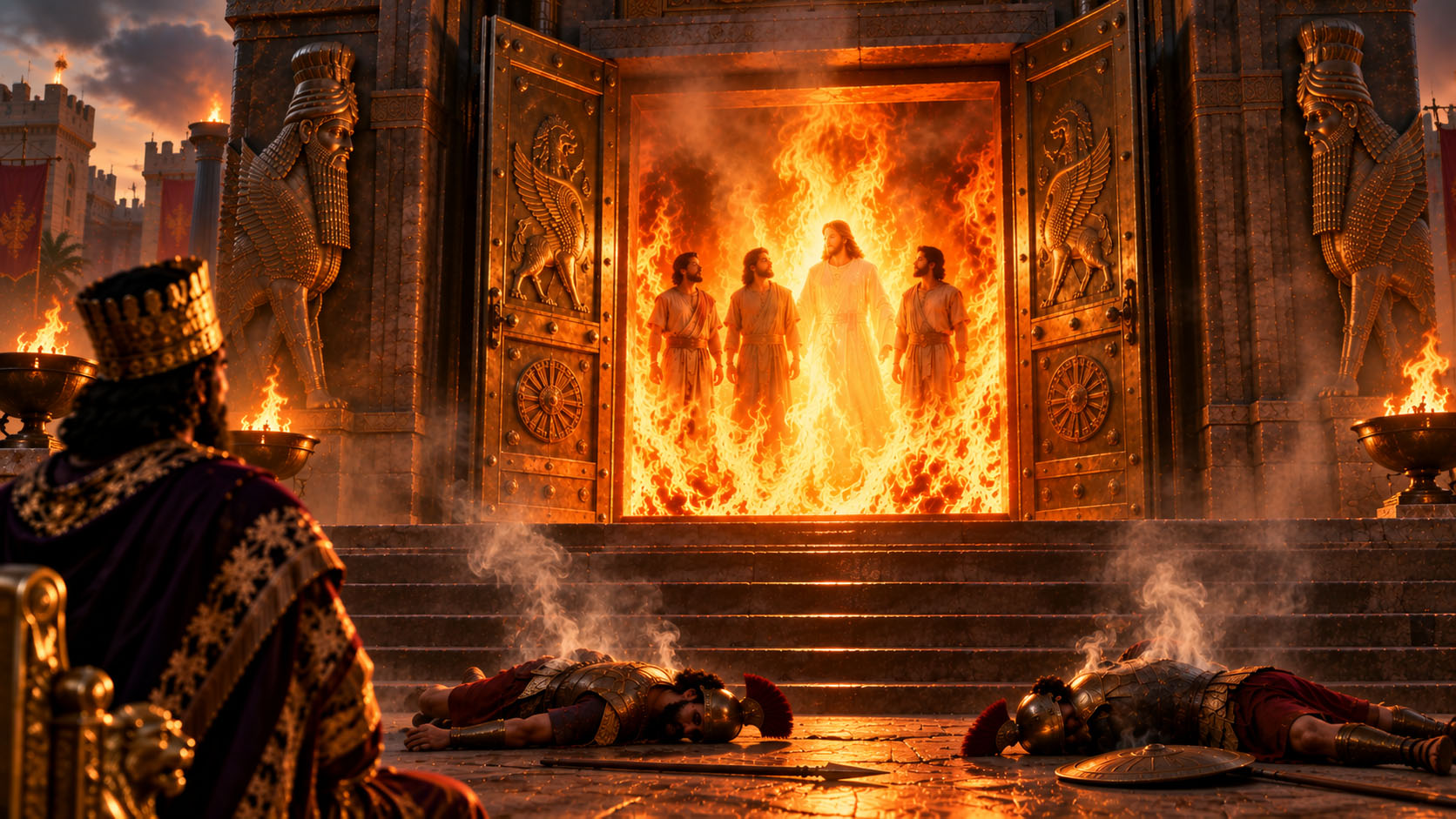
Shadrach, Meshach and Abednego standing unharmed in the fiery furnace with a fourth radiant figure while two soldiers lie overcome by the heat outside.
Shadrach, Meshach and Abednego in the Fiery Furnace. Nebuchadnezzar ordered the three Hebrews cast into a furnace heated seven times hotter after they refused to worship the golden image. The soldiers who carried them to the furnace were overcome by the intense heat, while the king saw four men walking unharmed in the flames, the fourth described in the KJV as being “like the Son of God.”

The Biblical Record

Prophets, Kings & Exile

Open each record for the full story, multiple KJV passages, historical setting, symbols, tables, archaeology, secular parallels where available, and cross-references that place the event within the larger biblical record.

Elijah enters the narrative by declaring that neither dew nor rain will fall except according to the word of the LORD. He is then directed eastward to the brook Cherith, where water remains available for a time during the growing drought.

Morning and evening, ravens bring him bread and flesh. The story combines prophetic judgment with personal provision: while the land begins to experience scarcity, the prophet who delivered the warning is sustained in an unlikely and unmistakably timed way.

“And the ravens brought him bread and flesh in the morning, and bread and flesh in the evening.”
1 Kings 17:6 · KJV
“There shall not be dew nor rain these years, but according to my word.”
1 Kings 17:1 · KJV
DetailBiblical RecordResearch Note
DroughtNo dew or rain except by prophetic word.Sets the larger crisis surrounding Ahab’s reign.
Brook CherithElijah drinks from the brook.A temporary refuge east of Jordan.
RavensBring food twice daily.The provision comes through creatures normally associated with scavenging.
✦Provision: food arrives morning and evening.
☁Judgment: the drought frames Elijah’s confrontation with Baal worship.
Historical ContextAhab and Jezebel’s reign is independently situated in the Iron Age kingdom of Israel. Assyrian records from the ninth century BC later mention Ahab of Israel in the context of regional warfare, anchoring the dynasty in a wider Near Eastern setting.
1 Kings 17:1-7 · Ahab · Cherith · Drought · Ravens

When the brook dries, Elijah is sent outside Israel to Zarephath in Sidonian territory. He meets a widow preparing what she expects to be the final meal for herself and her son. Elijah asks her first to make him a small cake, then promises that the barrel of meal and cruse of oil will not fail until rain returns.

The miracle is sustained provision rather than a single dramatic moment. Day after day the household eats during famine. Jesus later cites this episode in Nazareth, emphasizing that Elijah was sent to a widow in Sidon rather than to the many widows in Israel.

“The barrel of meal wasted not, neither did the cruse of oil fail.”
1 Kings 17:16 · KJV
“Unto none of them was Elias sent, save unto Sarepta, a city of Sidon, unto a woman that was a widow.”
Luke 4:26 · KJV
DetailBiblical RecordResearch Note
LocationZarephath, between Tyre and Sidon.Places the event in Phoenician territory.
SupplyMeal and oil.Staple ingredients in a subsistence household.
DurationUntil the LORD sent rain.A continuing provision through the drought.
◉Faith: the widow acts on Elijah’s word before seeing the provision.
✦Continuance: the miracle is repeated in ordinary daily use.
Geographic SettingZarephath is known from ancient Phoenician geography and archaeology as a settlement on the coast of modern Lebanon. The biblical story therefore occurs in a real Sidonian landscape beyond Israel’s border.
1 Kings 17:8-16 · Zarephath · Sidon · Famine · Meal · Oil

The same household that experienced miraculous provision is struck by death when the widow’s son becomes ill and stops breathing. Elijah carries the child to the upper room where he lodges, lays him upon his own bed, and cries to the LORD.

The text states plainly that the child’s soul came into him again and he revived. Elijah carries him downstairs and presents him alive to his mother. Her response is not merely joy but recognition that Elijah is a man of God and that the word of the LORD in his mouth is truth.

“And the LORD heard the voice of Elijah; and the soul of the child came into him again, and he revived.”
1 Kings 17:22 · KJV
“See, thy son liveth.”
1 Kings 17:23 · KJV
DetailBiblical RecordResearch Note
CrisisThe child becomes sick and dies.The story moves from provision to resurrection.
PrayerElijah cries unto the LORD.The miracle is explicitly attributed to God.
OutcomeThe child revives.The mother receives him alive.
♥Life restored: death is reversed in the narrative.
✦Witness: the mother’s confession confirms Elijah’s prophetic authority.
Cross-ReferenceElisha later raises the Shunammite woman’s son in 2 Kings 4. In the New Testament, Jesus raises children and adults from death, creating a strong biblical pattern of life restored by divine authority.
1 Kings 17:17-24 · Resurrection · Widow · Elijah

Elijah confronts Ahab and calls Israel to Mount Carmel together with the prophets of Baal and the prophets of the grove supported by Jezebel. The contest is deliberately public. Two sacrifices are prepared, no fire is supplied, and the God who answers by fire will be acknowledged as God.

Baal’s prophets cry out for hours without an answer. Elijah repairs the altar of the LORD with twelve stones, digs a trench, arranges the sacrifice, and has water poured over it repeatedly until the trench is filled. At Elijah’s brief prayer, fire falls and consumes the sacrifice, wood, stones, dust, and water. The people fall on their faces and confess, “The LORD, he is the God.”

“The God that answereth by fire, let him be God.”
1 Kings 18:24 · KJV
“Then the fire of the LORD fell, and consumed the burnt sacrifice, and the wood, and the stones, and the dust.”
1 Kings 18:38 · KJV
“The LORD, he is the God; the LORD, he is the God.”
1 Kings 18:39 · KJV
DetailBiblical RecordResearch Note
Twelve stonesElijah rebuilds the altar with twelve stones.Symbolically recalls all Israel.
WaterFour barrels poured three times.The offering and trench are saturated.
FireConsumes sacrifice, wood, stones, dust and water.The answer is immediate and overwhelming.
🔥Fire: the decisive public sign.
12Twelve stones: a national symbol of Israel.
💧Water: the drenched altar heightens the event.
👁Public witness: king, prophets and people are gathered.
Archaeological & Geographic ContextMount Carmel is a prominent limestone ridge overlooking the Jezreel Valley and Mediterranean coast. Its position between Israelite and Phoenician spheres makes the setting especially significant in a narrative confronting Baal worship associated with Jezebel’s Sidonian background.
Ancient WitnessJosephus retells Elijah’s conflict with Ahab and the Carmel episode in Antiquities of the Jews. He is a much later Jewish historian, so his account is a literary witness to the tradition, not a contemporary inscription of the event.
1 Kings 18:17-40 · Mount Carmel · Ahab · Jezebel · Baal · Fire

Immediately after Carmel, Elijah tells Ahab that there is a sound of abundance of rain. Yet the sky has not visibly changed. Elijah climbs to the top of Carmel, bows himself toward the ground, and repeatedly sends his servant to look toward the sea.

On the seventh look the servant sees a cloud as small as a man’s hand rising from the sea. Within a short time the sky darkens with clouds and wind, and a great rain falls. The hand of the LORD then comes upon Elijah, who runs before Ahab’s chariot to Jezreel.

“There ariseth a little cloud out of the sea, like a man’s hand.”
1 Kings 18:44 · KJV
“And there was a great rain.”
1 Kings 18:45 · KJV
DetailBiblical RecordResearch Note
Seven looksThe servant checks repeatedly.The sign begins small.
Sea cloudCloud rises from the Mediterranean direction.Fits Carmel’s western view toward the sea.
Great rainClouds and wind develop rapidly.The drought ends dramatically.
7Completion: the seventh observation reveals the cloud.
☁Cloud: small beginning, large outcome.
Geographic NoteMount Carmel’s proximity to the Mediterranean makes the observation of a sea-born rain cloud entirely natural to the setting. The extraordinary feature in the narrative is prophetic timing after the announced drought.
1 Kings 18:41-46 · Rain · Carmel · Jezreel

Elijah and Elisha travel from Gilgal to Bethel, Jericho, and finally the Jordan. Fifty sons of the prophets watch from a distance as Elijah strikes the river with his mantle and the waters divide, allowing both men to cross on dry ground.

After Elisha asks for a double portion of Elijah’s spirit, a chariot of fire and horses of fire appear between them. Elijah goes up by a whirlwind into heaven. Elisha tears his clothes, takes Elijah’s fallen mantle, returns to the Jordan, strikes the water, and the river divides again, publicly marking the transfer of prophetic ministry.

“There appeared a chariot of fire, and horses of fire... and Elijah went up by a whirlwind into heaven.”
2 Kings 2:11 · KJV
“Where is the LORD God of Elijah?”
2 Kings 2:14 · KJV
DetailBiblical RecordResearch Note
RouteGilgal, Bethel, Jericho, Jordan.The journey passes major prophetic centers.
JordanDivided before and after Elijah’s departure.Frames the transition of authority.
MantleFalls from Elijah and is taken by Elisha.Visible symbol of prophetic succession.
🔥Chariot of fire: heavenly imagery surrounding the departure.
🧥Mantle: the sign of prophetic succession.
Ancient WitnessJosephus also recounts Elijah’s disappearance and Elisha’s succession. His version again reflects the enduring Jewish memory of the event centuries later.
2 Kings 2:1-14 · Elijah · Elisha · Jordan · Chariot of fire · Whirlwind

Soon after Elijah’s departure, the men of Jericho tell Elisha that their city’s location is pleasant but the water is bad and the land suffers. Elisha asks for a new cruse with salt and goes to the spring itself.

He casts the salt into the spring and declares that the LORD has healed the waters. The text adds that the waters remained healed according to Elisha’s word. The miracle therefore concerns a continuing change in the city’s water supply, not merely a ceremonial act.

“Thus saith the LORD, I have healed these waters.”
2 Kings 2:21 · KJV
“So the waters were healed unto this day.”
2 Kings 2:22 · KJV
DetailBiblical RecordResearch Note
ProblemWater described as naught.The city’s water supply was harmful.
ActionSalt cast into the spring.The act accompanies the prophetic declaration.
ResultWaters healed.The effect is described as enduring.
💧Water: life of the city.
🧂Salt: a visible sign accompanying the prophetic word.
Archaeological SettingJericho’s ancient settlement at Tell es-Sultan is built around a powerful perennial spring, traditionally identified with Ein es-Sultan. The importance of a dependable spring to the city’s survival gives the narrative a concrete physical setting.
2 Kings 2:19-22 · Jericho · Spring · Salt · Healing

A widow of one of the sons of the prophets tells Elisha that a creditor is coming to take her two sons as bondservants. Her only remaining asset is a pot of oil. Elisha tells her to borrow empty vessels from all her neighbors, “borrow not a few,” then shut the door with her sons and pour.

The oil continues as long as empty vessels remain. Only when the final vessel is full does the oil stop. Elisha instructs her to sell the oil, pay the debt, and live with her children on what remains. The miracle directly addresses debt, family survival, and economic restoration.

“And it came to pass, when the vessels were full... And the oil stayed.”
2 Kings 4:6 · KJV
“Go, sell the oil, and pay thy debt, and live thou and thy children of the rest.”
2 Kings 4:7 · KJV
DetailBiblical RecordResearch Note
NeedDebt threatened the family.The sons faced servitude.
ResourceOne pot of oil.The miracle begins with what the widow already has.
ResultEnough oil to pay debt and live.Provision becomes economic rescue.
🏺Vessels: capacity is created before the oil is multiplied.
✦Provision: the outcome preserves the household.
Social ContextDebt servitude is known throughout the ancient Near East and is addressed in biblical law. The story’s economic stakes would have been immediately understandable to an Iron Age audience.
2 Kings 4:1-7 · Widow · Oil · Debt · Sons

A woman of Shunem regularly provides hospitality for Elisha and prepares a small chamber for him. Though she has no son and her husband is old, Elisha announces that she will embrace a son the following year. The promised child is born, grows, and later collapses after crying out about his head.

The mother travels urgently to Elisha at Carmel. Elisha returns to the house, prays, and stretches himself upon the child. Warmth returns, the child sneezes seven times, opens his eyes, and is restored to his mother. The account joins miraculous birth promise and resurrection within the same family.

“About this season, according to the time of life, thou shalt embrace a son.”
2 Kings 4:16 · KJV
“And the child sneezed seven times, and the child opened his eyes.”
2 Kings 4:35 · KJV
DetailBiblical RecordResearch Note
ShunemHome of the woman and child.Located in the Jezreel Valley region.
CarmelThe mother seeks Elisha there.Connects the story with Elijah’s earlier prophetic center.
Upper chamberElisha prays beside the child.A private resurrection scene.
7Seven sneezes: a vivid physical sign of restored life.
♥Mother and child: the miracle restores a promised family line.
Geographic ContextShunem is commonly identified with the area of modern Sulam on the south side of the Jezreel Valley, near the hill of Moreh. The Carmel-to-Shunem journey described in the narrative fits a recognizable northern Israelite landscape.
2 Kings 4:8-37 · Shunem · Carmel · Resurrection

A man from Baal-shalisha brings Elisha twenty loaves of barley and fresh grain. Elisha orders that the food be given to the people. His servant immediately questions how twenty loaves can be set before one hundred men.

Elisha repeats the command and adds the word of the LORD: “They shall eat, and shall leave thereof.” The food is distributed, the hundred men eat, and some remains. The pattern strongly anticipates later biblical feeding miracles in which scarcity becomes abundance and leftovers confirm sufficiency.

“Give the people, that they may eat: for thus saith the LORD, They shall eat, and shall leave thereof.”
2 Kings 4:43 · KJV
“So he set it before them, and they did eat, and left thereof.”
2 Kings 4:44 · KJV
DetailBiblical RecordResearch Note
FoodTwenty barley loaves plus grain.A modest supply.
PeopleOne hundred men.Five men per loaf before considering leftovers.
OutcomeThey eat and leave some.The result exceeds the apparent supply.
🍞Bread: ordinary provision multiplied.
➕Surplus: leftovers confirm abundance.
Cross-ReferenceThe feeding narratives of Jesus in the Gospels echo the same biblical theme of provision beyond visible resources, including barley loaves in John 6.
2 Kings 4:42-44 · Barley · One hundred men · Provision

Naaman is introduced as captain of the Syrian army, a great and honorable man, yet afflicted with leprosy. Through an Israelite captive girl he learns of the prophet in Samaria. After diplomatic confusion at the royal court, Naaman reaches Elisha’s house expecting an impressive ritual.

Instead, Elisha sends a messenger instructing him to wash seven times in the Jordan. Naaman is initially angry, comparing Israel’s river unfavorably with the rivers of Damascus. His servants persuade him to obey. After the seventh immersion his flesh returns “like unto the flesh of a little child,” and he confesses that there is no God in all the earth but in Israel.

“Go and wash in Jordan seven times, and thy flesh shall come again to thee, and thou shalt be clean.”
2 Kings 5:10 · KJV
“His flesh came again like unto the flesh of a little child, and he was clean.”
2 Kings 5:14 · KJV
DetailBiblical RecordResearch Note
StatusCaptain of the Syrian host.A high-ranking foreign military figure.
CommandWash seven times in Jordan.Simple obedience replaces expected ceremony.
OutcomeFlesh restored.The healing leads to confession of Israel’s God.
7Seven washings: the completed act of obedience.
💧Jordan: the despised river becomes the setting of healing.
Historical ContextAram-Damascus was a major regional power during the divided monarchy. Assyrian inscriptions from the ninth century BC frequently name Damascus and Israel in the same geopolitical world, independently confirming the broader political setting of the Elisha narratives.
2 Kings 5 · Naaman · Syria · Damascus · Jordan · Healing

The sons of the prophets need larger quarters and go to the Jordan to cut timber. While one man is felling a beam, the iron axe head flies from the handle and falls into the water. He cries out because the tool was borrowed.

Elisha asks where it fell, cuts a stick, casts it into the water at that location, and the iron floats. The man reaches out and retrieves it. The event is small compared with national judgments and battles, but its inclusion shows the prophetic ministry extending to an individual’s practical loss and debt obligation.

“Alas, master! for it was borrowed.”
2 Kings 6:5 · KJV
“And the iron did swim.”
2 Kings 6:6 · KJV
DetailBiblical RecordResearch Note
ObjectIron axe head.A valuable tool in the Iron Age.
ProblemBorrowed property lost in the river.Creates a personal financial obligation.
ResultIron floats and is recovered.The impossible physical reversal resolves the debt.
⚒Iron: heavy material made to float.
✦Providence: the miracle addresses an ordinary person’s need.
Material CultureIron tools became increasingly common in the Iron Age Levant, though metal remained valuable enough that a borrowed axe head represented a serious loss. Archaeology supplies the material context even though it cannot identify this individual tool.
2 Kings 6:1-7 · Jordan · Iron · Axe head

The king of Syria repeatedly finds his plans exposed because Elisha warns the king of Israel where Syrian forces will be. Learning that Elisha is at Dothan, the Syrian king sends horses, chariots, and a great host by night to surround the city.

Elisha’s servant wakes to the encirclement and panics. Elisha answers, “They that be with us are more than they that be with them,” then prays that the young man’s eyes be opened. He sees the mountain full of horses and chariots of fire around Elisha. The Syrian army is then struck with blindness or bewilderment, led into Samaria, fed, and released.

“Behold, the mountain was full of horses and chariots of fire round about Elisha.”
2 Kings 6:17 · KJV
“They that be with us are more than they that be with them.”
2 Kings 6:16 · KJV
DetailBiblical RecordResearch Note
DothanElisha is surrounded there.A real hill-country site north of Samaria.
Syrian forceHorses, chariots, great host.Visible military threat.
Heavenly forceHorses and chariots of fire.Revealed only after Elisha’s prayer.
👁Opened eyes: the servant is enabled to see the unseen army.
🔥Chariots of fire: heavenly protection surrounds the prophet.
Archaeological ContextTell Dothan has long been identified with biblical Dothan and preserves occupation from periods relevant to the kingdoms of Israel. The site sits along an important north-south route, fitting its appearance in narratives involving military movement.
2 Kings 6:8-23 · Dothan · Syria · Chariots of fire · Samaria

After Elisha dies and is buried, Moabite raiding bands enter the land. During one burial, mourners see a band approaching and hastily cast the dead man into Elisha’s sepulchre.

When the corpse touches Elisha’s bones, the man revives and stands on his feet. The miracle occurs after the prophet’s death and without prayer, speech, or conscious action by Elisha, emphasizing that the power belongs to God rather than to the prophet as an autonomous miracle-worker.

“When the man was let down, and touched the bones of Elisha, he revived, and stood up on his feet.”
2 Kings 13:21 · KJV
DetailBiblical RecordResearch Note
TimingAfter Elisha’s death.The prophet is already buried.
CrisisMoabite raiders interrupt a burial.Explains the hurried placement of the body.
OutcomeThe dead man revives.Life returns at contact with the bones.
⚱Tomb: the miracle occurs in a burial setting.
♥Life: death is reversed after the prophet himself has died.
Historical ContextMoab and Israel are independently known neighboring kingdoms of the Iron Age. The Mesha Stele, commissioned by the Moabite king Mesha, names Israel and reflects the same world of conflict between Moab and the northern kingdom, although it does not describe this miracle.
2 Kings 13:20-21 · Elisha · Tomb · Moab · Resurrection

Sennacherib invades Judah during Hezekiah’s reign, captures fortified cities, and sends senior officials to Jerusalem with a psychological warfare speech questioning Hezekiah’s trust in the LORD. Hezekiah goes to the Temple, sends to Isaiah, and later spreads Sennacherib’s threatening letter before the LORD in prayer.

The biblical account culminates when the angel of the LORD smites 185,000 in the Assyrian camp. Sennacherib departs and returns to Nineveh. This episode is unusually rich historically because Assyrian royal inscriptions and palace reliefs independently confirm Sennacherib’s 701 BC campaign in Judah, his capture of Lachish, and his pressure on Hezekiah, while notably not accounting the capture of Jerusalem.

“Then the angel of the LORD went forth, and smote in the camp of the Assyrians an hundred and fourscore and five thousand.”
Isaiah 37:36 · KJV
“So Sennacherib king of Assyria departed, and went and returned, and dwelt at Nineveh.”
2 Kings 19:36 · KJV
DetailBiblical RecordResearch Note
Assyrian campaignSennacherib attacks Judah.Externally documented in Assyrian inscriptions and reliefs.
LachishA major Judean city is captured.The siege is depicted in Sennacherib’s palace at Nineveh.
JerusalemHezekiah remains in the city.Assyrian inscriptions boast of confining him but do not account Jerusalem’s capture.
🛡Jerusalem: the city survives the campaign.
🪨Lachish reliefs: monumental Assyrian art preserves the campaign context.
Secular Record: SennacheribThe British Museum preserves Assyrian inscriptions and the Lachish reliefs from Sennacherib’s palace. The reliefs depict the siege and capture of Lachish in 701 BC. Assyrian annals describe Hezekiah as shut up in Jerusalem “like a bird in a cage,” an extraordinary external parallel to the biblical setting of the campaign.
What the Evidence VerifiesThe secular sources verify Sennacherib, Hezekiah, the 701 BC Judean campaign, the fall of Lachish, tribute, and Jerusalem under pressure. They do not verify the angelic destruction of 185,000, which remains the explicit biblical miracle account.
2 Kings 18-19 · 2 Chronicles 32 · Isaiah 36-37 · Sennacherib · Hezekiah · Lachish · Jerusalem

Hezekiah becomes sick unto death and Isaiah initially tells him to set his house in order. Hezekiah turns his face to the wall and prays. Before Isaiah has left the middle court, the word of the LORD sends him back with a promise of healing and fifteen additional years of life.

As a confirming sign, Hezekiah is offered movement of the shadow on the “dial of Ahaz.” He chooses the harder sign, that the shadow go backward ten degrees. Isaiah cries to the LORD and the shadow returns. The episode ties healing, royal chronology, and an extraordinary celestial or shadow phenomenon together.

“I will add unto thy days fifteen years.”
2 Kings 20:6 · KJV
“The shadow brought ten degrees backward.”
2 Kings 20:11 · KJV
DetailBiblical RecordResearch Note
IllnessHezekiah is sick unto death.The king faces an announced end of life.
ExtensionFifteen years promised.Healing is tied to a defined span.
SignShadow reverses ten degrees.A visible confirmation accompanies the promise.
☀Shadow: time and light become the sign.
15Years: the extension is numerically specified.
Historical SettingHezekiah is one of the best-attested kings of Judah archaeologically. Royal seal impressions bearing the name of Hezekiah have been published from Jerusalem, and the Assyrian records place him firmly in the late eighth century BC.
2 Kings 20:1-11 · Isaiah 38 · Hezekiah · Shadow · Fifteen years

Jonah attempts to flee his commission to Nineveh by sailing toward Tarshish. A great storm threatens the ship, and after the lot identifies Jonah, he acknowledges that he is fleeing from the LORD. At his own instruction, the sailors cast him into the sea and the storm immediately ceases.

The LORD prepares a great fish to swallow Jonah, and he remains in its belly three days and three nights. From within the fish he prays, describing descent into the depths and deliverance from corruption. The fish then vomits Jonah onto dry land, after which the prophetic commission to Nineveh is repeated.

“Now the LORD had prepared a great fish to swallow up Jonah.”
Jonah 1:17 · KJV
“And the LORD spake unto the fish, and it vomited out Jonah upon the dry land.”
Jonah 2:10 · KJV
“For as Jonas was three days and three nights in the whale’s belly...”
Matthew 12:40 · KJV
DetailBiblical RecordResearch Note
StormA great wind threatens the ship.The sea becomes calm when Jonah is cast overboard.
Great fishPrepared by the LORD.Jonah is preserved three days and nights.
Dry landJonah is expelled alive.The mission resumes.
🐟Great fish: the appointed means of preservation.
3Three days and nights: the duration becomes a later biblical sign.
Nineveh and HistoryNineveh is one of the best-excavated capitals of ancient Assyria, with monumental palaces, inscriptions and reliefs. Its archaeological reality strongly anchors the destination of Jonah’s mission. The miracle of Jonah’s preservation is theological testimony within the biblical text rather than an event recorded in Assyrian annals.
Ancient & Later WitnessJesus explicitly refers to Jonah’s three days and nights and to the men of Nineveh in Matthew 12. Josephus also retells Jonah’s story in Antiquities, preserving it within later Jewish historical tradition.
Jonah 1-4 · Matthew 12:39-41 · Nineveh · Great fish

Nebuchadnezzar erects a great golden image and commands officials from throughout the empire to worship when the instruments sound. Shadrach, Meshach and Abednego refuse, declaring that God is able to deliver them but that even if He does not, they will not worship the image.

The enraged king orders the furnace heated seven times hotter. The heat kills the soldiers who throw the three men in, yet Nebuchadnezzar sees four figures walking unbound in the fire, with the fourth described as like “the Son of God” in the KJV. The three emerge without burned hair, damaged garments, or even the smell of fire.

“Lo, I see four men loose, walking in the midst of the fire, and they have no hurt.”
Daniel 3:25 · KJV
“Nor was an hair of their head singed... nor the smell of fire had passed on them.”
Daniel 3:27 · KJV
DetailBiblical RecordResearch Note
HeatFurnace heated seven times.So intense the executioners die.
Three menBound and thrown in.They are later seen walking loose.
Fourth figureSeen in the fire.Nebuchadnezzar interprets the figure as divine or angelic.
🔥Fire: the instrument of execution becomes harmless.
7Sevenfold heat: the king intensifies the furnace.
4Fourth figure: a heavenly presence appears with the three.
Babylonian Historical ContextNebuchadnezzar II is abundantly attested in cuneiform inscriptions and monumental building remains. The British Museum notes his reign from 605 to 562 BC and his massive rebuilding of Babylon. These records independently anchor the king and city in which Daniel places the event.
Daniel 3 · Nebuchadnezzar II · Babylon · Fiery furnace

Nebuchadnezzar dreams of a vast tree cut down while its stump remains bound. Daniel interprets the tree as the king and warns that he will be driven from men until he learns that the Most High rules in the kingdom of men. Twelve months later, while boasting over Babylon, the judgment falls.

Nebuchadnezzar is driven from human society and described as eating grass like oxen, with hair growing like eagles’ feathers and nails like birds’ claws. At the appointed time he lifts his eyes to heaven, his understanding returns, and he praises the King of heaven. His reason, honor, and kingdom are restored.

“Is not this great Babylon, that I have built... by the might of my power?”
Daniel 4:30 · KJV
“Mine understanding returned unto me... and I blessed the most High.”
Daniel 4:34 · KJV
DetailBiblical RecordResearch Note
DreamGreat tree cut down.Prophetic warning before judgment.
DurationSeven times pass over him.A defined period of humiliation.
RestorationReason and kingdom return.The story ends with praise of God’s sovereignty.
🌳Tree: symbol of imperial greatness brought low.
👑Kingdom: authority is removed and restored.
Secular ContextNebuchadnezzar’s own inscriptions strongly emphasize his building achievements in Babylon, which makes Daniel’s portrayal of royal pride historically resonant. The surviving inscriptions do not describe the madness episode itself.
Daniel 4 · Nebuchadnezzar II · Babylon · Humbling · Restoration

Belshazzar holds a great feast for a thousand lords and orders the gold and silver vessels taken from the Jerusalem Temple to be brought in. As the company drinks and praises idols, fingers of a man’s hand appear and write on the plaster of the palace wall. The king’s face changes and his knees knock together.

Daniel is summoned and refuses the promised rewards before reading the words MENE, MENE, TEKEL, UPHARSIN. He interprets them as numbered, weighed, and divided: Belshazzar’s kingdom is finished and given to the Medes and Persians. That very night Belshazzar is slain and the regime changes.

“In the same hour came forth fingers of a man’s hand, and wrote over against the candlestick upon the plaister of the wall.”
Daniel 5:5 · KJV
“In that night was Belshazzar the king of the Chaldeans slain.”
Daniel 5:30 · KJV
DetailBiblical RecordResearch Note
FeastOne thousand lords.A public royal setting.
Temple vesselsUsed in the banquet.Links the event directly to Jerusalem’s exile.
WritingMENE, MENE, TEKEL, UPHARSIN.Daniel interprets immediate judgment.
✋Hand: the visible sign of judgment.
⚖Weighed: the king is measured and found wanting.
Secular Record: BelshazzarCuneiform records from the reign of Nabonidus identify Belshazzar as the king’s son and an important royal figure who exercised authority in Babylon while Nabonidus was absent. This was a major confirmation of Daniel’s historical setting after earlier writers had questioned Belshazzar’s existence.
Fall of BabylonBabylon passed to Persian control in 539 BC. The British Museum’s Babylon resources identify Cyrus’s conquest of the city in that year, independently anchoring the political transition described in Daniel’s exile-era framework.
Daniel 5 · Belshazzar · Nabonidus · Babylon · Medes and Persians

Daniel’s rivals exploit his regular prayer life by persuading the king to issue an unalterable decree forbidding petitions to any god or man except the king for thirty days. Daniel continues opening his windows toward Jerusalem and praying three times a day as before.

The king reluctantly orders Daniel cast into the lions’ den, which is sealed with a stone and royal signets. After a sleepless night the king hurries to the den. Daniel answers that God sent His angel and shut the lions’ mouths. He is lifted out without injury because he believed in God.

“My God hath sent his angel, and hath shut the lions’ mouths, that they have not hurt me.”
Daniel 6:22 · KJV
“So Daniel was taken up out of the den, and no manner of hurt was found upon him.”
Daniel 6:23 · KJV
DetailBiblical RecordResearch Note
DecreeThirty-day restriction on petitions.Political law is weaponized against Daniel.
PrayerThree times daily toward Jerusalem.Daniel maintains his established practice.
DenStone and seals secure the opening.The deliverance occurs in a controlled execution setting.
🦁Lions: the instrument of execution is restrained.
👼Angel: Daniel explicitly credits divine intervention.
Persian Court ContextAdministrative titles, royal decrees, seals, and court rivalry fit the broader bureaucratic world known from the Achaemenid period. Archaeology and Persian inscriptions richly document the imperial setting, though no known Persian inscription records Daniel’s individual deliverance.
Biblical Cross-ReferenceHebrews 11 celebrates unnamed heroes who “stopped the mouths of lions,” a phrase traditionally connected with Daniel’s deliverance.
Daniel 6 · Lions’ den · Angel · Prayer · Persian court