Archoseum

Museum Exhibition

Preparing the exhibition

0%
← Museum Home ← Miracles Gallery

Extraordinary Biblical Miracles · Section 06

The Apostolic Age

Jerusalem to Rome · Signs, Wonders, Visions and Deliverance

The Ascension, Pentecost, apostolic healings, prison deliverances, resurrections, Paul’s conversion, and the extraordinary events recorded in Acts.

Research Room Orientation

From Jerusalem to Rome

Acts opens with the risen Jesus preparing His apostles for a witness that will move from Jerusalem into Judaea, Samaria and the wider Roman world. The extraordinary events that follow include healings, visions, angelic deliverances, resurrections, judgments, prophecy, preservation and direct confrontations with unclean and evil spirits.

The chronology below is approximate, beginning around AD 30 and extending into the early AD 60s. Acts supplies important historical anchors through rulers, governors, cities and Roman institutions. Archaeology and ancient writers are used to illuminate that first-century setting while the KJV biblical record remains primary.

“But ye shall receive power, after that the Holy Ghost is come upon you: and ye shall be witnesses unto me... unto the uttermost part of the earth.”
Acts 1:8 · KJV
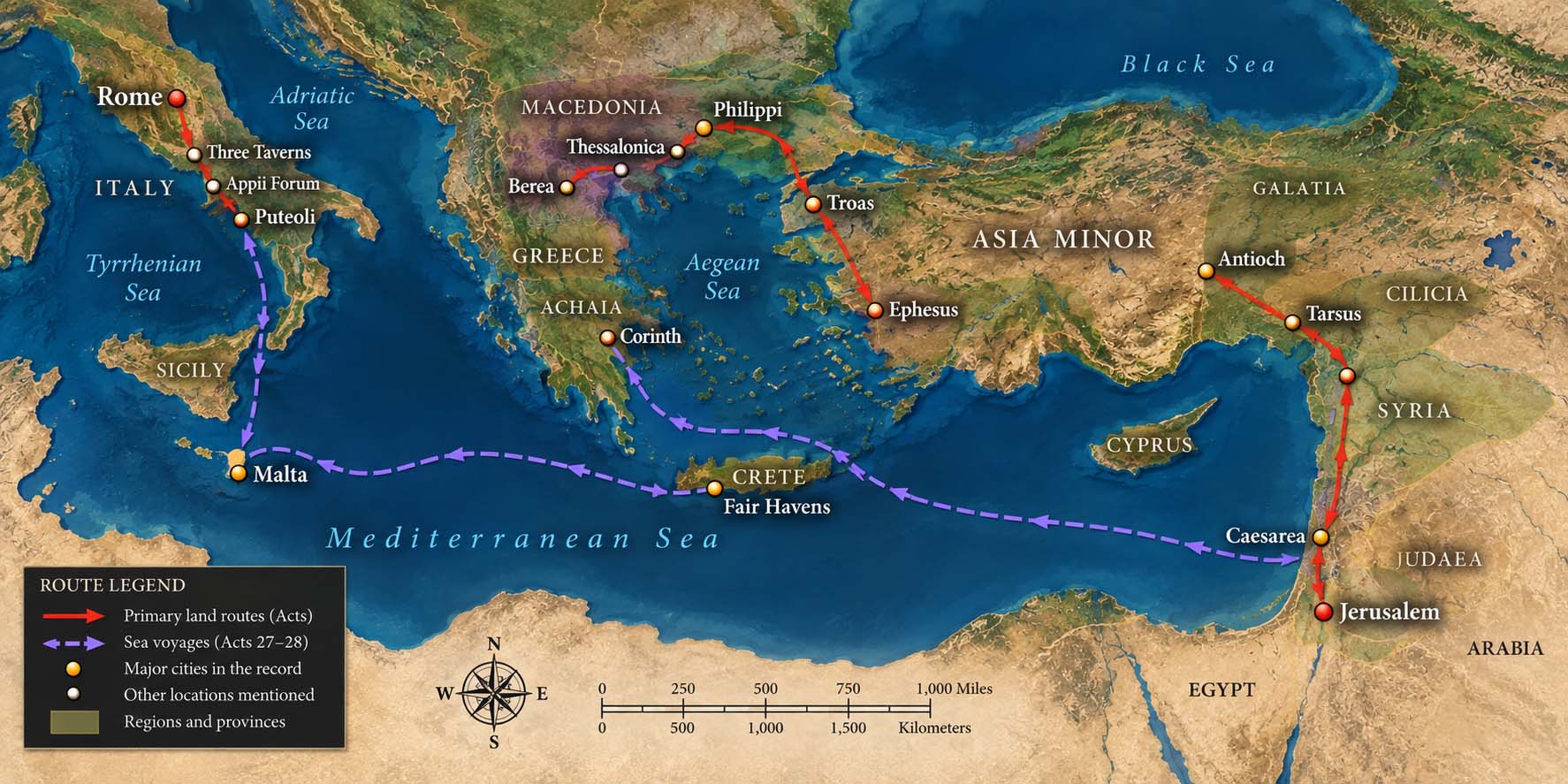
Map showing principal locations and routes in Acts from Jerusalem through the eastern Mediterranean to Rome
The Apostolic World in Acts. Principal cities and routes associated with the expanding witness from Judaea through the eastern Mediterranean and onward to Rome.
Canonical RecordKJV Acts and related New Testament passages.
Ancient WitnessJosephus and Roman-era historical context.
ArchaeologyJerusalem, Caesarea, Philippi, Ephesus, Malta and the Roman world.
Spiritual ConflictUnclean spirits, divination and evil spirits explicitly recorded in Acts.
Demons and Evil SpiritsPhilip casts out unclean spirits in Samaria. Paul commands the spirit of divination to leave the slave girl at Philippi. At Ephesus, evil spirits depart during Paul's ministry, while the sons of Sceva encounter an evil spirit that recognizes Jesus and Paul. Acts presents deliverance from evil spirits as a continuing and visible part of apostolic ministry.
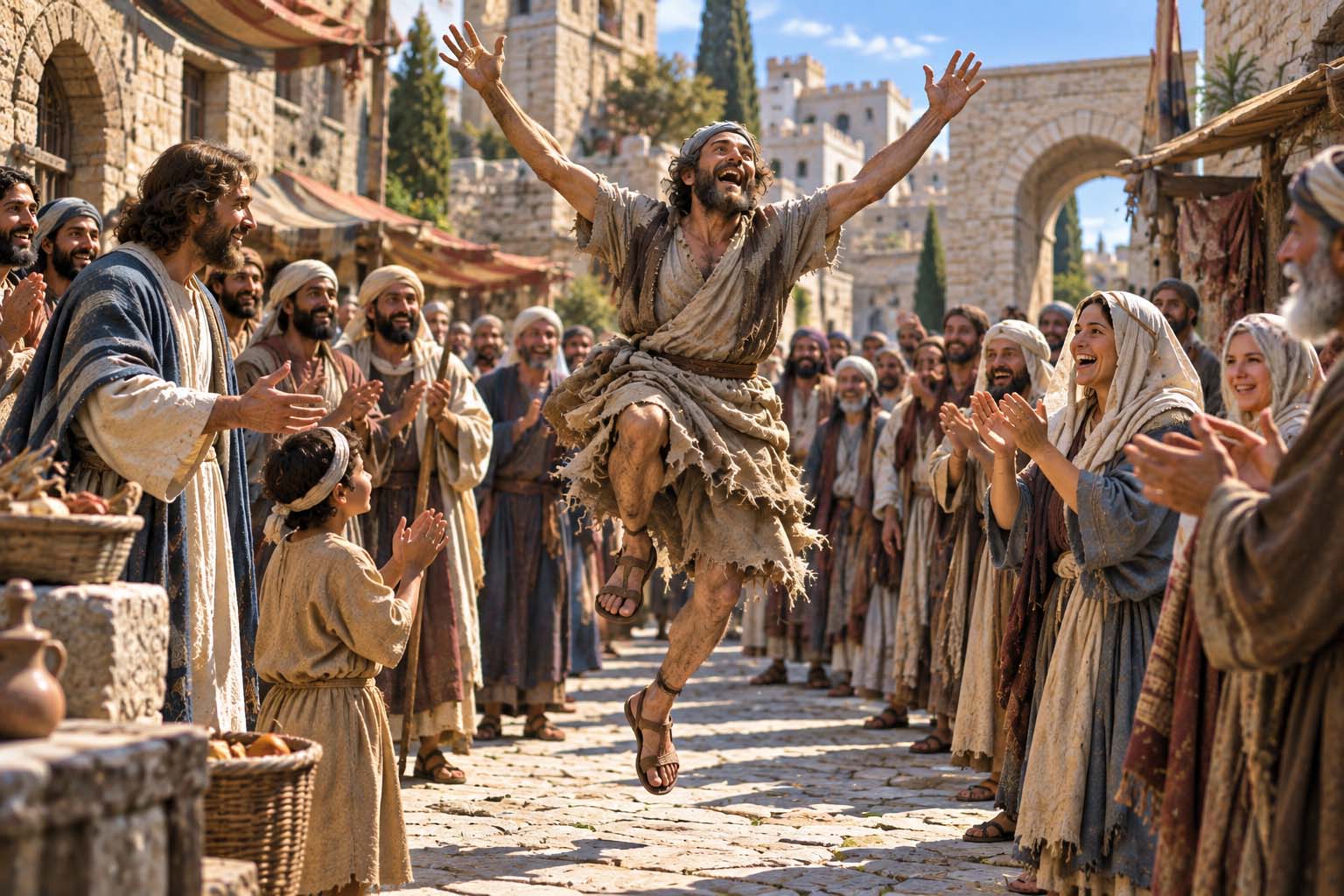
The man lame from birth leaping for joy after being healed near the Temple while people gather around him
The Lame Man Healed at the Beautiful Gate. After Peter commanded him in the name of Jesus Christ of Nazareth to rise up and walk, the man who had been lame from birth entered the Temple with Peter and John, “walking, and leaping, and praising God.” Acts 3:1-10 KJV.

The Record in Acts

Signs, Wonders and Deliverance

Thirty-three substantial chronological exhibits follow the apostolic witness from Jerusalem toward Rome, with KJV references, dates, locations, historical context, archaeology, symbols and research panels.

The Event

Jesus was taken up before the apostles and a cloud received Him from their sight. Two men in white apparel announced that He would return in like manner.

What makes it extraordinary

The apostles watch Jesus ascend until a cloud receives Him from sight. The two heavenly messengers immediately connect that visible departure with His future return, making the Ascension both an observed event and the opening commission of Acts.

Historical setting

Acts locates the scene at the Mount of Olives, a ridge directly east of Jerusalem across the Kidron Valley. Luke 24:50-53 supplies the companion ending to Luke's Gospel, while Acts 1 expands the event and moves the story toward Pentecost.

Scripture TrailActs 1:6-11. Read the surrounding chapter as part of the complete narrative, then compare later speeches in Acts when the event is retold.
Museum ResearchThe biblical event is presented first. Archaeology, Josephus, Roman history and modern scholarship are used where they illuminate the people, location, institutions or first-century setting.
Date & PlaceEventScripture
c. AD 30 · Mount of OlivesAscensionActs 1:6-11
✦Witness
Ascension
⌖Setting
c. AD 30 · Mount of Olives
§Scripture
Acts 1:6-11

The Event

A sound like a rushing mighty wind filled the house, cloven tongues like fire appeared, and the disciples spoke in other tongues. Pilgrims heard the works of God in their own languages and about three thousand were baptized.

What the crowd experienced

Pentecost combines audible, visible and linguistic signs: a sound from heaven like a rushing mighty wind, appearances like cloven tongues of fire, and speech understood by pilgrims from many regions. Peter then interprets the event publicly from Joel and proaccounts the risen Christ.

Why it matters

Acts names Parthians, Medes, Elamites, Mesopotamians, visitors from Rome and others, emphasizing the international character of the crowd. About three thousand receive the word and are baptized, turning the miracle into the first great expansion of the apostolic witness.

Scripture TrailActs 2:1-41. Read the surrounding chapter as part of the complete narrative, then compare later speeches in Acts when the event is retold.
Museum ResearchThe biblical event is presented first. Archaeology, Josephus, Roman history and modern scholarship are used where they illuminate the people, location, institutions or first-century setting.
Date & PlaceEventScripture
c. AD 30 · JerusalemHoly GhostActs 2:1-41
✦Witness
Holy Ghost
⌖Setting
c. AD 30 · Jerusalem
§Scripture
Acts 2:1-41

The Event

A man lame from birth and more than forty years old was commanded to rise in the name of Jesus Christ. His feet and ankle bones received strength, and he entered the Temple walking and leaping.

What happened

The man's condition was not recent. Acts says he had been lame from his mother's womb and later states that he was more than forty years old. After Peter's command, he stands, walks and leaps in the Temple where worshippers recognize the familiar beggar.

Public verification

The healing is followed by questioning before Jerusalem's rulers, elders and scribes. Acts 4:14 says the healed man was standing with Peter and John during the confrontation, making the beneficiary himself part of the public aftermath.

Scripture TrailActs 3:1-10; 4:22. Read the surrounding chapter as part of the complete narrative, then compare later speeches in Acts when the event is retold.
Museum ResearchThe biblical event is presented first. Archaeology, Josephus, Roman history and modern scholarship are used where they illuminate the people, location, institutions or first-century setting.
Date & PlaceEventScripture
c. AD 30-31 · Jerusalem TempleHealingActs 3:1-10; 4:22
✦Witness
Healing
⌖Setting
c. AD 30-31 · Jerusalem Temple
§Scripture
Acts 3:1-10; 4:22

The Event

The sick were brought into the streets and people vexed with unclean spirits came from surrounding cities. Acts says they were healed every one.

What Luke is summarizing

This passage represents many miracles rather than a single event. Sick people are carried into Jerusalem's streets, people arrive from surrounding cities, and those vexed with unclean spirits are specifically included among those healed.

Connection to Jesus' ministry

The summary deliberately resembles the Gospel accounts in which crowds bring the sick and demonized to Jesus. Acts presents the apostles' ministry as continuing in His name, while the growing public response provokes renewed action from the high priest and Sadducees.

Scripture TrailActs 5:12-16. Read the surrounding chapter as part of the complete narrative, then compare later speeches in Acts when the event is retold.
Museum ResearchThe biblical event is presented first. Archaeology, Josephus, Roman history and modern scholarship are used where they illuminate the people, location, institutions or first-century setting.
Date & PlaceEventScripture
c. AD 30-33 · JerusalemMass Healing / DeliveranceActs 5:12-16
✦Witness
Mass Healing / Deliverance
⌖Setting
c. AD 30-33 · Jerusalem
§Scripture
Acts 5:12-16

The Event

Ananias and Sapphira separately maintained a deceptive account of the proceeds from a sale. Each fell down and died after being confronted, and great fear came upon the church.

A miracle of judgment

This is not a healing narrative. Peter exposes deliberate deception concerning money that Ananias and Sapphira were free to keep, and both die after separate confrontations.

Effect on the early Church

Acts twice emphasizes fear. The deaths occur amid a community experiencing remarkable generosity and apostolic signs, making the episode a severe warning about deceit within the newly forming Church.

Scripture TrailActs 5:1-11. Read the surrounding chapter as part of the complete narrative, then compare later speeches in Acts when the event is retold.
Museum ResearchThe biblical event is presented first. Archaeology, Josephus, Roman history and modern scholarship are used where they illuminate the people, location, institutions or first-century setting.
Date & PlaceEventScripture
c. AD 30-33 · JerusalemJudgmentActs 5:1-11
✦Witness
Judgment
⌖Setting
c. AD 30-33 · Jerusalem
§Scripture
Acts 5:1-11

The Event

An angel opened the prison doors during the night and brought the apostles out. At daybreak they returned to the Temple and resumed teaching while the secured prison was found empty.

The secured prison

The narrative stresses confinement: the apostles are placed in the common prison, yet an angel opens the doors during the night. They do not flee Jerusalem but return at daybreak to the Temple and resume the very teaching for which they were arrested.

The discovery

Officers find the prison shut securely and the keepers standing outside, but the prisoners are gone. A messenger then reports that the apostles are publicly teaching in the Temple, turning the deliverance into an immediate challenge to the authorities.

Scripture TrailActs 5:17-25. Read the surrounding chapter as part of the complete narrative, then compare later speeches in Acts when the event is retold.
Museum ResearchThe biblical event is presented first. Archaeology, Josephus, Roman history and modern scholarship are used where they illuminate the people, location, institutions or first-century setting.
Date & PlaceEventScripture
c. AD 30-33 · JerusalemAngelic DeliveranceActs 5:17-25
✦Witness
Angelic Deliverance
⌖Setting
c. AD 30-33 · Jerusalem
§Scripture
Acts 5:17-25

The Event

As Stephen stood before the council, those looking steadfastly at him saw his face as though it were the face of an angel. The sign precedes his long defense.

The visible sign

Stephen is already described as performing great wonders and miracles when he is seized. During the council hearing, every observer looking at him sees his face as though it were the face of an angel.

Biblical connection

The description recalls the transformed appearance of Moses after speaking with God in Exodus 34. It prepares the reader for Stephen's defense of Israel's history and for the heavenly vision that follows at his death.

Scripture TrailActs 6:8-15. Read the surrounding chapter as part of the complete narrative, then compare later speeches in Acts when the event is retold.
Museum ResearchThe biblical event is presented first. Archaeology, Josephus, Roman history and modern scholarship are used where they illuminate the people, location, institutions or first-century setting.
Date & PlaceEventScripture
c. AD 33-35 · JerusalemVisible SignActs 6:8-15
✦Witness
Visible Sign
⌖Setting
c. AD 33-35 · Jerusalem
§Scripture
Acts 6:8-15

The Event

Stephen, full of the Holy Ghost, saw the glory of God and Jesus standing at God's right hand. He announced that the heavens were opened before he was cast out and stoned.

Heaven opened

Stephen sees the glory of God and Jesus standing at the right hand of God. He announces the vision aloud while the council reacts violently and drives him outside the city.

A pivotal moment

The witnesses place their garments at the feet of Saul. Stephen's death therefore closes one phase of the Jerusalem story while introducing the future apostle whose conversion will transform the geographical scope of Acts.

Scripture TrailActs 7:54-60. Read the surrounding chapter as part of the complete narrative, then compare later speeches in Acts when the event is retold.
Museum ResearchThe biblical event is presented first. Archaeology, Josephus, Roman history and modern scholarship are used where they illuminate the people, location, institutions or first-century setting.
Date & PlaceEventScripture
c. AD 33-35 · JerusalemVisionActs 7:54-60
✦Witness
Vision
⌖Setting
c. AD 33-35 · Jerusalem
§Scripture
Acts 7:54-60

The Event

Unclean spirits cried with a loud voice as they came out of many, while people with palsies and lameness were healed. Acts says there was great joy in the city.

Miracles in Samaria

Philip's ministry includes two explicitly named classes of restoration: people with palsies and lameness are healed, and unclean spirits cry aloud as they leave many who had been afflicted.

Why Samaria matters

Jesus had named Samaria in Acts 1:8 as a stage in the outward witness. Philip's ministry is therefore both miraculous and geographical, showing the message crossing a long-standing Jewish-Samaritan boundary.

Scripture TrailActs 8:5-13. Read the surrounding chapter as part of the complete narrative, then compare later speeches in Acts when the event is retold.
Museum ResearchThe biblical event is presented first. Archaeology, Josephus, Roman history and modern scholarship are used where they illuminate the people, location, institutions or first-century setting.
Date & PlaceEventScripture
c. AD 34-36 · SamariaHealing / Unclean SpiritsActs 8:5-13
✦Witness
Healing / Unclean Spirits
⌖Setting
c. AD 34-36 · Samaria
§Scripture
Acts 8:5-13

The Event

An angel directed Philip toward the Gaza road, where he explained Isaiah to an Ethiopian official and baptized him. Afterward the Spirit of the Lord caught Philip away and he was found at Azotus.

A directed encounter

An angel sends Philip toward the desert road, and the Spirit directs him to the Ethiopian official's chariot at the moment the man is reading Isaiah. Philip explains the passage, preaches Jesus and baptizes him.

The extraordinary departure

After they come out of the water, Acts says the Spirit of the Lord catches Philip away. The Ethiopian sees him no more, while Philip is subsequently found at Azotus and continues preaching toward Caesarea.

Scripture TrailActs 8:26-40. Read the surrounding chapter as part of the complete narrative, then compare later speeches in Acts when the event is retold.
Museum ResearchThe biblical event is presented first. Archaeology, Josephus, Roman history and modern scholarship are used where they illuminate the people, location, institutions or first-century setting.
Date & PlaceEventScripture
c. AD 34-36 · Gaza roadGuidance / RemovalActs 8:26-40
✦Witness
Guidance / Removal
⌖Setting
c. AD 34-36 · Gaza road
§Scripture
Acts 8:26-40

The Event

A heavenly light surrounded Saul and he heard Jesus address him by name. Saul entered Damascus blind and remained without sight for three days.

The persecutor stopped

Saul is traveling with authority to arrest believers when a light from heaven surrounds him and Jesus addresses him by name. The encounter leaves the persecutor blind and dependent on others to lead him into Damascus.

Three accounts in Acts

Luke narrates the event in Acts 9, and Paul later recounts it in Acts 22 and Acts 26. Reading all three preserves the full apostolic testimony, including the heavenly light, the voice of Jesus and Paul's commission.

Scripture TrailActs 9:1-9; 22:6-11; 26:12-18. Read the surrounding chapter as part of the complete narrative, then compare later speeches in Acts when the event is retold.
Museum ResearchThe biblical event is presented first. Archaeology, Josephus, Roman history and modern scholarship are used where they illuminate the people, location, institutions or first-century setting.
Date & PlaceEventScripture
c. AD 34-36 · Damascus roadVision / ConversionActs 9:1-9; 22:6-11; 26:12-18
✦Witness
Vision / Conversion
⌖Setting
c. AD 34-36 · Damascus road
§Scripture
Acts 9:1-9; 22:6-11; 26:12-18

The Event

The Lord directed Ananias by vision to find Saul on the street called Straight. After Ananias laid hands on him, something like scales fell from Saul's eyes and he received sight.

Two visions converge

While Saul waits blind, the Lord appears to Ananias and directs him to the street called Straight. Saul has also received a vision that a man named Ananias will come and restore his sight.

Sight restored

Ananias lays hands on Saul, identifies Jesus as the one who appeared on the road, and something like scales falls from Saul's eyes. Saul immediately receives sight, is baptized and soon begins preaching the Christ he had opposed.

Scripture TrailActs 9:10-19. Read the surrounding chapter as part of the complete narrative, then compare later speeches in Acts when the event is retold.
Museum ResearchThe biblical event is presented first. Archaeology, Josephus, Roman history and modern scholarship are used where they illuminate the people, location, institutions or first-century setting.
Date & PlaceEventScripture
c. AD 34-36 · DamascusHealing / VisionActs 9:10-19
✦Witness
Healing / Vision
⌖Setting
c. AD 34-36 · Damascus
§Scripture
Acts 9:10-19

The Event

Aeneas had been confined to bed for eight years with palsy. Peter told him Jesus Christ made him whole, and Acts says he arose immediately.

Eight years ended

Acts names Aeneas and states that he had been bedridden for eight years with palsy. Peter attributes the healing directly to Jesus Christ and commands him to rise and make his bed.

Regional effect

The result extends beyond one household. Luke says those dwelling at Lydda and Sharon saw him and turned to the Lord, connecting a named physical restoration with wider public response.

Scripture TrailActs 9:32-35. Read the surrounding chapter as part of the complete narrative, then compare later speeches in Acts when the event is retold.
Museum ResearchThe biblical event is presented first. Archaeology, Josephus, Roman history and modern scholarship are used where they illuminate the people, location, institutions or first-century setting.
Date & PlaceEventScripture
c. AD 37-40 · LyddaHealingActs 9:32-35
✦Witness
Healing
⌖Setting
c. AD 37-40 · Lydda
§Scripture
Acts 9:32-35

The Event

Tabitha died and was laid in an upper chamber while widows displayed the garments she had made. Peter prayed, commanded her to arise, and presented her alive.

A death witnessed by a community

Tabitha is known for clothing and charitable work. After she dies, widows gather in the upper chamber and show Peter the garments she had made, grounding the account in a remembered and loved individual.

Raised and presented alive

Peter sends everyone out, kneels in prayer and commands, “Tabitha, arise.” She opens her eyes, sits up and is presented alive to the saints and widows, after which the event becomes known throughout Joppa.

Scripture TrailActs 9:36-42. Read the surrounding chapter as part of the complete narrative, then compare later speeches in Acts when the event is retold.
Museum ResearchThe biblical event is presented first. Archaeology, Josephus, Roman history and modern scholarship are used where they illuminate the people, location, institutions or first-century setting.
Date & PlaceEventScripture
c. AD 37-40 · JoppaResurrectionActs 9:36-42
✦Witness
Resurrection
⌖Setting
c. AD 37-40 · Joppa
§Scripture
Acts 9:36-42

The Event

Cornelius, a centurion, saw an angel who told him his prayers and alms had come up before God. He was instructed to send to Joppa for Peter.

A Roman centurion receives a vision

Cornelius is a centurion at Caesarea, the Roman administrative center of Judaea. An angel calls him by name and tells him that his prayers and alms have come up for a memorial before God.

The meeting is arranged

The angel gives Cornelius precise instructions for finding Peter at Joppa in the house of Simon the tanner. The narrative then shifts to Peter, where a second revelation prepares him for the same meeting.

Scripture TrailActs 10:1-8. Read the surrounding chapter as part of the complete narrative, then compare later speeches in Acts when the event is retold.
Museum ResearchThe biblical event is presented first. Archaeology, Josephus, Roman history and modern scholarship are used where they illuminate the people, location, institutions or first-century setting.
Date & PlaceEventScripture
c. AD 38-40 · CaesareaAngelic VisionActs 10:1-8
✦Witness
Angelic Vision
⌖Setting
c. AD 38-40 · Caesarea
§Scripture
Acts 10:1-8

The Event

Peter saw heaven opened and a great vessel descending with many kinds of creatures. The command and response occurred three times before messengers from Cornelius arrived.

The threefold vision

Peter sees heaven opened and a vessel like a great sheet descending with animals. A voice commands him to rise, kill and eat; Peter objects; and the answer declares that what God has cleansed is not to be called common.

Meaning revealed by events

The exchange happens three times. Immediately afterward the Spirit tells Peter to accompany Cornelius's messengers, and Peter later explains that God showed him not to call any man common or unclean.

Scripture TrailActs 10:9-23. Read the surrounding chapter as part of the complete narrative, then compare later speeches in Acts when the event is retold.
Museum ResearchThe biblical event is presented first. Archaeology, Josephus, Roman history and modern scholarship are used where they illuminate the people, location, institutions or first-century setting.
Date & PlaceEventScripture
c. AD 38-40 · JoppaVisionActs 10:9-23
✦Witness
Vision
⌖Setting
c. AD 38-40 · Joppa
§Scripture
Acts 10:9-23

The Event

While Peter was still speaking in Cornelius's house, the Holy Ghost fell on the Gentile hearers. Jewish believers heard them speak with tongues and magnify God.

The interruption of Peter's sermon

The Holy Ghost falls on Cornelius's household while Peter is still speaking. The Jewish believers accompanying Peter are astonished because they hear Gentiles speaking with tongues and magnifying God.

A decisive expansion

Peter points to what has happened as the reason water baptism cannot be refused. In Acts 11 he retells the event to Jerusalem believers, presenting it as God's own confirmation of Gentile inclusion.

Scripture TrailActs 10:34-48. Read the surrounding chapter as part of the complete narrative, then compare later speeches in Acts when the event is retold.
Museum ResearchThe biblical event is presented first. Archaeology, Josephus, Roman history and modern scholarship are used where they illuminate the people, location, institutions or first-century setting.
Date & PlaceEventScripture
c. AD 38-40 · CaesareaHoly GhostActs 10:34-48
✦Witness
Holy Ghost
⌖Setting
c. AD 38-40 · Caesarea
§Scripture
Acts 10:34-48

The Event

Peter slept between soldiers bound with two chains when an angel appeared and the chains fell from his hands. He passed the guards and an iron gate opened of its own accord.

Maximum security and an angel

Peter is chained between two soldiers with guards before the door when an angel appears. His chains fall, he passes the guard stations, and the iron gate leading into the city opens of its own accord.

Even Peter is astonished

Peter initially thinks he is seeing a vision. Only after the angel departs does he declare that the Lord has truly delivered him from Herod, and the praying believers at Mary's house are themselves slow to believe Rhoda's report.

Scripture TrailActs 12:1-19. Read the surrounding chapter as part of the complete narrative, then compare later speeches in Acts when the event is retold.
Museum ResearchThe biblical event is presented first. Archaeology, Josephus, Roman history and modern scholarship are used where they illuminate the people, location, institutions or first-century setting.
Date & PlaceEventScripture
AD 44 · JerusalemAngelic DeliveranceActs 12:1-19
✦Witness
Angelic Deliverance
⌖Setting
AD 44 · Jerusalem
§Scripture
Acts 12:1-19

The Event

A crowd acaccounted Herod's speech as the voice of a god, and Acts records that he was struck and died. Josephus independently places Agrippa's final illness at Caesarea after divine acclamations and says he died five days later.

Acts and Josephus meet

Acts says Agrippa receives the cry that his is the voice of a god and not a man, after which he is struck and dies. Josephus independently describes Agrippa at Caesarea in brilliant royal clothing, receiving divine acclamation, becoming suddenly ill and dying five days later.

Why this comparison matters

The accounts are independent and not identical, which makes their overlap especially useful. Both connect Agrippa, Caesarea, public divine honors, sudden physical affliction and death in AD 44.

Scripture TrailActs 12:20-23. Read the surrounding chapter as part of the complete narrative, then compare later speeches in Acts when the event is retold.
Museum ResearchThe biblical event is presented first. Archaeology, Josephus, Roman history and modern scholarship are used where they illuminate the people, location, institutions or first-century setting.
Date & PlaceEventScripture
AD 44 · CaesareaJudgment / Historical ParallelActs 12:20-23
✦Witness
Judgment / Historical Parallel
⌖Setting
AD 44 · Caesarea
§Scripture
Acts 12:20-23

The Event

Elymas opposed Paul before the proconsul Sergius Paulus. Paul announced temporary blindness, and immediately mist and darkness fell upon him.

A confrontation before a Roman governor

Elymas attempts to turn the proconsul Sergius Paulus away from Paul's message. Paul, filled with the Holy Ghost, announces that Elymas will be blind for a season.

Immediate result

Acts says a mist and darkness immediately fall upon him and he seeks people to lead him by the hand. The proconsul sees what occurs and believes, astonished at the doctrine of the Lord.

Scripture TrailActs 13:6-12. Read the surrounding chapter as part of the complete narrative, then compare later speeches in Acts when the event is retold.
Museum ResearchThe biblical event is presented first. Archaeology, Josephus, Roman history and modern scholarship are used where they illuminate the people, location, institutions or first-century setting.
Date & PlaceEventScripture
c. AD 46-48 · Paphos, CyprusJudgmentActs 13:6-12
✦Witness
Judgment
⌖Setting
c. AD 46-48 · Paphos, Cyprus
§Scripture
Acts 13:6-12

The Event

A man unable to walk from birth heard Paul, who commanded him to stand upright. He leaped and walked, and the pagan crowd tried to honor Paul and Barnabas as gods.

A man who had never walked

Luke specifies that the man at Lystra was crippled from birth and had never walked. Paul commands him to stand upright, and the man leaps and walks.

The pagan reaction

The crowd interprets the healing through local Greco-Roman religion and calls Barnabas Jupiter and Paul Mercurius. The apostles refuse sacrifice and divine honors, making the aftermath as important as the physical healing itself.

Scripture TrailActs 14:8-18. Read the surrounding chapter as part of the complete narrative, then compare later speeches in Acts when the event is retold.
Museum ResearchThe biblical event is presented first. Archaeology, Josephus, Roman history and modern scholarship are used where they illuminate the people, location, institutions or first-century setting.
Date & PlaceEventScripture
c. AD 47-48 · LystraHealingActs 14:8-18
✦Witness
Healing
⌖Setting
c. AD 47-48 · Lystra
§Scripture
Acts 14:8-18

The Event

Paul was stoned and dragged outside the city because his attackers supposed him dead. The disciples gathered around him, he rose, returned to the city and departed the next day.

Left for dead

Opponents stone Paul, drag him outside Lystra and leave because they suppose he is dead. When the disciples gather around him, he rises and returns to the city.

Careful reading

Acts does not explicitly state that Paul died, so the exhibit should not call this a resurrection. What the text does describe is a remarkable survival and recovery after a stoning severe enough that his attackers believed the assault had killed him.

Scripture TrailActs 14:19-20. Read the surrounding chapter as part of the complete narrative, then compare later speeches in Acts when the event is retold.
Museum ResearchThe biblical event is presented first. Archaeology, Josephus, Roman history and modern scholarship are used where they illuminate the people, location, institutions or first-century setting.
Date & PlaceEventScripture
c. AD 47-48 · LystraPreservationActs 14:19-20
✦Witness
Preservation
⌖Setting
c. AD 47-48 · Lystra
§Scripture
Acts 14:19-20

The Event

Paul saw a man of Macedonia in a night vision pleading for help. The company concluded that God had called them to preach in Macedonia and crossed the Aegean.

A journey redirected

Paul's company has already been prevented from entering other regions when he reaches Troas. During the night he sees a Macedonian man pleading, “Come over into Macedonia, and help us.”

A continental turning point

The group immediately seeks passage across the Aegean, concluding that God has called them to preach there. The vision leads directly toward Philippi and the extraordinary events that follow in Macedonia.

Scripture TrailActs 16:6-10. Read the surrounding chapter as part of the complete narrative, then compare later speeches in Acts when the event is retold.
Museum ResearchThe biblical event is presented first. Archaeology, Josephus, Roman history and modern scholarship are used where they illuminate the people, location, institutions or first-century setting.
Date & PlaceEventScripture
c. AD 49-50 · TroasVision / GuidanceActs 16:6-10
✦Witness
Vision / Guidance
⌖Setting
c. AD 49-50 · Troas
§Scripture
Acts 16:6-10

The Event

A slave girl with a spirit of divination followed Paul for many days. Paul commanded the spirit in the name of Jesus Christ to come out, and her owners lost their source of profit.

An evil spirit and an economy

The slave girl possesses a spirit of divination and earns money for her owners through soothsaying. After many days Paul commands the spirit in the name of Jesus Christ to leave her, and Acts says it comes out the same hour.

The financial consequence

Her owners recognize that their hope of profit is gone and seize Paul and Silas. The deliverance therefore produces a documented economic reaction and leads directly to the beating and imprisonment that precede the Philippian earthquake.

Scripture TrailActs 16:16-18. Read the surrounding chapter as part of the complete narrative, then compare later speeches in Acts when the event is retold.
Museum ResearchThe biblical event is presented first. Archaeology, Josephus, Roman history and modern scholarship are used where they illuminate the people, location, institutions or first-century setting.
Date & PlaceEventScripture
c. AD 49-50 · PhilippiEvil Spirit / DeliveranceActs 16:16-18
✦Witness
Evil Spirit / Deliverance
⌖Setting
c. AD 49-50 · Philippi
§Scripture
Acts 16:16-18

The Event

At midnight Paul and Silas prayed and sang while confined in stocks. A great earthquake shook the prison, all doors opened and everyone's bands were loosed.

The prison opens

Paul and Silas have been beaten, placed in the inner prison and fastened in stocks. At midnight, while they pray and sing, a great earthquake shakes the foundations, every door opens and everyone's bands are loosed.

No one escapes

The jailer assumes the prisoners have fled and prepares to kill himself. Paul stops him by announcing that everyone remains, after which the jailer brings them out, hears the gospel and is baptized with his household.

Scripture TrailActs 16:22-34. Read the surrounding chapter as part of the complete narrative, then compare later speeches in Acts when the event is retold.
Museum ResearchThe biblical event is presented first. Archaeology, Josephus, Roman history and modern scholarship are used where they illuminate the people, location, institutions or first-century setting.
Date & PlaceEventScripture
c. AD 49-50 · PhilippiEarthquake / DeliveranceActs 16:22-34
✦Witness
Earthquake / Deliverance
⌖Setting
c. AD 49-50 · Philippi
§Scripture
Acts 16:22-34

The Event

Acts says God worked special miracles by Paul's hands. Diseases departed and evil spirits went out from afflicted people.

More than one miracle

Luke's phrase “special miracles” summarizes repeated events. Items that had been in contact with Paul were carried to sick people, diseases departed, and evil spirits went out of those afflicted.

What happened next

The surrounding account then records attempted imitation by itinerant exorcists, the sons of Sceva being overpowered by an evil spirit, fear spreading through Ephesus, public confession, and the burning of books associated with curious arts valued at fifty thousand pieces of silver.

Scripture TrailActs 19:11-12. Read the surrounding chapter as part of the complete narrative, then compare later speeches in Acts when the event is retold.
Museum ResearchThe biblical event is presented first. Archaeology, Josephus, Roman history and modern scholarship are used where they illuminate the people, location, institutions or first-century setting.
Date & PlaceEventScripture
c. AD 52-55 · EphesusHealing / Evil SpiritsActs 19:11-12
✦Witness
Healing / Evil Spirits
⌖Setting
c. AD 52-55 · Ephesus
§Scripture
Acts 19:11-12

The Event

Seven sons of Sceva attempted to invoke Jesus' name over an evil spirit. The spirit answered that it knew Jesus and Paul, then the possessed man overpowered them.

The evil spirit answers

The sons of Sceva attempt to invoke Jesus as though His name were a formula derived from Paul's ministry. The evil spirit replies, “Jesus I know, and Paul I know; but who are ye?”

A dramatic failure

The possessed man leaps upon them, overcomes them and sends them fleeing naked and wounded. News spreads among Jews and Greeks in Ephesus, fear falls upon the city, and the name of the Lord Jesus is magnified.

Scripture TrailActs 19:13-20. Read the surrounding chapter as part of the complete narrative, then compare later speeches in Acts when the event is retold.
Museum ResearchThe biblical event is presented first. Archaeology, Josephus, Roman history and modern scholarship are used where they illuminate the people, location, institutions or first-century setting.
Date & PlaceEventScripture
c. AD 52-55 · EphesusEvil Spirit / ConflictActs 19:13-20
✦Witness
Evil Spirit / Conflict
⌖Setting
c. AD 52-55 · Ephesus
§Scripture
Acts 19:13-20

The Event

Eutychus fell from a third-story window and Acts says he was taken up dead. Paul embraced him, and the congregation later brought the young man alive.

A third-story fall

Eutychus falls from a third loft after being overcome by sleep during Paul's long discourse. Acts states plainly that he is taken up dead.

The congregation receives him alive

Paul goes down, embraces him and tells the gathering that his life is in him. Later the believers bring the young man alive and are greatly comforted, making this one of Acts' clearest restoration-to-life accounts.

Scripture TrailActs 20:7-12. Read the surrounding chapter as part of the complete narrative, then compare later speeches in Acts when the event is retold.
Museum ResearchThe biblical event is presented first. Archaeology, Josephus, Roman history and modern scholarship are used where they illuminate the people, location, institutions or first-century setting.
Date & PlaceEventScripture
c. AD 57 · TroasRestoration / LifeActs 20:7-12
✦Witness
Restoration / Life
⌖Setting
c. AD 57 · Troas
§Scripture
Acts 20:7-12

The Event

During the storm an angel told Paul not to fear because he must stand before Caesar and that the lives aboard would be preserved. Paul announced that the ship would be lost but the people saved.

A promise in the storm

After days without sun or stars and with hope of survival disappearing, Paul reports that an angel stood by him during the night. The message says he must stand before Caesar and that God has given him all those sailing with him.

Prophecy before fulfillment

Paul announces that the ship will be lost but the lives aboard will be preserved. The following shipwreck narrative then records, step by step, how that prediction is fulfilled.

Scripture TrailActs 27:9-26. Read the surrounding chapter as part of the complete narrative, then compare later speeches in Acts when the event is retold.
Museum ResearchThe biblical event is presented first. Archaeology, Josephus, Roman history and modern scholarship are used where they illuminate the people, location, institutions or first-century setting.
Date & PlaceEventScripture
c. AD 59-60 · MediterraneanProphecy / AngelActs 27:9-26
✦Witness
Prophecy / Angel
⌖Setting
c. AD 59-60 · Mediterranean
§Scripture
Acts 27:9-26

The Event

After fourteen nights at sea the ship grounded and broke under the waves. All 276 aboard reached land safely by swimming or clinging to pieces of the vessel.

Two hundred seventy-six lives

Acts supplies the exact number aboard and describes anchors, soundings, a failed escape attempt, grounding and the ship breaking under the waves. Soldiers even propose killing the prisoners before the centurion intervenes.

The promised outcome

Some reach shore by swimming and others on boards or broken pieces of the ship. Luke closes the ordeal by saying that all escaped safely to land, matching Paul's earlier announcement.

Scripture TrailActs 27:27-44. Read the surrounding chapter as part of the complete narrative, then compare later speeches in Acts when the event is retold.
Museum ResearchThe biblical event is presented first. Archaeology, Josephus, Roman history and modern scholarship are used where they illuminate the people, location, institutions or first-century setting.
Date & PlaceEventScripture
c. AD 59-60 · MaltaPreservationActs 27:27-44
✦Witness
Preservation
⌖Setting
c. AD 59-60 · Malta
§Scripture
Acts 27:27-44

The Event

A viper fastened onto Paul's hand at the fire. He shook it into the flames and suffered no harm while the islanders watched for the expected effects.

The expected death never comes

A viper fastens onto Paul's hand while he tends the fire. The Maltese observers expect swelling or sudden death and watch him for a long time.

Their conclusion reverses

Paul shakes the creature into the fire and suffers no harm. The islanders move from assuming he is a murderer pursued by divine justice to declaring him a god, revealing how the event was interpreted within their own religious worldview.

Scripture TrailActs 28:1-6. Read the surrounding chapter as part of the complete narrative, then compare later speeches in Acts when the event is retold.
Museum ResearchThe biblical event is presented first. Archaeology, Josephus, Roman history and modern scholarship are used where they illuminate the people, location, institutions or first-century setting.
Date & PlaceEventScripture
c. AD 60 · MaltaPreservationActs 28:1-6
✦Witness
Preservation
⌖Setting
c. AD 60 · Malta
§Scripture
Acts 28:1-6

The Event

Publius received the travelers, and his father lay sick with fever and a bloody flux. Paul prayed, laid hands on him and healed him.

Prayer and laying on of hands

Publius's father lies sick with fever and a bloody flux. Paul enters, prays, lays hands on him and heals him.

Roman Malta

Acts calls Publius the chief man of the island. The episode joins a named local official, hospitality toward the shipwreck survivors and a specific healing that becomes the catalyst for many more people seeking help.

Scripture TrailActs 28:7-8. Read the surrounding chapter as part of the complete narrative, then compare later speeches in Acts when the event is retold.
Museum ResearchThe biblical event is presented first. Archaeology, Josephus, Roman history and modern scholarship are used where they illuminate the people, location, institutions or first-century setting.
Date & PlaceEventScripture
c. AD 60 · MaltaHealingActs 28:7-8
✦Witness
Healing
⌖Setting
c. AD 60 · Malta
§Scripture
Acts 28:7-8

The Event

After Publius's father was healed, other sick people on the island came and were healed. The islanders honored the travelers and supplied what they needed for departure.

A wave of healings

After the healing in Publius's household, other people on Malta who have diseases come to Paul. Luke compresses these many cases into the simple statement that they are healed.

The final movement toward Rome

The islanders honor the travelers and supply what they need when they depart three months later. The miracle sequence therefore closes the dangerous voyage and prepares the final journey through Syracuse, Rhegium and Puteoli to Rome.

Scripture TrailActs 28:9-10. Read the surrounding chapter as part of the complete narrative, then compare later speeches in Acts when the event is retold.
Museum ResearchThe biblical event is presented first. Archaeology, Josephus, Roman history and modern scholarship are used where they illuminate the people, location, institutions or first-century setting.
Date & PlaceEventScripture
c. AD 60 · MaltaMass HealingActs 28:9-10
✦Witness
Mass Healing
⌖Setting
c. AD 60 · Malta
§Scripture
Acts 28:9-10