Genesis 6:1-4
“There were giants in the earth in those days; and also after that...”
Genesis establishes the sons of God, daughters of men, giants, and “mighty men ... of renown.” It does not provide a catalog of forbidden arts.
Archoseum
Museum Exhibition
Preparing the exhibition
0%Gallery VI
The Flood does not end the giant question. Later biblical texts name giant peoples, champions, and regions, while traditions around the world preserve memories of extraordinary beings.
Pre-Flood Biblical Record · Quick Recap
Gallery VI focuses on the giant peoples and champions who appear after the Flood. Before entering that record, this panel gives visitors a concise refresher on the earlier episode in Genesis 6 and the ancient Jewish traditions that place the descent of the Watchers in the days of Jared.
Genesis describes a time when humanity was multiplying upon the earth. The “sons of God” saw the daughters of men, took wives from among them, and children were born from those unions. Genesis 6:4 identifies the Nephilim, translated “giants” in the KJV, and calls the resulting figures “mighty men which were of old, men of renown.”
The passage then moves directly into the accelerating corruption and violence of the pre-Flood world. The museum therefore treats Genesis 6:1-4 as the canonical starting point for the giant question, while keeping later ancient literature clearly identified as non-canonical.
“There were giants in the earth in those days; and also after that, when the sons of God came in unto the daughters of men, and they bare children to them...”Genesis 6:4, KJV
Years shown are calculated directly from the ages given in Genesis 5 and are expressed as approximate years from Adam, not BC dates.
Why Jared is highlighted: Genesis itself does not date the sons-of-God episode to a specific patriarch. The association with Jared comes from the ancient Enochic tradition, which places the Watchers' descent “in the days of Jared.” The timeline therefore shows the traditional placement without turning that tradition into a biblical date.
Giants Collection
Enter four major research exhibits examining the beings, peoples, clans, and named rulers preserved in Scripture and ancient textual traditions.
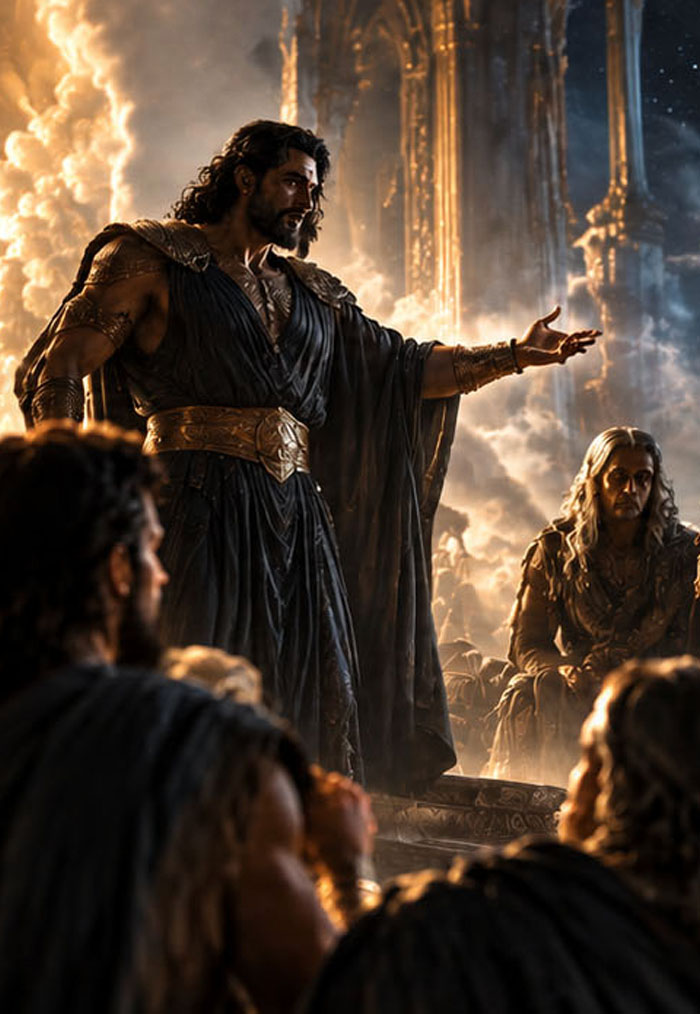
Examine who the Watchers were, the documents that describe them, and what those ancient records say they did on earth.
Explore The Watchers →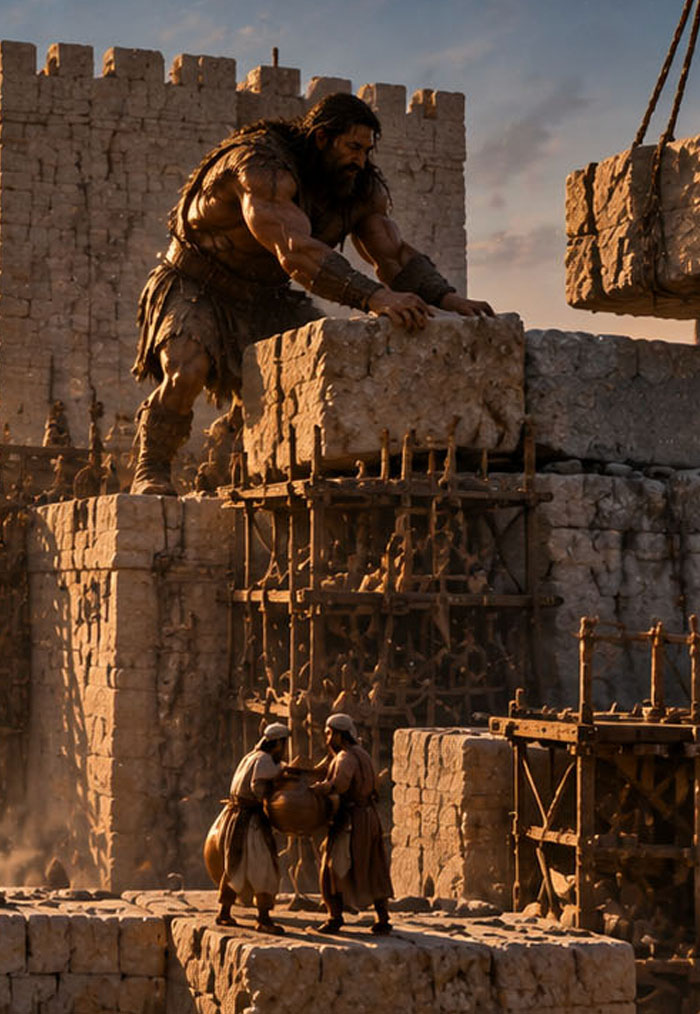
Follow the biblical record and ancient textual traditions surrounding the Nephilim and the extraordinary beings associated with the world before the Flood.
Explore The Nephilim →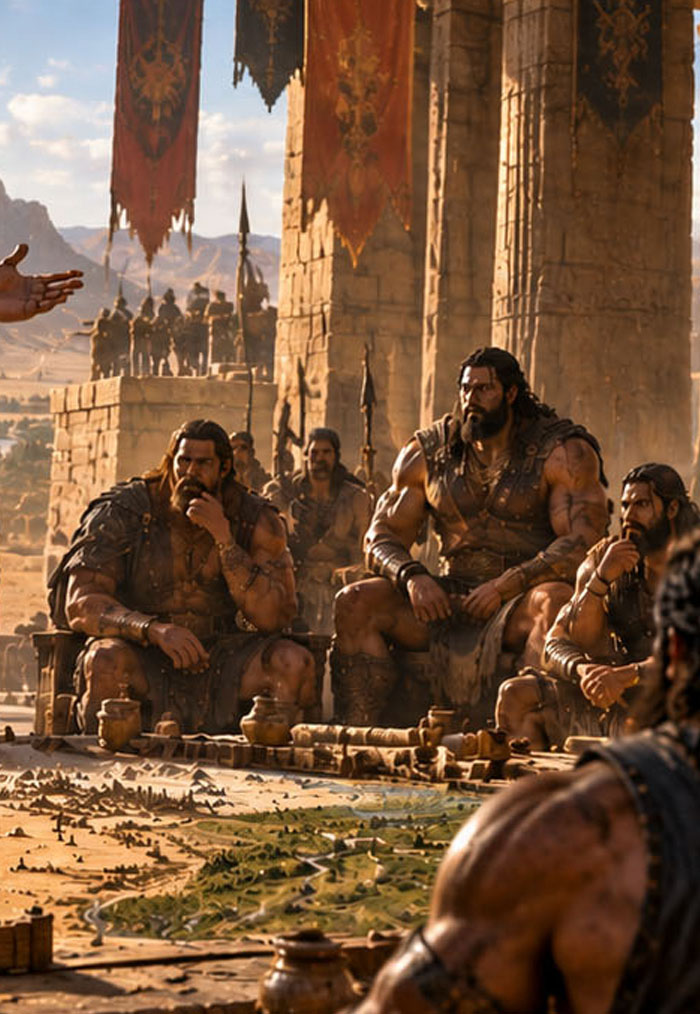
Enter the peoples, lands, and lineages room: Anakim, Rephaim, Emim, Zamzummim, Avim, territories, migrations, and Israelite encounters.
Explore The Giant Clans →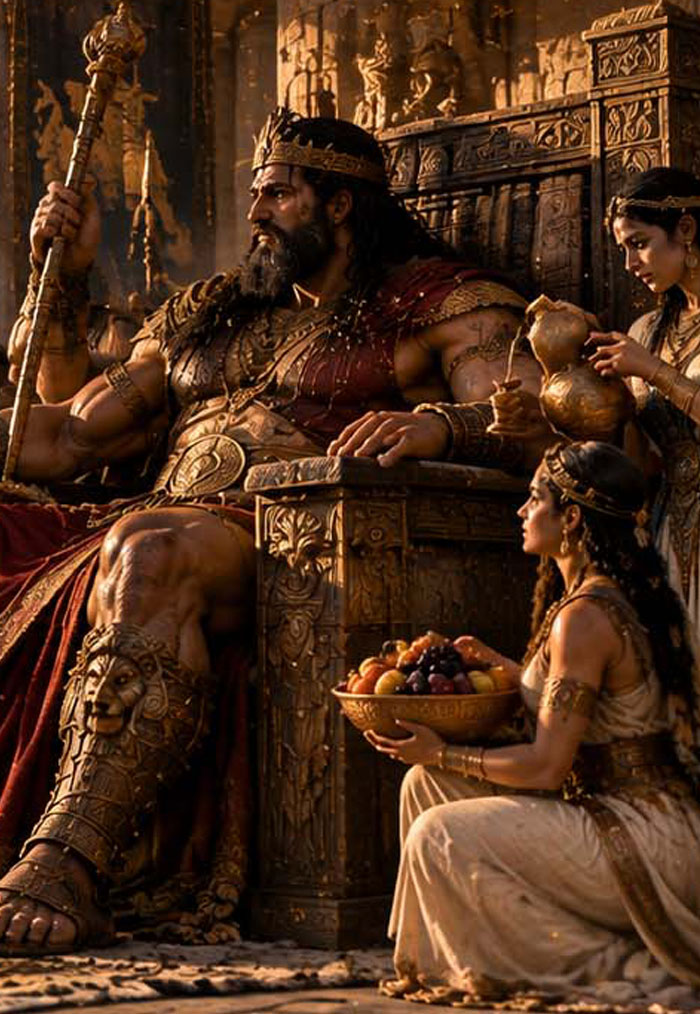
Enter the biographical dossier of kings, champions, and named figures, from Og and the sons of Anak to Goliath and the warriors of Gath.
Explore The Giant Kings →The Watchers · Forbidden Knowledge
The biblical text records the transgression of the “sons of God,” the appearance of giants, and the rapid corruption of the world before the Flood. Ancient Jewish works such as 1 Enoch and Jubilees expand that brief account by describing the Watchers and the knowledge associated with their rebellion. These later writings are valuable witnesses to ancient interpretation, but they are not presented here as equal in authority to Scripture.
“There were giants in the earth in those days; and also after that...”
Genesis establishes the sons of God, daughters of men, giants, and “mighty men ... of renown.” It does not provide a catalog of forbidden arts.
“...revealed the eternal secrets which were preserved in heaven...”
1 Enoch develops the Watchers tradition most extensively. It associates individual Watchers with weapons, metalworking, enchantments, roots, astrology, celestial signs, and adornment.
“...in his days the angels of the Lord descended on the earth...”
Jubilees places the Watchers in Jared's days and says their original task was instruction in judgment and uprightness, followed by their corruption, unions with women, and judgment.
| Symbol | Knowledge or Practice | Ancient Source | Why It Matters in the Tradition |
|---|---|---|---|
| ⚔ | Weapons and warfare Swords, knives, shields, breastplates | 1 Enoch 8:1 | The story links advanced metal craft with an escalation of violence and bloodshed. |
| ⚒ | Metals and their working Extraction, shaping, ornament and fabrication | 1 Enoch 8:1 | The text does not condemn every use of metal. Its concern is knowledge revealed within a rebellion and used in a corrupt world. |
| ✦ | Enchantment and sorcery Charms, incantations, enchantments | 1 Enoch 7:1; 8:3 | This is the clearest ancient basis for describing part of the Watcher tradition as occult or “dark arts.” The modern phrase “dark arts” is a museum category, not wording from the ancient text. |
| ❧ | Roots, plants and secret preparations “Cutting of roots” and plant knowledge | 1 Enoch 7:1; 8:3 | Often interpreted as magical or ritual use of plants. The text should not be stretched into accounts about modern medicine, genetics, or chemistry. |
| ☉ | Signs of the sun | 1 Enoch 8:3 | Celestial observation becomes part of a larger catalog of heavenly secrets disclosed to humanity. |
| ☾ | Course of the moon | 1 Enoch 8:3 | Knowledge of lunar movements is specifically assigned to a Watcher in the Enochic list. |
| ★ | Stars, constellations and astrology | 1 Enoch 8:3 | The tradition distinguishes ordinary observation of the heavens from divinatory or illicit knowledge associated with the rebellion. |
| ☁ | Clouds and signs of the earth | 1 Enoch 8:3 | The catalog extends beyond warfare and magic into interpretation of natural and celestial signs. |
| ◈ | Adornment and beautification Bracelets, ornaments, antimony, costly stones, dyes | 1 Enoch 8:1 | Enoch places luxury arts beside weapons and occult instruction. The issue in the narrative is corruption and seduction, not a blanket biblical prohibition on jewelry or cosmetics. |
| ⌁ | Heavenly secrets | 1 Enoch 9:6 | The larger accusation is that knowledge belonging to the heavenly realm was disclosed in a transgressive way and became part of humanity's corruption. |
Genesis 6 connects the sons of God, human women, giants, and mighty men immediately before its description of pervasive human wickedness. Jude 6 and 2 Peter 2:4 later speak of angels that sinned and were kept for judgment. The canonical passages do not themselves identify metallurgy, astrology, cosmetics, or plant lore as teachings of those angels.
1 Enoch supplies the detailed forbidden-knowledge catalog. Jubilees preserves a related but importantly different tradition: the Watchers initially descended to instruct humanity in judgment and uprightness, then transgressed. That difference is worth preserving rather than blending the two sources into one account.
From Corruption to Judgment
The Watcher tradition belongs inside a much larger biblical setting. Genesis describes a world whose moral corruption had become pervasive. The Flood narrative then moves from human wickedness, to divine judgment, to the preservation of Noah and his family. Centuries later, Jesus deliberately pointed His disciples back to those days when speaking of His own return.
Genesis does not portray the Flood as an arbitrary catastrophe. Humanity had become deeply corrupt, and the earth was filled with violence. God saw what mankind had become and announced judgment upon that world.
“...every imagination of the thoughts of his heart was only evil continually.”
Genesis 6:5, KJV · see also 6:11-13Against that darkness stands Noah. Scripture calls him a just man who walked with God. God instructed him to build the Ark, preserving Noah, his wife, their sons and their sons’ wives, together with the creatures appointed to survive the coming Flood.
“But Noah found grace in the eyes of the LORD.”
Genesis 6:8, KJV · see also 6:9, 13-22Noah obeyed. The appointed day arrived, the waters came, and the world described in the opening chapters of Genesis passed under judgment. The Ark became the vessel through which the human family continued beyond the Flood.
“...Noah only remained alive, and they that were with him in the ark.”
Genesis 7:23, KJVJesus Looks Back to Noah
“But as the days of Noe were, so shall also the coming of the Son of man be.”Matthew 24:37, KJV · read Matthew 24:3, 36-39
How far had the first world fallen? Genesis answers with unusually severe language: wickedness was great, human thoughts were continually bent toward evil, the earth was corrupt, and it was filled with violence. Jesus later used the days immediately preceding the Flood as a warning about the world at His return. His comparison does not say that every detail of Noah’s age must repeat, but it does demand that the warning be taken seriously: ordinary life can continue while corruption deepens and judgment approaches. For the Christian visitor, the return of Christ is therefore both a warning and a hope, the coming of the One who will finally confront evil, judge it, and deliver His people.
Physical Accounts · Scale · Distinctive Traits
The surviving accounts emphasize extraordinary stature, unusual strength and intimidating physical presence. Some descriptions are very specific. Others belong to later traditions from different regions and should be read as separate witnesses rather than as a single uniform portrait.
1 Samuel 17:4 gives Goliath as six cubits and a span in the KJV. Using an 18-inch cubit and a 9-inch span produces an illustrative height of about 9 feet 9 inches.
1 Chronicles 20:6 describes a man of great stature from Gath with six fingers on each hand and six toes on each foot, twenty-four digits in all. Scripture does not say that every giant possessed this feature.
The weight of Goliath's armor, the size of his spearhead, Og's iron bedstead and repeated references to peoples who were great and tall contribute to the biblical picture of formidable physical size.
Red or reddish hair occurs in some later giant traditions and reported historical accounts outside the biblical lands. The Bible does not describe Og, Goliath or the Anakim as red-haired, so the illustration uses this as a comparative traditional trait, not a biblical identification.
Goliath is described with a helmet, coat of mail, brass greaves, a large spear and a shield bearer. Other giant-associated peoples are remembered primarily through their size, fortified territories and reputation in battle.
Biblical narratives repeatedly show ordinary people reacting with fear to exceptionally large warriors and giant-associated clans. Their size was part of how the ancient accounts explained the danger they represented.
Gallery Orientation
Gallery VI gathers the canonical post-Flood giant record first: Rephaim, Anakim, Emim, Zamzummim, Og, Goliath, and other named figures or peoples.
Within these three rooms, the museum brings together the canonical record, Josephus, ancient Jewish literature, geographical detail, physical measurements, and comparative traditions from around the world while keeping each source clearly identified.
Gallery VI · Exhibit Rooms
Open each room to examine the principal post-Flood giant record. The image remains visible while the research content opens beneath it.
Exhibit I · Biblical Peoples & Territories
The post-Flood giant record is not confined to a single name. Scripture places several unusually formidable peoples in distinct territories east and west of Jordan, especially in the lands later occupied by Moab, Ammon, Edom and Israel. This exhibit organizes the names, places, relationships and surviving traditions without collapsing every ancient giant story into one category.
“The Emims dwelt therein in times past, a people great, and many, and tall, as the Anakims; Which also were accounted giants, as the Anakims; but the Moabites call them Emims.”Deuteronomy 2:10-11
“That also was accounted a land of giants: giants dwelt therein in old time; and the Ammonites call them Zamzummims.”Deuteronomy 2:20
| People / Figure | Biblical Setting | Territory | Key Record | What the text preserves |
|---|---|---|---|---|
| Nephilim | Before the Flood and named again by the spies | Genesis 6; Canaan report in Numbers 13 | Genesis 6:4; Numbers 13:33 | Genesis calls them giants in the KJV. The spies later use the same name when describing the sons of Anak. |
| Rephaim | Patriarchal and conquest periods | Ashteroth Karnaim, Bashan and neighboring regions | Genesis 14:5; Deuteronomy 3:11-13 | A broad ancient population name associated with formidable stature. Og is explicitly connected with their remnant. |
| Emim | Before Moabite possession | Moab | Deuteronomy 2:10-11 | Described as great, numerous and tall, and reckoned as giants like the Anakim. |
| Zamzummim | Before Ammonite possession | Ammon | Deuteronomy 2:20-21 | Described as great, numerous and tall. The text says the LORD destroyed them before the Ammonites. |
| Anakim | Spies and conquest | Hebron, Debir, Anab, hill country, later Gaza, Gath and Ashdod | Numbers 13:28-33; Joshua 11:21-22 | Sons of Anak whose stature terrified the spies. Joshua cut them off from much of the hill country, with remnants in three Philistine cities. |
| Og of Bashan | Moses' Transjordan campaign | Bashan, Argob, Edrei | Numbers 21:33-35; Deuteronomy 3 | King of a heavily fortified territory and a remnant of the giants. His iron bedstead is given exact dimensions. |
| Goliath and later champions | Davidic period | Gath and Philistine territory | 1 Samuel 17; 2 Samuel 21; 1 Chronicles 20 | The giant tradition continues in named warriors associated with Gath, including men defeated by David and his servants. |
Writing in the first century AD, Josephus says the spies reported “the posterity of the giants” at Hebron. In his account of the conquest he later describes surviving giants there as extraordinary in bodily size and terrifying in appearance, and says their bones were still being shown in his own day.
Ancient historical witness
1 Enoch develops the pre-Flood Watcher tradition: heavenly beings take wives, their offspring become giants, violence increases, and judgment follows. The work supplies details not contained in Genesis and belongs in the museum as an ancient Jewish interpretive tradition, not as canonical Scripture.
Non-canonical Jewish literature
Jubilees likewise places the Watchers in the generations before the Flood and connects their transgression with giant offspring, bloodshed and judgment. Its version is related to Enoch but has its own chronology and emphases and should be read as a separate ancient witness.
Non-canonical Jewish literature
Museum reconstruction illustrating the kind of communal giant settlement remembered in later traditions: feasting, drinking, rivalry and life among monumental stone architecture.
| Region / Tradition | Figures | Character of the account | Museum use |
|---|---|---|---|
| Greek world | Gigantes, Titans, enormous heroic figures | Divine conflict, primordial beings, heroic-age memory | Comparative tradition. Similar themes do not by themselves establish identity with biblical clans. |
| Northern Europe | Jötnar and other giant beings | Powerful beings associated with wilderness, mountains and conflict with the gods | Useful for tracing the persistence of giant motifs across cultures. |
| Ancient Mesopotamia | Exceptional heroes and semi-divine figures | Kingship, heroic strength and primeval memory | Placed alongside, not inside, the biblical clan record. |
| Celtic traditions | Fomorians and giant builders in later folklore | Otherworldly peoples, warfare and explanations for monumental landscapes | Important to the museum's study of megalithic memory and folklore. Open Regional Collection 07 → |
| North American traditions | Numerous tribal traditions include unusually large, powerful or primordial beings | Oral histories vary greatly by nation and must be preserved in their own cultural setting | Catalog individual traditions by named source rather than treating them as one universal story. |
| Central and South America | Accounts of ancient oversized builders or primordial peoples appear in colonial chronicles and Indigenous traditions | Often connected with monumental places, conquest memories or earlier peoples | Record the account, source and location first, then compare patterns across regions. |
Compare the biblical giant peoples with Ugaritic and wider Ancient Near Eastern traditions in Regional Collection 06.
OPEN REGIONAL COLLECTION 06 →Exhibit II · Kings · Warriors · Named Figures
The giant record becomes most useful when the names are separated from the clans. Scripture preserves one ruler who is explicitly both a king and a surviving Rephaim, Og of Bashan, and then a wider group of named Anakim and giant-associated champions. Josephus remembers the extraordinary bodies of the Hebron giants, while 1 Enoch and Jubilees explain the pre-Flood giant tradition collectively. The Qumran Book of Giants is different again: its surviving fragments actually preserve personal names among the antediluvian giants. This exhibit keeps those source layers separate so that a visitor can see exactly what is stated, what is inferred, and what belongs to later tradition.
The remaining named figures are ancestors, Anakim, Philistine champions, or men described as descendants of “the giant.” This exhibit separates rulers, champions, ancestors, and other named figures rather than treating every large warrior as a king. Og anchors the royal record, while the wider personal record includes Anakim and the champions associated with Gath.
♛ Related Royal Tradition · Babel & Shinar
Genesis places Nimrod at the beginning of the post-Flood kingdom centered on Babel: “And the beginning of his kingdom was Babel, and Erech, and Accad, and Calneh, in the land of Shinar” (Genesis 10:10, KJV). The biblical text calls him “a mighty one in the earth” and “a mighty hunter before the LORD,” but Genesis 11 does not explicitly say that Nimrod commanded the building of the Tower of Babel or name him as king during the Tower episode.
Josephus preserves the stronger Tower tradition. In Antiquities of the Jews, Book I, chapter 4, he portrays Nimrod as the leader who turned the people toward defiance of God and urged them to construct the Tower. This is an important ancient witness to the Nimrod-Babel association, but it was written long after Genesis and should not be presented as though Genesis itself makes that statement.
Museum distinction: Nimrod belongs in this exhibit as a related ruler because Scripture explicitly connects the beginning of his kingdom with Babel. He should not be labeled a giant or Nephilim as a biblical fact. Any proposed giant connection belongs under later tradition or interpretation.
“For only Og king of Bashan remained of the remnant of giants; behold his bedstead was a bedstead of iron...”Deuteronomy 3:11, KJV
“And there was yet a battle in Gath, where was a man of great stature, that had on every hand six fingers, and on every foot six toes...”2 Samuel 21:20, KJV
| Figure | Role / Line | Territory | Primary Text | What can be said securely |
|---|---|---|---|---|
| ♛ Og of Bashan | King · remnant of the Rephaim | Bashan · Edrei · Argob | Numbers 21:33-35; Deuteronomy 3:1-13; Joshua 12:4-5 | The clearest named giant ruler in Scripture. Deuteronomy connects him directly with the remnant of the giants and records the dimensions of his iron bedstead. |
| ⚔ Goliath of Gath | Philistine champion · Gath | Gath · Valley of Elah | 1 Samuel 17 | A named champion of exceptional stature and massive weaponry. Later Gath warriors are described as born to “the giant,” placing Goliath inside the same giant-associated military tradition. |
| ⚔ Ishbi-benob | Son of the giant | Philistine wars | 2 Samuel 21:15-17 | Named warrior who intended to kill David. The KJV identifies him as one of the sons of the giant; Abishai killed him. |
| ⚔ Saph / Sippai | Son of the giant | Gob / Gezer tradition | 2 Samuel 21:18; 1 Chronicles 20:4 | The parallel accounts preserve the forms Saph and Sippai. He was killed by Sibbechai the Hushathite. |
| ⚔ Lahmi | Brother of Goliath | Gath | 1 Chronicles 20:5 | Named as Goliath’s brother in Chronicles. Elhanan son of Jair killed him; his spear staff is compared to a weaver’s beam. |
| ⚔ Unnamed six-fingered champion | Son of the giant · man of great stature | Gath | 2 Samuel 21:20-21; 1 Chronicles 20:6-7 | Not named, but individually described. He had six fingers on each hand and six toes on each foot, twenty-four digits in all. |
| ◆ Arba | Anakim ancestral figure | Hebron / Kirjath-arba | Joshua 14:15; 15:13 | Associated with the ancestry and place-name of the Anakim. Joshua 14:15 calls him “a great man among the Anakims.” Scripture does not supply his height. |
| ◆ Anak | Ancestral namesake of the Anakim | Canaan · Hebron tradition | Numbers 13:22, 28, 33; Joshua 15:13-14 | The Anakim are repeatedly identified through him. The spies connect the sons of Anak with the Nephilim in their fearful report. |
| ◆ Sheshai | Child / descendant of Anak | Hebron | Numbers 13:22; Joshua 15:14; Judges 1:10 | One of three named Anakim at Hebron. Caleb’s forces drove them out; Judges records their defeat. |
| ◆ Ahiman | Child / descendant of Anak | Hebron | Numbers 13:22; Joshua 15:14; Judges 1:10 | Named with Sheshai and Talmai among the Anakim encountered at Hebron. |
| ◆ Talmai | Child / descendant of Anak | Hebron | Numbers 13:22; Joshua 15:14; Judges 1:10 | The third named Anakim figure at Hebron. As with the others, Scripture preserves lineage and encounter but no personal height measurement. |
Genesis introduces the Nephilim. Numbers and Deuteronomy preserve giant peoples and territorial memories. Joshua names Anakim locations and individuals. Samuel and Chronicles preserve the Gath champions. Of the named rulers, Og is the decisive royal figure.
Canonical · KJVJosephus says the spies found “the posterity of the giants” at Hebron. In his conquest narrative he describes surviving giants as extraordinary in bodily size and terrifying in appearance, adding that their bones were still shown in his day. Josephus strengthens the ancient memory of the Anakim but does not supply a new list of biblical giant kings.
Antiquities III & V · 1st century AD1 Enoch 6-16 expands the Genesis 6 episode. The Watchers take human wives, giant offspring are born, violence consumes the earth, and judgment follows. Importantly, 1 Enoch names many Watchers, but it does not give a comparable roster of individual giant sons. Its contribution is origin, behavior, judgment, and the later fate of the giants’ spirits.
Ancient Jewish · Non-canonicalJubilees 5 retells the fallen-angel episode and explicitly says the women bore sons who were giants. It emphasizes corruption, violence, mutual destruction, judgment, and Noah’s preservation. Like 1 Enoch, it gives the giant generation as a class rather than furnishing a list of personally named giant rulers.
Ancient Jewish · Non-canonicalJosephus reports that the spies encountered the posterity of the giants at Hebron and later describes surviving giants there as astonishing in bodily size.Antiquities of the Jews, Books III and V · paraphrased for exhibit use
Jubilees retells the angelic marriages and says that sons were born to them who were giants, after which lawlessness and corruption spread through the earth.Jubilees 5:1-2 · summarized, non-canonical
The Dead Sea Scroll fragments commonly called the Book of Giants belong to the same broad Enochic world but are especially valuable here because they preserve names for individual giants. The manuscripts are fragmentary, so the museum should resist reconstructing biographies beyond what survives.
A prominent giant in the surviving fragments and brother of Hahyah. He appears in the dream material and in discussions surrounding the coming judgment.
Brother of Ohyah and another central dream recipient. The fragmentary narrative associates the brothers with foreknowledge that destruction is approaching.
A named giant who functions as a messenger between the giants and Enoch in the surviving narrative. His role is one of the clearest individual actions preserved in the fragments.
The name Gilgamesh appears in the Aramaic Book of Giants fragments. The presence of the Mesopotamian heroic name is significant, but the damaged text does not justify simply equating the Qumran figure with every detail of the later Epic of Gilgamesh.
A form related to Hubaba/Humbaba appears in the fragments. Because the manuscripts are damaged, the exhibit should present the name as a textual witness rather than build a complete character biography around it.
Additional names or partial names appear in scholarly reconstructions of the fragments. Where readings are under study, the museum should display the manuscript designation and ongoing study rather than silently normalize the name.
| Source layer | Named individuals? | Main contribution to the giant record | Evidence category |
|---|---|---|---|
| Hebrew Bible / KJV | Yes | Og, Goliath, Gath champions, Anakim ancestors and named Hebron Anakim | Primary canonical record for this museum |
| Josephus | Mostly repeats biblical figures | First-century AD historical retelling and a account that giant bones remained on display | Ancient historical witness, later than the biblical events |
| 1 Enoch | Names Watchers, not a comparable list of giant sons | Origin, violence, judgment and the spirits of the dead giants | Ancient Jewish interpretive literature, non-canonical |
| Jubilees | No giant roster | Giant offspring, corruption, judgment and Flood framework | Ancient Jewish interpretive literature, non-canonical |
| Book of Giants | Yes | Ohyah, Hahyah, Mahaway and other names preserved in fragmentary giant narratives | Dead Sea Scrolls / Enochic literature, non-canonical and fragmentary |
Arba → Anak → Sheshai, Ahiman, Talmai. The texts do not provide a complete genealogy in modern terms, but these names form the clearest personal chain associated with the Anakim of Hebron.
Hebron · Numbers · Joshua
Goliath → later champions of Gath. Samuel and Chronicles remember multiple men “born to the giant” or belonging to the giant line, including Ishbi-benob, Saph/Sippai, Lahmi and the unnamed six-digit warrior.
Philistine frontier · Samuel · Chronicles
Og of Bashan stands alone as the explicitly named king who “remained of the remnant of giants.” Scripture does not give a surviving royal genealogy for Og, so none should be invented.
Bashan · Deuteronomy
That distinction is more valuable than inflating the list. It lets the museum show visitors exactly where the evidence is strongest and where later tradition begins.
Exhibit III · Deuteronomy 3
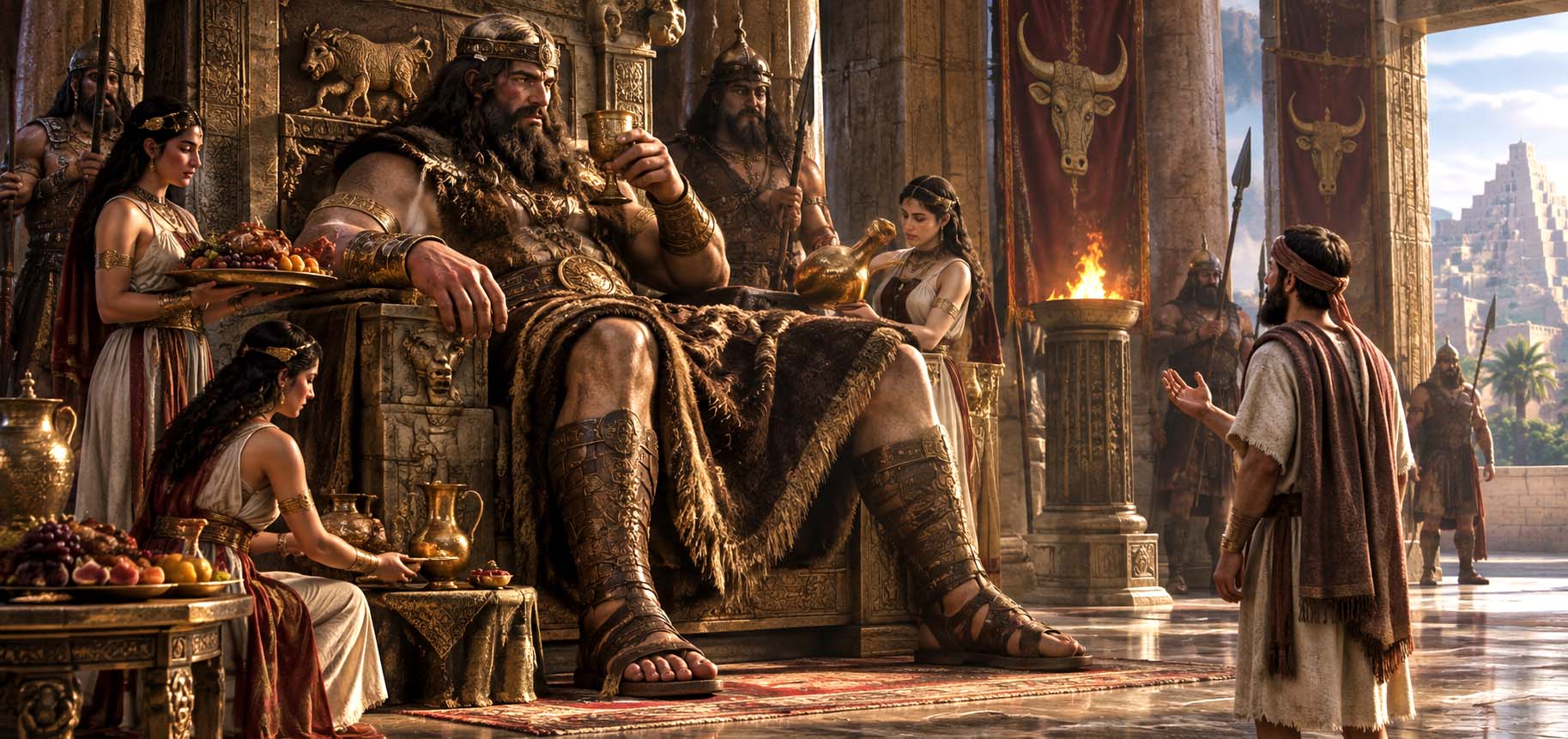
Og is one of the clearest post-Flood giant figures because the biblical record gives us more than a name. It gives a kingdom, battle location, fortified cities, association with the Rephaim, and the measured dimensions of an iron bedstead preserved at Rabbath of the children of Ammon.
“For only Og king of Bashan remained of the remnant of giants; behold his bedstead was a bedstead of iron... nine cubits was the length thereof, and four cubits the breadth of it, after the cubit of a man.”Deuteronomy 3:11, KJV
Israel met Og after the defeat of Sihon. Og came out to battle at Edrei. Deuteronomy records the capture of the whole region of Argob and sixty fortified cities, in addition to unwalled towns. Bashan stretched through the Transjordan highlands toward Mount Hermon and was remembered as a rich and formidable territory.
Primary passages: Numbers 21:33-35; Deuteronomy 3:1-14; Joshua 12:4-5; 13:12.
Illustrated reconstruction: King Og resting upon a massive iron bedstead, with normal-sized attendants included to communicate scale. The scene is interpretive; Deuteronomy 3:11 supplies the bedstead's material and dimensions, but not its construction, furnishings, or surrounding domestic setting.
Using a common 18-inch cubit, the bedstead is approximately 13 feet 6 inches long by 6 feet wide, or about 4.11 by 1.83 meters. The text measures the bed, not Og himself, so his exact height is not directly stated.
A bed is normally longer than its occupant. Older commentators therefore proposed heights around 10½ to 12 feet, while other interpreters leave the question open because a royal bed could also be intentionally oversized.
The KJV calls it a “bedstead of iron.” The Hebrew term can denote a bed or couch, and some interpreters have proposed a funerary couch or sarcophagus. Whatever its precise form, the writer treats the object as remarkable enough to identify its material, dimensions and location at Rabbath.
For the exhibit illustration, the safest reconstruction is a massive iron-framed royal bed or couch rather than a modern mattress-and-frame design.
| Feature | Suggested reconstruction | Basis | Estimated mass |
|---|---|---|---|
| Overall footprint | 13.5 ft × 6 ft | 9 × 4 cubits at 18 inches per cubit | Not applicable |
| Heavy iron frame | Large forged perimeter rails with several transverse supports | Literal “bedstead of iron,” interpreted as structural ironwork | Roughly 800 to 1,800 lb depending on section thickness and number of supports |
| Very heavy frame / platform | Thick forged members or partly plated platform | Visual reconstruction emphasizing a royal object of exceptional mass | Roughly 1,800 to 3,500 lb |
| Solid 1-inch iron plate comparison | 81 sq ft of iron, 1 inch thick | Engineering comparison only, not accounted by the text | About 3,300 lb |
| Solid 3-inch slab comparison | 81 sq ft of iron, 3 inches thick | Extreme comparison only | About 9,900 lb |
Josephus describes Og as having few equals in bodily size and says observers could infer his strength and magnitude from the iron bed preserved at Rabbath. Josephus repeats the four-cubit width and nine-cubit length and links Og's defeat with Israel's capture of sixty fortified cities.
Antiquities of the Jews · Book IV
Deuteronomy's wording is unusually concrete: material, dimensions and a location where the object could be identified. In museum terms, the bedstead functions almost like an ancient exhibit label inside the biblical narrative, a physical reminder attached to a named king and vanished giant population.
Object tradition · Rabbath
Regional Collection 06 places Og and Bashan beside the Rephaim, Ugaritic material and the wider Ancient Near Eastern record.
OPEN REGIONAL COLLECTION 06 →Exhibit IV · 1 Samuel 17
Goliath is the best-known giant champion in Scripture, but the text places him inside a larger Philistine warrior tradition centered especially on Gath. His story contains unusually specific measurements of stature, armor and weapons, while later passages name additional giant champions defeated during David's reign.
“And there went out a champion out of the camp of the Philistines, named Goliath, of Gath, whose height was six cubits and a span.”1 Samuel 17:4, KJV
For forty days Goliath came forward between the armies and challenged Israel to settle the conflict through single combat. Saul and the army were afraid. David arrived from Bethlehem while bringing provisions to his brothers, heard the challenge, rejected Saul's armor, selected five smooth stones and went out with his sling and staff.
The stone struck Goliath in the forehead. Goliath fell upon his face to the earth. David then used Goliath's own sword to complete the victory, after which the Philistine army fled.
“And David took the head of the Philistine, and brought it to Jerusalem; but he put his armour in his tent.”
When David returned from the slaughter of Goliath, Abner, captain of Saul’s host, brought the young victor before King Saul. The biblical record is unusually vivid at this point: David was still carrying the head of the Philistine in his hand. Scripture later states that David brought Goliath’s head to Jerusalem, while Goliath’s armor was placed in his tent. The text does not say that David gave the head to Saul or to any other named person.
1 Samuel 17:54, 57, KJVDavid first struck Goliath in the forehead with a stone from his sling. He then stood over the fallen champion, drew Goliath’s own sword, killed him and cut off his head. When the Philistines saw that their champion was dead, they fled, and the men of Israel and Judah pursued them.
Abner subsequently took David before Saul. David appeared before the king with Goliath’s head still in his hand. The head was afterward brought to Jerusalem. This sequence makes the severed head not merely a battlefield trophy, but a visible testimony to the defeat of the Philistine champion.
1 Samuel 17:49-57 · KJV
| Detail | Biblical figure | Approximate modern equivalent | Passage |
|---|---|---|---|
| Height | Six cubits and a span | About 9 ft 9 in using an 18-inch cubit and 9-inch span | 1 Samuel 17:4 |
| Coat of mail | 5,000 shekels of brass | Often estimated around 125 lb if a shekel is roughly 11.3 g | 1 Samuel 17:5 |
| Spearhead | 600 shekels of iron | About 15 lb under the same approximate shekel value | 1 Samuel 17:7 |
| Equipment | Helmet, greaves, target of brass, spear, shield bearer | Heavy champion equipment emphasizing protection and intimidation | 1 Samuel 17:5-7 |
| David's weapon | Sling and five smooth stones | Pastoral missile weapon used with practiced accuracy | 1 Samuel 17:40, 49 |
| Champion | Opponent | Distinctive detail | Source |
|---|---|---|---|
| Ishbi-benob | David, rescued by Abishai | Named among the sons of the giant; carried a heavy spearhead and a new sword | 2 Samuel 21:15-17 |
| Saph / Sippai | Sibbechai the Hushathite | Another descendant of the giant | 2 Samuel 21:18; 1 Chronicles 20:4 |
| Brother of Goliath | Elhanan | 1 Chronicles names him Lahmi, brother of Goliath the Gittite; his spear staff was like a weaver's beam | 1 Chronicles 20:5; compare 2 Samuel 21:19 |
| Unnamed man of great stature | Jonathan, David's nephew | Six fingers on each hand and six toes on each foot, twenty-four digits in all | 2 Samuel 21:20-21; 1 Chronicles 20:6-7 |
Joshua 11:22 says that after the Anakim were cut off from much of Israel's hill country, remnants remained in Gaza, Gath and Ashdod. Generations later, Goliath is specifically called “Goliath of Gath.” The geographic continuity is one of the most important connections in the post-Flood giant record.
Josephus retells David's confrontation with Goliath as a contest between an intimidating Philistine champion and a young Israelite who trusted God rather than conventional armor. His history reflects how strongly the event remained embedded in Jewish memory centuries later.
Ancient historical witness
The later battles show that the giant question does not end when Goliath falls. David's servants face additional men associated with the giant at Gath, giving the biblical record a sequence rather than a single isolated encounter.
| Tradition | Type of figure | Recurring theme | Why it belongs here |
|---|---|---|---|
| Hebrew Bible | Goliath and giant-descended champions | Single combat, extraordinary stature, oversized weaponry | Canonical foundation of this exhibit. |
| Greek heroic tradition | Enormous champions, Gigantes and heroic opponents | Combat between exceptional warriors and culture-defining heroes | Provides a comparative ancient Mediterranean pattern. |
| Mesopotamian heroic literature | Kings and heroes of extraordinary strength | Oversized power, dangerous adversaries, fame carried through epic tradition | Shows that exceptional champion figures were a major ancient literary category. |
| Northern European tradition | Jötnar and giant opponents | Conflict at the boundary between ordered society and powerful older beings | Demonstrates the wide persistence of giant-combat motifs. |
| Oral traditions of the Americas | Large primordial beings, powerful enemies or builders in individual tribal and regional traditions | Earlier peoples, conflict, landscape memory and extraordinary size | These accounts should be cataloged separately by nation, source and location, then compared without flattening their differences. |
The Gallery's Final Threshold
Unlike the earlier galleries, the World of Giants does not end at one biblical event. It becomes a bridge into the Giants Collection, Archaeological Collection, Research Library, migration studies, and historical case files.
This page can ultimately serve as the chronological entrance into the museum's largest long-term investigation.
Explore the Galleries
View Galleries Overview →