Gallery II
The First World
The generations after Eden begin to build, cultivate, invent, organize, worship, kill, remember, and multiply. Genesis presents a world becoming recognizably human long before the Flood.
Gallery Orientation
A world begins to take shape
Genesis 4 and 5 move rapidly from the first family to cities, occupations, music, metalworking, long genealogies, and a growing human population. The text gives only brief statements, but those statements describe the foundations of organized life.
This gallery follows those statements in sequence. It distinguishes what Genesis explicitly records from questions raised by the speed and complexity of early civilization.
Gallery II · Planned Exhibits
The first generations
Each room begins with the biblical text, then examines the people, places, occupations, chronology, and questions that arise from it.
Life Outside Eden
Adam and Eve begin a family outside the Garden. Cain becomes a tiller of the ground and Abel a keeper of sheep, introducing distinct occupations immediately within the first generation.
Family · Agriculture · Animal husbandry Open Exhibit↓ Exhibit II Genesis 4:3–16Cain & Abel
The first recorded brothers bring offerings to God. Jealousy, warning, murder, judgment, exile, and the mark of Cain introduce violence into the human story.
Worship · Murder · Judgment · Exile Open Exhibit↓ Exhibit III Genesis 4:17The First City
Cain builds a city and names it after his son Enoch. The brief statement raises one of the gallery's central questions: what population, labor, planning, and social organization did an early city require?
Settlement · Population · Construction Open Exhibit↓ Exhibit IV Genesis 4:20–22The Fathers of Civilization
Jabal is associated with tents and livestock, Jubal with the harp and organ, and Tubal-cain with the working of brass and iron. Genesis remembers specialized knowledge by name.
Pastoral life · Music · Metallurgy Open Exhibit↓ Exhibit V Genesis 4:25–26 · Genesis 5The Line of Seth
The narrative returns to Adam's family through Seth and begins the genealogical line that leads toward Noah. Names, generations, fatherhood, and chronology become the spine of the pre-Flood record.
Genealogy · Worship · Adam to Noah Open Exhibit↓ Exhibit VI Genesis 5The Long Lives
Genesis records extraordinarily long lifespans for the patriarchs before the Flood. Those overlapping generations create a very different human world from the one familiar to us today.
Longevity · Generational overlap · Chronicle Open Exhibit↓Exhibit I · First Generation
Life Outside Eden
Genesis 4:1–2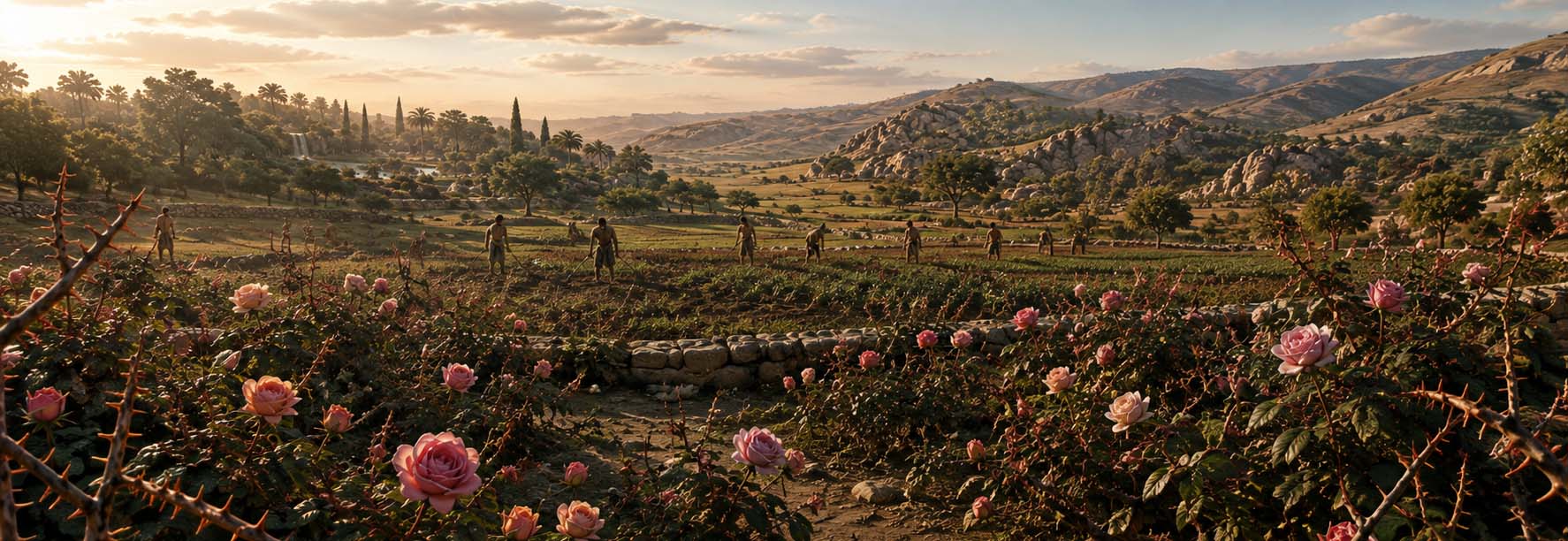
Open Life Outside Eden
Life Outside Eden begins with a contrast between memory and necessity. Adam and Eve did not enter the post-Eden world as people who had never known anything better. They had lived in the Garden itself. They knew a place planted by God, filled with trees that were both beautiful and good for food, and they had experienced direct instruction from their Creator. Genesis presents Adam as responsible for tending and keeping the Garden before the Fall, so human work was already part of life. What changed after sin was not the existence of work, but the conditions under which human beings would now labor.
Outside Eden, the ground itself became resistant. Food would still come from the earth, but now through sorrow, sweat, cultivation, and the continual struggle against thorns and thistles. Eve's experience of childbirth would likewise be marked by multiplied sorrow. Mortality became explicit, clothing of skins appeared, and access to the Tree of Life was barred. The first world outside Eden should therefore not be imagined as a primitive wasteland, nor as a continuation of effortless Paradise. It was a still-productive creation under altered conditions, a world in which human beings could build family life and cultivate the land, but only while living with consequences they had never known inside the Garden.
This exhibit deliberately stops before the murder of Abel, the rise of cities, the later specialized crafts, Jared, or the Watcher narrative. Its focus is narrower and more personal: what did it mean for the first man and woman to begin ordinary human life after having personally known Eden? Every harvest, pregnancy, garment, meal, and passing year took place against that remembered contrast.
Abundance in Eden
“every tree that is pleasant to the sight, and good for food”Genesis 2:9, KJV
The Garden is introduced not merely as fertile ground but as a place intentionally planted by God. Genesis emphasizes both appearance and provision: the trees were pleasant to the sight and good for food. Adam and Eve's first experience of obtaining food was therefore not defined by scarcity, exhausted soil, or the constant need to defend crops against weeds.
The text does not say Adam was idle in Eden. He was given responsibility there. The contrast is therefore not between work and no work. It is between stewardship in a divinely ordered garden and labor under a ground that would later resist him.
Work Existed Before the Curse
“the LORD God took the man, and put him into the garden of Eden to dress it and to keep it.”Genesis 2:15, KJV
Genesis 2:15 establishes that Adam's responsibility to dress and keep the Garden predates sin. Work is therefore part of humanity's original vocation rather than a punishment introduced afterward. The curse changes the experience of labor, not the fact that human beings were meant to act, cultivate, organize, and care for what God had made.
Outside Eden, similar abilities would still be necessary, but the conditions were different. Cultivation now involved resistance from the soil, sweat, and the appearance of thorns and thistles. The same human capacity for stewardship remained, but the world in which it was exercised had changed.
God Spoke Directly to Adam
“the LORD God commanded the man, saying, Of every tree of the garden thou mayest freely eat”Genesis 2:16, KJV
The command in Genesis 2 is direct and personal. Adam receives instruction from God before Eve is introduced into the narrative. The text presents moral responsibility as part of human life from the beginning: Adam is not merely placed in an environment; he is given freedom, a boundary, and a warning.
This direct communication is important to the later experience outside Eden. Adam did not merely inherit a tradition saying God had once spoken to humanity. He had personally received God's command. The memory of Eden therefore included not only abundance and beauty, but also direct divine instruction and accountability.
They Knew the Voice and Presence of God
“they heard the voice of the LORD God walking in the garden in the cool of the day”Genesis 3:8, KJV
Genesis 3:8 says Adam and Eve heard the voice of the LORD God walking in the Garden in the cool of the day. The passage does not require us to invent the form of God's appearance, but it does portray His presence and voice as something they recognized. Their reaction after sin is to hide, which itself assumes familiarity with the One from whom they are hiding.
For the exhibit, this is one of the most significant losses connected with Eden. Adam and Eve remembered a setting in which God's presence and voice belonged to their lived experience. Outside Eden, they continued to know God, but the Garden setting itself was gone. Their memory of Eden was spiritual as well as environmental.
Childbearing Changed
“I will greatly multiply thy sorrow and thy conception; in sorrow thou shalt bring forth children”Genesis 3:16, KJV
Genesis 3:16 places the consequences of the Fall within family life itself. Eve is told that sorrow connected with conception and childbirth will be multiplied. The passage does not describe every medical or social consequence of childbirth, so the exhibit stays closely with the text. It does, however, clearly state that bringing children into the world would now involve pain and sorrow as part of humanity's altered condition.
This becomes especially significant because the first generations would grow from Adam and Eve's family. Human continuity depended upon childbirth, yet childbirth itself now carried suffering. The growth of the human family was therefore both a continuation of life and a reminder that life outside Eden was no longer what it had been.
The Ground Was Cursed
“cursed is the ground for thy sake; in sorrow shalt thou eat of it all the days of thy life”Genesis 3:17, KJV
Genesis 3:17 directs the curse toward the ground “for thy sake.” Adam's relationship to the earth changes. The soil still produces food, but it does so under conditions of sorrow and resistance. This is why the post-Eden landscape should still appear beautiful and fertile rather than barren. The text does not describe the Earth becoming a desert.
That gives the visual scene a specific balance: cultivated plots can be green and productive, while uncultivated margins show rough growth, weeds, thorns, and harder terrain. The world remains inhabitable, but it is no longer effortless.
Thorns and Thistles
“Thorns also and thistles shall it bring forth to thee; and thou shalt eat the herb of the field”Genesis 3:18, KJV
Thorns and thistles are among the most concrete physical details Genesis gives us about life outside Eden. They symbolize resistance in the land itself. Fields cannot simply be assumed to remain ordered and productive without continual effort. Human beings must clear, weed, cut, protect, and maintain the areas they depend upon for food.
For the illustration, these details should be visible without making the landscape ugly. A productive field beside patches of thistles and thorny growth would communicate the biblical contrast better than a barren wasteland. The difficulty lies in maintaining order within a creation that now pushes back.
Food Now Required Sweat
“In the sweat of thy face shalt thou eat bread”Genesis 3:19, KJV
Genesis 3:19 connects food directly with physical exertion: “In the sweat of thy face shalt thou eat bread.” Bread gives us a useful clue that the cycle of food now involved more than simple gathering. Cultivation, harvest, processing, grinding, preparation, and storage naturally belong to the world outside Eden.
The exhibit can therefore show baskets, stored produce, grain or other cultivated plants, grinding or preparation tools, and a household organized around food production. None of this requires advanced technology. It follows from the demands of obtaining and preparing food under the conditions Genesis describes.
Mortality Became Explicit
“for dust thou art, and unto dust shalt thou return.”Genesis 3:19, KJV
The declaration that Adam will return to dust places mortality at the center of the post-Eden condition. Adam and Eve now live with the knowledge that their bodies will not continue indefinitely. Aging, weakness, injury, and death become part of the horizon of human experience.
For the first generation, this knowledge would have been especially stark. Adam and Eve remembered a Garden containing the Tree of Life, yet outside Eden they were barred from access to it. Their future family therefore begins with a consciousness of mortality that did not define their original life in the Garden.
God Provided Clothing of Skins
“Unto Adam also and to his wife did the LORD God make coats of skins, and clothed them.”Genesis 3:21, KJV
Genesis 3:21 is the first explicit reference to animal skins being used as clothing for humans. The text states that God made coats of skins for Adam and Eve and clothed them. It does not specify the species of animal, the exact process, or whether Adam later produced additional garments by the same means. Those questions should remain open.
The point we can state confidently is that life outside Eden included clothing more substantial than the fig-leaf coverings Adam and Eve had made for themselves. The scene should therefore show them wearing animal-skin garments, but should not depict hunting or slaughter unless a later exhibit specifically addresses evidence for those practices.
Adam Was Sent Out to Cultivate the Ground
“the LORD God sent him forth from the garden of Eden, to till the ground from whence he was taken.”Genesis 3:23, KJV
Genesis 3:23 is the clearest transition verse for this exhibit. Adam is sent from the Garden “to till the ground from whence he was taken.” The post-Eden vocation is therefore not vague survival but active cultivation. Human beings are still expected to work with the earth, but now under the conditions already described in the curse.
This verse also gives us the central composition for the illustration: cultivated land, visible labor, a dwelling or household forming nearby, and a landscape that remains capable of sustaining life. The entire scene should feel like the beginning of a human world outside Paradise rather than a collapse into savagery.
The Way Back Was Guarded
“he placed at the east of the garden of Eden Cherubims, and a flaming sword... to keep the way of the tree of life.”Genesis 3:24, KJV
Genesis 3:24 makes the separation from Eden irreversible by ordinary human effort. Cherubim and a flaming sword are placed at the east of the Garden to guard the way to the Tree of Life. The text does not say Adam and Eve forgot where Eden was. The act of guarding the way instead presents a boundary that could not simply be crossed.
This is one of the most emotionally powerful elements for the exhibit. Adam and Eve remembered the Garden, yet could not return to the life they had lost. The illustration can suggest Eden in the far distance as an inaccessible, exceptionally lush region, while avoiding excessive supernatural spectacle beyond the guarded boundary described in Genesis.
Exhibit II · Worship and Violence
Cain & Abel
Genesis 4:3–16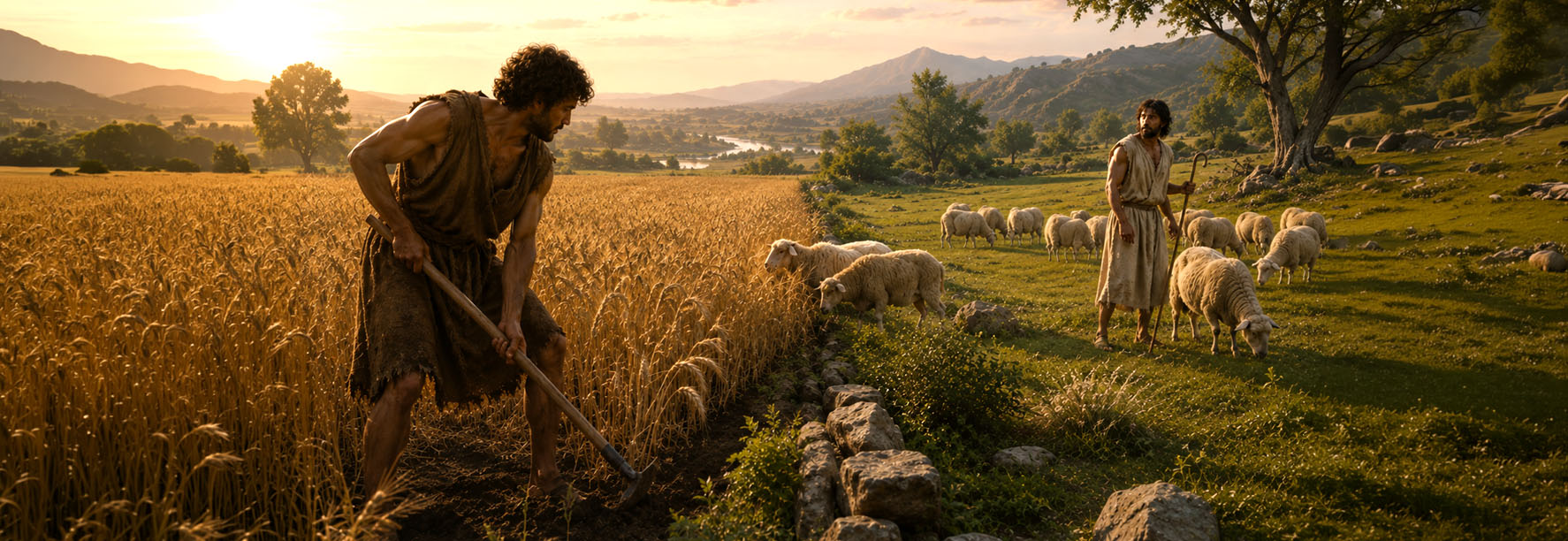
Open Cain & Abel
Cain and Abel enter the biblical record as members of the first generation born outside Eden. Their story begins not with violence, but with family, work, worship, and responsibility. Cain cultivates the ground and Abel keeps sheep. Both bring offerings to the LORD. The account therefore presents agriculture, animal husbandry, and worship as established features of the earliest post-Eden human world.
The turning point is Cain's response when his offering is not regarded as Abel's is. Before any murder occurs, God speaks directly to Cain, questions his anger, warns him about sin, and tells him that he must rule over it. Cain is therefore not portrayed as acting without warning. Genesis deliberately places divine counsel before the crime, making Cain's later action a moral choice made after an explicit warning.
The murder of Abel introduces the first recorded human death at the hand of another human being. The consequences extend beyond the loss of Abel. Cain is judged in relation to the ground he cultivated, fears retaliation from other people, receives a protective mark from God, leaves the presence of the LORD, and settles in the land of Nod east of Eden. The story then moves toward Cain's family and city building, which this gallery will examine more fully in the next exhibit.
Two Brothers, Two Occupations
“Abel was a keeper of sheep, but Cain was a tiller of the ground.”Genesis 4:2, KJV
The first two sons named in Genesis are associated with specialized work. Cain continues the cultivation of the ground already assigned to Adam outside Eden, while Abel manages flocks. The text therefore begins this episode in an organized working household rather than an undefined primitive setting.
The Offerings
“Cain brought of the fruit of the ground an offering unto the LORD. And Abel, he also brought of the firstlings of his flock and of the fat thereof.”Genesis 4:3–4, KJV
Both brothers understand the act of bringing an offering to God. Genesis distinguishes what each brings and then records that the LORD had respect unto Abel and his offering, but not unto Cain and his offering. The passage itself should control the exhibit; we should not invent details about the quality of Cain's produce that Genesis does not state.
God Warned Cain Before the Murder
“Why art thou wroth? and why is thy countenance fallen? ... sin lieth at the door ... and thou shalt rule over him.”Genesis 4:6–7, KJV
This warning is central to the narrative. Cain's anger is recognized before it becomes violence. God addresses him, confronts the danger, and places responsibility upon Cain to master what is developing within him. The murder that follows is therefore preceded by warning and opportunity to choose differently.
The First Recorded Murder
“Cain rose up against Abel his brother, and slew him.”Genesis 4:8, KJV
Genesis is strikingly brief about the act itself. It does not specify the weapon or method. That restraint is important. Later writings expand the story, but the canonical account simply records that Cain killed his brother.
“Am I My Brother's Keeper?”
“Where is Abel thy brother? And he said, I know not: Am I my brother's keeper?”Genesis 4:9, KJV
God's question is followed by Cain's denial and one of the most remembered statements in Genesis. The exchange moves the account from the physical act of murder to responsibility, truth, and accountability before God.
Abel's Blood and the Ground
“The voice of thy brother's blood crieth unto me from the ground.”Genesis 4:10, KJV
The ground is again central. Cain had been introduced as a tiller of it; now it has received Abel's blood. His judgment specifically affects his relationship with that ground: it will no longer yield its strength to him as before.
Cain Becomes a Fugitive and Wanderer
“a fugitive and a vagabond shalt thou be in the earth.”Genesis 4:12, KJV
Cain's punishment includes displacement. The agricultural worker becomes a fugitive and wanderer. This judgment becomes especially significant when the narrative later identifies his destination as the land of Nod.
The Mark of Cain: What Scripture Actually Says
Cain responds to his judgment with fear that someone who encounters him will kill him:
“it shall come to pass, that every one that findeth me shall slay me.”
Genesis 4:14, KJV
God answers that fear with a declaration of protection:
“whosoever slayeth Cain, vengeance shall be taken on him sevenfold. And the LORD set a mark upon Cain, lest any finding him should kill him.”
Genesis 4:15, KJV
The stated purpose of the mark is therefore clear: it protected Cain from being killed. Genesis does not describe what the mark looked like, where it appeared, its color, its shape, or its physical character. Those details should not be supplied by the exhibit as though Scripture recorded them.
Cain's fear also raises a legitimate textual question: who did Cain believe might kill him? Genesis does not give Cain and Abel's ages at the time of the murder, nor does it say that only four human beings then existed. Genesis 5:4 later states that Adam “begat sons and daughters.” The text therefore leaves room for a larger family population without requiring us to invent a number.
The Land of Nod: A Land of Wandering
“Cain went out from the presence of the LORD, and dwelt in the land of Nod, on the east of Eden.”
Genesis 4:16, KJV
Scripture gives one geographic relationship: Nod was east of Eden. It provides no river, mountain, distance, boundary, or other geographic marker sufficient to identify Nod confidently with a modern location. For that reason, this museum does not attempt to place Nod on a modern map.
There is also an important linguistic connection. Hebrew נֹוד (Nod) is associated with wandering or being a wanderer, closely echoing Cain's judgment in Genesis 4:12: “a fugitive and a vagabond shalt thou be in the earth.” The name Nod may therefore carry the sense of a land of wandering, while Genesis nevertheless presents it as somewhere Cain went and dwelt.
The next verse records Cain's family and the building of a city. That development belongs primarily to Exhibit III: The First City, where we can examine what the biblical use of the word “city” may imply about settlement, population, construction, and organization.
How Later Scripture Remembers Abel and Cain
Hebrews 11:4 interprets Abel's offering through faith: “By faith Abel offered unto God a more excellent sacrifice than Cain,” adding that through it “he obtained witness that he was righteous” and “being dead yet speaketh.”
Hebrews 12:24 later contrasts the blood of Jesus with “the blood of Abel.” Abel's blood had cried from the ground in Genesis; the New Testament uses that memory in a theological comparison with the blood of Christ.
1 John 3:12 recalls Cain as one “who was of that wicked one, and slew his brother,” and asks why he killed him: “Because his own works were evil, and his brother's righteous.”
Jude 11 uses the expression “the way of Cain” as a warning within a much later context of rebellion and corruption.
Jesus Himself identifies Abel as righteous. Matthew 23:35 speaks of “righteous Abel,” while Luke 11:50–51 places Abel at the beginning of the remembered history of righteous bloodshed.
area for further study: Was Cain Under Demonic Possession?
“Not as Cain, who was of that wicked one, and slew his brother. And wherefore slew he him? Because his own works were evil, and his brother's righteous.”
1 John 3:12, KJV
John's wording is striking because it explicitly associates Cain with “that wicked one.” In the immediate context, 1 John has already contrasted the children of God with those who are “of the devil.” Cain becomes the earliest named example of murderous hatred in that argument.
This raises a legitimate theological question for the exhibit: does “of that wicked one” describe temptation and spiritual allegiance, or could Cain have experienced some more direct form of demonic influence? Scripture does not tell us that a demon entered Cain's body, and it never uses the language normally associated with possession to describe him. We therefore cannot identify Cain as the first demon-possessed person from the biblical text.
Genesis 4:6–7 also preserves Cain's moral agency. Before Abel is killed, God confronts Cain's anger, warns that sin lies at the door, and tells Cain that he must rule over it. Cain is presented as someone being warned and held responsible for the choice he is about to make.
Jubilees and the Expanding First Family
Jubilees 4 preserves a considerably fuller family sequence than Genesis. It records that Adam and Eve mourned Abel, that Seth was later born as another seed in Abel's place, and that a daughter named Azûrâ followed. It says Cain married his sister Âwân, who bore Enoch, while Seth later married Azûrâ and fathered Enos. Jubilees also states that Adam and Eve subsequently had nine additional sons.
Family Detail Preserved in Jubilees
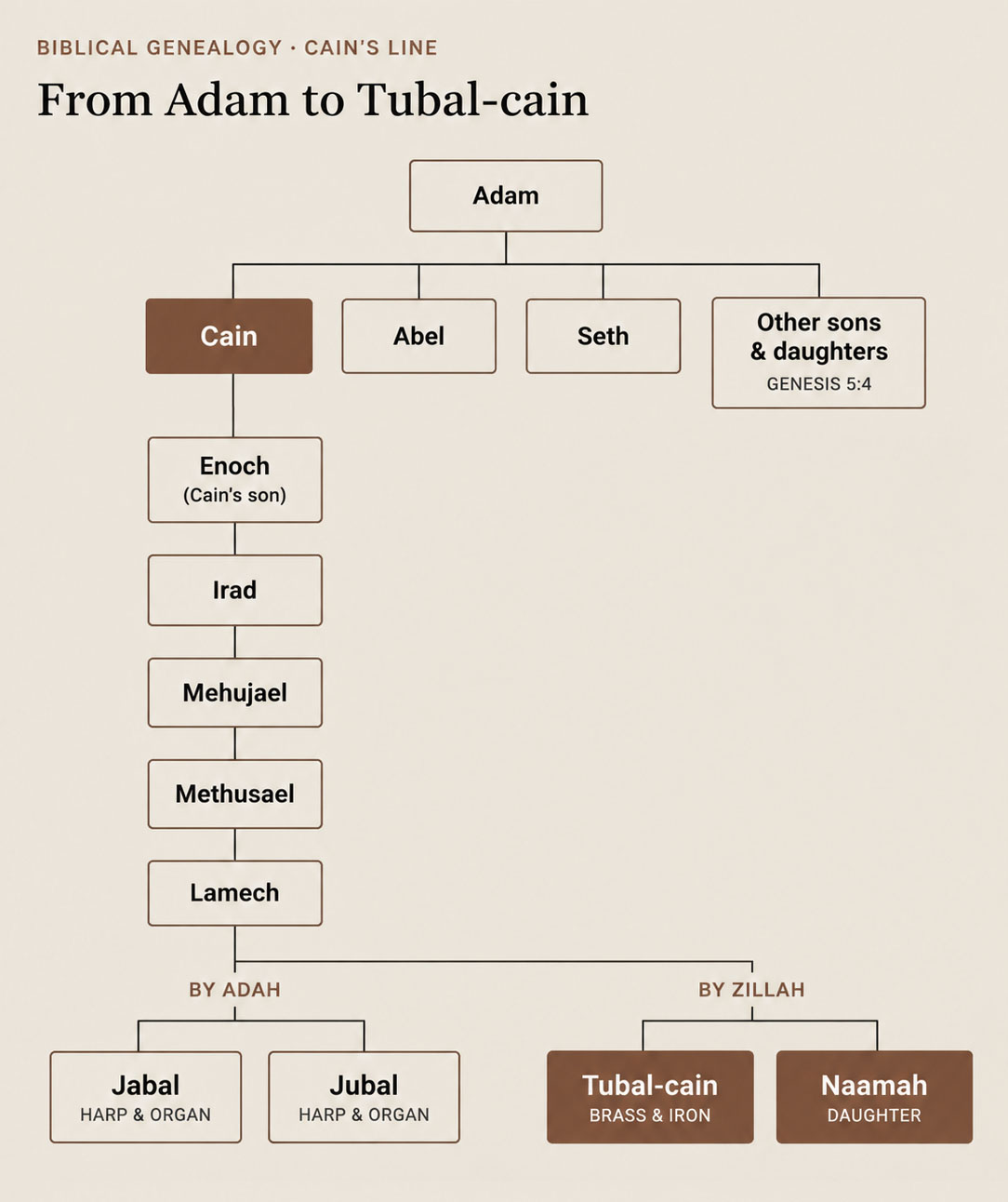
Jubilees continues the genealogy toward Jared and supplies additional wives and chronological notices along the way. These details help explain how the ancient work envisioned the rapid expansion of the first family. They are useful documentary evidence for the tradition, but they are not supplied by Genesis itself and therefore remain clearly labeled non-canonical.
Jasher's Expanded Account of Abel's Death
Genesis states only that Cain and Abel were in the field when Cain rose against his brother and killed him. The later Book of Jasher supplies a much more elaborate version of the circumstances. In its account, Abel's flock passes over ground Cain had cultivated, and the brothers enter into a difference involving the land, the flock, clothing, and the produce each accounted as his own.
Jasher then intensifies the confrontation. Cain questions Abel about who could demand Abel's blood if Cain killed him, while Abel appeals to God as judge. The account finally says Cain:
“took the iron part of his ploughing instrument”
Jasher 1:25 then says Cain struck Abel with it and killed him. The following verses describe Cain grieving, digging a hole in the field, and covering Abel's body with earth.
This is a valuable example of an expanded extra-biblical tradition, but the distinction is essential: Genesis does not identify a weapon, describe a property difference, or say Cain buried Abel. Those details belong specifically to the later Jasher account and should remain labeled as such.
Josephus: An Ancient Character Portrait of the Brothers
Writing in the first century AD, Flavius Josephus retold the account in Antiquities of the Jews, Book I. His version gives the brothers more explicit character descriptions than Genesis does. Josephus calls Abel:
“a lover of righteousness”
and says Abel believed “that God was present at all his actions.” By contrast, Josephus characterizes Cain as “very wicked” and “wholly intent upon getting.”
Josephus also expands the account of the murder. After describing the brothers' sacrifices and Cain's anger at Abel being preferred, he says Cain:
“slew his brother, and hid his dead body”
His retelling contains another notable difference from the wording of Genesis. Josephus says Cain feared that while wandering he might perish among wild beasts, after which God marked him and commanded him to depart. Genesis 4:14 instead records Cain's fear that “every one that findeth me shall slay me.” The distinction is worth preserving because it shows where Josephus is interpreting or expanding the biblical narrative rather than merely quoting it.
Source classification: Josephus is an important ancient witness to how the Cain and Abel account was understood and retold in the first century AD, but his added characterizations and narrative details remain an ancient historical interpretation rather than canonical Scripture.
Exhibit III · Settlement
The First City
Genesis 4:17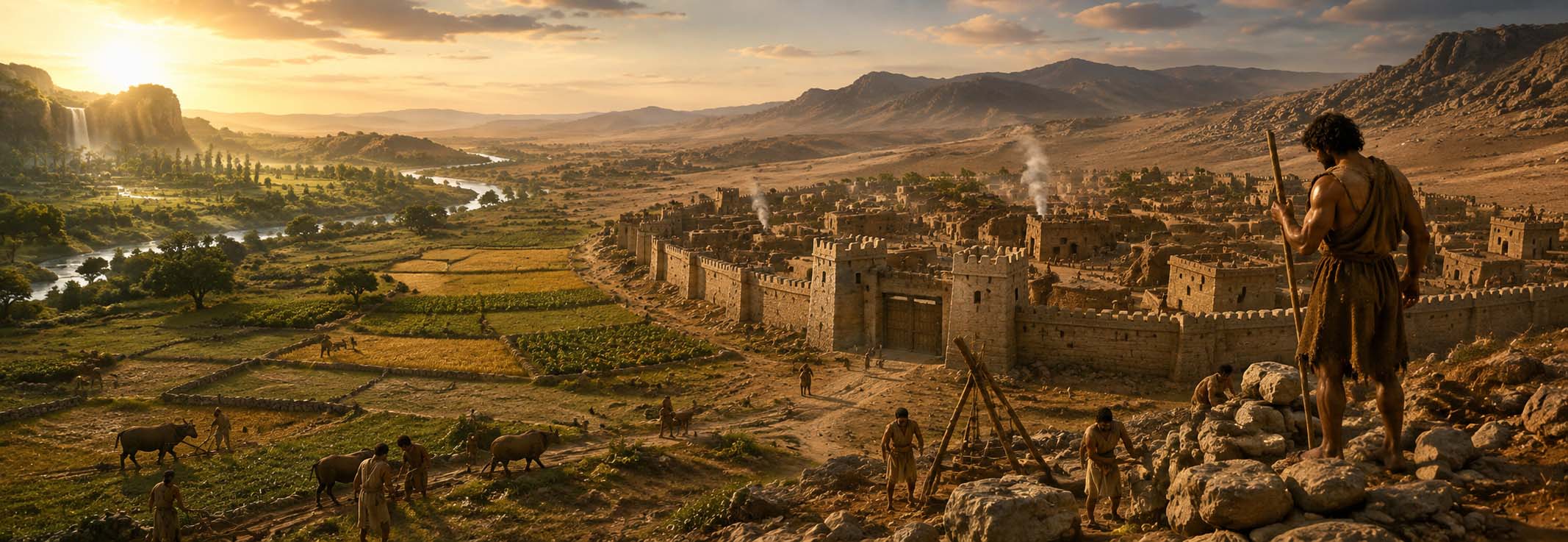
Open The First City
The first city mentioned in Scripture appears almost immediately after the first recorded murder. Cain has killed Abel, been judged by God, expressed fear that others may kill him, received a protective mark, departed from the presence of the LORD, and settled east of Eden. Genesis then records that Cain and his wife had a son, Enoch, and that Cain built a city bearing his son's name.
“And Cain knew his wife; and she conceived, and bare Enoch: and he builded a city, and called the name of the city, after the name of his son, Enoch.”
Genesis 4:17, KJV
The statement is brief, but the word city raises substantial questions. A city suggests more than an isolated dwelling. Even a modest early settlement would require people, repeated construction, food and water, cooperation, family organization, and some reason for gathering together rather than remaining dispersed.
The First Recorded Movement Eastward
“And Cain went out from the presence of the LORD, and dwelt in the land of Nod, on the east of Eden.”
Genesis 4:16, KJV
This is the first explicit directional movement of a human family recorded after Eden. Scripture does not give enough geographic information to identify Nod on a modern map, but it does preserve the direction: east of Eden.
The sequence is therefore worth documenting without adding geography the text does not provide: displacement → movement eastward → settlement → city building. This anchor can later be cross-referenced from the museum's migration material as the first directional movement explicitly recorded in the biblical narrative.
Why Did Cain Build a City?
Genesis does not state Cain's motive. Any proposed reason must therefore remain interpretation. Yet the circumstances immediately preceding the city's construction are striking.
“it shall come to pass, that every one that findeth me shall slay me.”
Genesis 4:14, KJV
Cain expected retaliation after Abel's murder. Genesis records no human court, prison, police authority, or civil government at this stage of the narrative. God Himself judges Cain and places a mark upon him so that he will not be killed. We cannot conclude from that silence that murder had become commonplace, but the text clearly shows that Cain believed other people might take his life.
Could a concentrated settlement have offered Cain's growing family greater security than isolated households? A settlement could bring relatives together, concentrate labor and food, define territory, and potentially provide protection. This possibility becomes especially interesting when compared with the much later account of Josephus, who explicitly describes Cain's city as fortified.
From Wandering to Settlement
“a fugitive and a vagabond shalt thou be in the earth.”
Genesis 4:12, KJV
There is an important tension in the narrative. The man sentenced to become a fugitive and wanderer becomes the first person Scripture records as building a city. Cain's movement away from Eden does not end with perpetual isolation. Genesis moves rapidly from exile and wandering to family, settlement, and construction.
The first murderer recorded in Scripture is therefore also the first city-builder recorded in Scripture. Organized settlement enters the narrative after humanity has already experienced sin, murder, fear, judgment, separation, and movement away from Eden.
What Does a City Imply?
Genesis does not describe the size, walls, street plan, architecture, or population of Cain's city. We should not imagine a later imperial metropolis and project it backward into Genesis. Nevertheless, calling the settlement a city invites legitimate questions about what was already developing within the first generations.
Construction requires labor and materials. A permanent population requires food and water. Families living together require organization. Agricultural work must support people who are building, tending animals, raising children, and performing other tasks. Defined settlement also introduces questions of territory, storage, cooperation, security, and social order.
From Wanderer to Walls
One of the most intriguing features of Cain's story is the sequence itself. God tells Cain that he will be “a fugitive and a vagabond” in the earth. Cain immediately voices fear that someone who finds him will kill him. God then places a protective sign upon Cain. Only a few verses later, Cain is associated with the building of a city.
“a fugitive and a vagabond shalt thou be in the earth.”
Genesis 4:12, KJV
“every one that findeth me shall slay me.”
Genesis 4:14, KJV
Genesis never states that Cain built the city because he feared attack, so defense should not be presented as his stated motive. Yet the fear of being killed is explicit and occurs immediately before Cain's eastward departure, family settlement, and city building. It is therefore reasonable to ask whether security, family protection, permanence, or control of a settled place contributed to the development of the community.
What Did the First “City” Look Like?
The word city can cause a modern reader to imagine monumental streets, towers, palaces, or the great cities of later Mesopotamia. Genesis 4 describes nothing of that scale. It gives no population, dimensions, walls, gates, towers, government, or architectural plan for Cain's city.
The safest picture is an organized settlement substantial enough for Genesis to distinguish it from individual households or temporary movement. Clustered dwellings, work areas, storage, animal enclosures, water access, nearby cultivated land, and boundaries are reasonable possibilities, but they remain historical inference, not details supplied by Genesis.
The biblical statement is more basic and perhaps more consequential: Cain is now associated with a named, built place.
What Does a City Change?
A permanent settlement changes the conditions under which knowledge can accumulate. Families living near one another can divide labor, preserve food, maintain shared structures, exchange materials, teach specialized skills, protect stored resources, and pass techniques beyond a single household. Genesis does not specifically describe these arrangements in Cain's city, but they help explain why permanent settlement matters in the development of civilization.
The order of Genesis 4 is therefore interesting. The first named city appears before Jabal, Jubal, and Tubal-cain and their specialized traditions of pastoral life, music, instruments, and metalworking. The city becomes a natural bridge into The Fathers of Civilization.
Josephus Saw Cain's Settlement as an Expansion of Organized Society
Writing in the first century AD, Josephus expands Cain's story beyond the brief account in Genesis. In Antiquities of the Jews, Book I, he portrays Cain as accumulating possessions and changing the way people lived together. Josephus associates him with measures and weights, property boundaries, and fortified settlement.
Those details should not be read back into Genesis as though Genesis itself described Cain inventing those institutions. They are valuable because they show how an ancient Jewish historian interpreted the first-city narrative: Cain's building activity represented a transition toward concentrated, bounded, increasingly organized human society.
Josephus gives this development a moral dimension as well, portraying Cain's innovations negatively because he believed Cain used organization and possessions to increase selfishness and violence. That judgment belongs to Josephus's retelling. Genesis itself is far more concise.
The City Becomes the Setting for the Next Generations
Genesis does not end the city story with Cain. Cain names the city after his son Enoch, and the genealogy continues through Enoch → Irad → Mehujael → Methusael → Lamech. With Lamech's household, the text suddenly identifies particular descendants by specialized activities.
Agriculture and animal keeping have already appeared. Cain migrates east and builds a city. Generations continue within his line. Then Genesis introduces Jabal and pastoral life, Jubal and musical instruments, and Tubal-cain and metalworking. The narrative moves from survival → settlement → succession → specialization.
The First City is therefore not an isolated curiosity. It is the beginning of the built environment from which the next stage of the Genesis 4 civilization narrative emerges.
Had Human Religion Already Begun to Divide?
At this point in the museum narrative, the visitor has not yet been introduced to the Watchers. That story belongs later, in the generation of Jared. For now, the important question is simpler: after Eden, were human communities already capable of developing beliefs and religious practices that departed from worship of the Creator?
Genesis shows that human rebellion begins long before the later Watcher tradition. Cain knows God, communicates with Him, receives a direct warning, murders Abel, and then leaves the presence of the LORD. Yet the biblical record also preserves continued worship. Abel brings an offering to God, and Genesis later says of Seth's line:
“then began men to call upon the name of the LORD.”
Genesis 4:26, KJV
The picture is therefore not necessarily one of all humanity abandoning God at once. The text allows us to observe diverging human behavior: worship and faithfulness continuing in some lines while rebellion, violence, separation, and increasingly organized settlement develop elsewhere.
Archaeological sites such as Göbekli Tepe demonstrate that very early communities were capable of organizing substantial labor around monumental structures containing powerful ritual and symbolic imagery. Archaeology can document the structures, carvings, gathering places, and material remains. It cannot tell us with certainty whom those people believed they were addressing, whether they remembered the Creator, whether they had rejected Him, or precisely what their symbols meant.
This creates an important museum question rather than a conclusion: could organized religious practices contrary to worship of the Creator have developed through human rebellion before any later supernatural intervention described in Enoch or Jubilees?
Later in this collection, the visitor will encounter ancient writings that associate the generation of Jared with the descent of beings called the Watchers. We will examine those texts when the narrative reaches Jared. Nothing in the present exhibit requires those beings to explain Cain's sin, early migration, city building, or the possibility of developing human religious traditions.
Jubilees: Houses and Cain's City
Jubilees 4 expands the settlement tradition by associating Cain's period with the building of houses and then recounting Cain's construction of a city named after his son Enoch. Jubilees also supplies its own chronology for these events.
This is useful because it portrays the first city within a broader transition toward permanent houses and settled life. The chronology and added details belong specifically to Jubilees and should not be presented as dates or statements supplied by Genesis.
Josephus: Travel, Boundaries, Measures, and Fortification
Writing in the first century AD, Flavius Josephus gives a much fuller interpretation of Cain's life after Abel's death. Josephus portrays Cain as traveling before settling, accumulating possessions, establishing boundaries around lands, and introducing measures and weights.
Most significant for the question of protection, Josephus says Cain:
“built a city, and fortified it with walls”
Josephus also portrays Cain as gathering his family into the settlement. That description is not found in Genesis, but it is important as an ancient interpretation of what Cain's first city may have represented: concentrated population, defined territory, economic organization, and physical defense.
Source boundary: Genesis records the city but does not mention walls. The fortified city belongs to Josephus's later historical retelling and is presented here as such.
From the First City Toward Civilization
The narrative does not stop with Cain's settlement. Only a few verses later Genesis names descendants associated with livestock and tent dwelling, music, and metalworking. The biblical text therefore moves rapidly from the first family outside Eden to recognizable elements of organized civilization.
That progression leads directly into the next exhibit, The Fathers of Civilization, where Jabal, Jubal, and Tubal-cain become central to the record.
Exhibit IV · Specialized Knowledge
The Fathers of Civilization
Genesis 4:20–22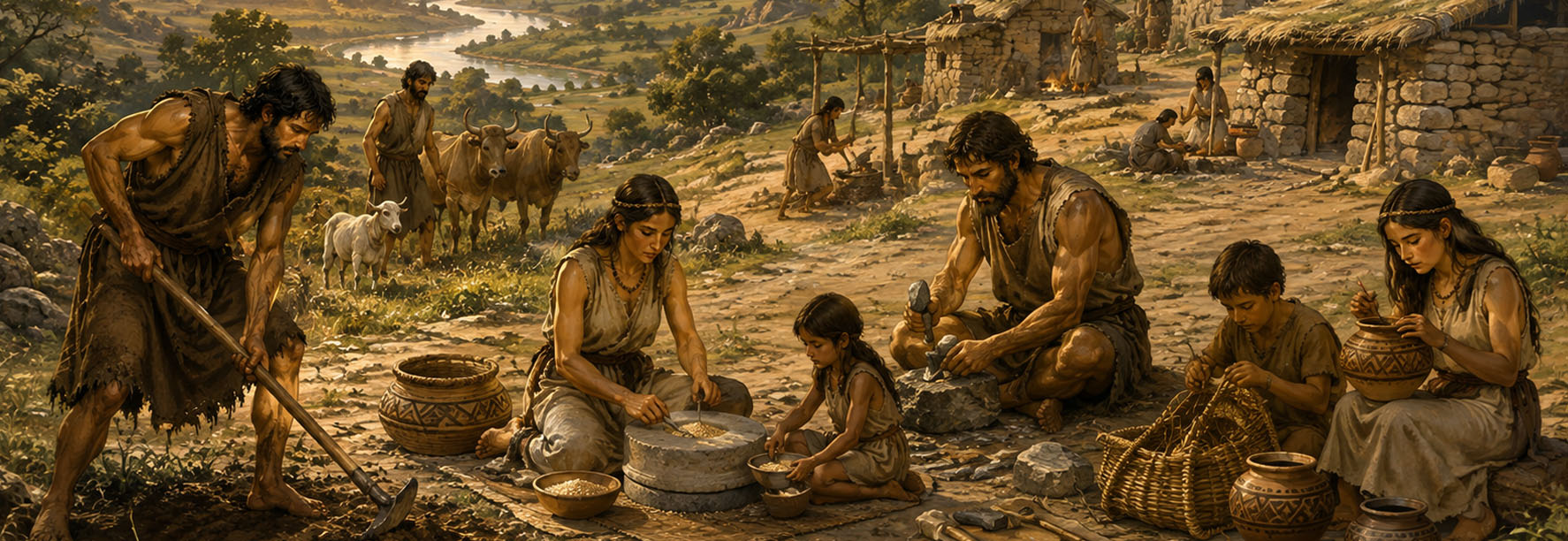
Open The Fathers of Civilization
Civilization Did Not Begin with Jabal and Tubal-cain
Genesis presents civilization as a progression. Before Jabal, Jubal, and Tubal-cain ever appear, the text has already described cultivation, animal husbandry, worship, migration, family expansion, settlement, and city building. The later specialists therefore enter a world that is already becoming organized.
Adam is placed in the Garden “to dress it and to keep it” before the Fall (Genesis 2:15). Outside Eden, Cain becomes “a tiller of the ground” and Abel “a keeper of sheep” (Genesis 4:2). After Abel's death, Cain moves east of Eden, establishes a family, and builds the first city named in Scripture (Genesis 4:16–17).
“and he builded a city, and called the name of the city, after the name of his son, Enoch.”
Genesis 4:17, KJV
Genesis then moves quickly through Cain's descendants: Enoch → Irad → Mehujael → Methusael → Lamech. With Lamech's household, the text slows down and begins identifying descendants not merely by ancestry, but by the fields of knowledge and activity associated with them.
Jabal: Pastoral Life Becomes a Named Tradition
“he was the father of such as dwell in tents, and of such as have cattle.”
Genesis 4:20, KJV
Jabal is associated with a way of life built around tents and livestock. This suggests more than simply possessing animals. Herding communities must manage grazing, breeding, water, seasonal movement, shelter, food storage, and the repeated construction and transport of habitation.
The phrase “father of such as” presents Jabal as the remembered beginning or representative ancestor of a recognizable pastoral tradition.
Jubal: Music Becomes a Specialized Art
“he was the father of all such as handle the harp and organ.”
Genesis 4:21, KJV
Jubal's appearance marks another development. Music requires more than the human voice. The biblical wording specifically associates him with instruments. Instrument making requires material selection, shaping, tension, resonance, repeated experimentation, and the transmission of technique.
Genesis therefore remembers artistic and technical knowledge alongside agriculture and herding. Civilization in the text is not merely about survival. It includes creative expression.
Tubal-cain: Metalworking and the Skilled Craftsman
“an instructer of every artificer in brass and iron”
Genesis 4:22, KJV
Tubal-cain is associated with the working of metals and with other craftsmen. Metalworking implies access to ores or metal-bearing material, control of heat, furnaces or hearths, fuel, repeated experimentation, shaping, hammering, and the knowledge required to reproduce successful results.
The KJV's word “instructer” is especially significant to the museum's larger question. Knowledge is no longer merely possessed by one person. The wording presents Tubal-cain in connection with craftsmen and the transmission or refinement of a specialized skill.
A Name Preserved Without Explanation
Naamah: Why Does Genesis Preserve Her Name?
“and the sister of Tubal-cain was Naamah.”
Genesis 4:22, KJV
Genesis has just identified Jabal, Jubal, and Tubal-cain by the activities for which they were remembered. Then, without assigning her an occupation or explaining her importance, the text pauses to preserve the name of Naamah, Tubal-cain's sister.
That does not prove that a missing story once existed, nor does Scripture itself tell us why Naamah was named. But the unusual preservation of her name invites a legitimate textual question: was Naamah already a known figure to ancient readers whose significance required no explanation at the time?
Biblical Precedent for Naming a Sister
Naamah is not the only woman whose name appears unexpectedly within genealogical material. Later biblical passages specifically preserve Timna as Lotan's sister (Genesis 36:22), Miriam within a family record (Numbers 26:59), and Maacah as a named sister (1 Chronicles 7:15). Such examples do not establish why Naamah was named, but they show that the preservation of a woman's name within a genealogy can carry family or narrative significance.
Ancient Tradition 1: Was Naamah Noah's Wife?
Genesis Rabbah preserves a rabbinic tradition identifying Naamah as Noah's wife and explaining her name through the pleasantness of her deeds. Rashi later repeats the identification. Ramban discusses the same tradition and reasons that, if it were correct, her importance would explain why Scripture preserved her name: through her, a remnant of Cain's family would survive the Flood.
This identification is not stated in Genesis, and other ancient traditions give Noah's wife a different identity. It therefore belongs in the museum as an ancient interpretation, not as biblical fact.
Ancient Tradition 2: A Connection to the “Sons of God”?
Ramban also preserves a very different tradition, citing Pirkei de-Rabbi Eliezer, in which Naamah is associated with the woman through whom the benei ha'elohim, the “sons of God,” went astray. This became significant to later interpreters because the unexplained naming of Naamah in Genesis 4 occurs shortly before the narrative reaches Genesis 6 and the account of the “sons of God” and the “daughters of men.”
Again, the boundary is crucial: Genesis 6 never names Naamah, and 1 Enoch does not identify her as one of the women taken by the Watchers. The association belongs to later interpretive tradition.
A Third Rabbinic Possibility
Genesis Rabbah also preserves a different opinion about a Naamah associated with music used in idolatrous worship. This demonstrates how widely ancient interpreters differed over the reason her name was preserved. Rather than giving us one certain biography, the traditions show that earlier readers were themselves trying to answer the same question raised by the biblical text: why Naamah?
Genesis records generations of Cain's descendants, then pauses to preserve the name of Tubal-cain's sister without telling us why. Later Jewish writers noticed the same peculiarity and supplied dramatically different explanations: righteous wife of Noah, a woman connected with the “sons of God,” or a figure associated with idolatrous music.
We cannot determine from Genesis which, if any, of these traditions preserves the original reason. But the name itself remains in the biblical record. Its unexplained appearance deserves attention, especially as the narrative approaches Genesis 6.
How Later Writings Expand the Picture
Jubilees expands the early family record with additional names, marriages, houses, and chronology. It portrays the generations as an expanding human society rather than a handful of isolated individuals.
Jasher also expands the Cainite family narrative, but its additional details belong to extra-biblical tradition and should remain separated from the statements of Genesis.
Josephus, writing in the first century AD, develops the civilizational theme further. His retelling associates Cain's society with property boundaries, measures and weights, concentrated settlement, and fortification. These details are not stated in Genesis, but they show how an ancient writer understood Cain's descendants as participants in the growth of organized society.
What Did Humanity Already Know?
By the time the Genesis narrative reaches Jabal, Jubal, and Tubal-cain, it has already described cultivation, herding, city building, family organization, music, instrument making, and metallurgy. The biblical text therefore attributes a substantial body of practical and creative knowledge to human society before the later Watcher traditions are introduced.
This distinction will matter later. When 1 Enoch describes particular teachings associated with the Watchers, the museum can compare those accounts against the knowledge Genesis has already credited to humanity. The question will not simply be “What did the Watchers teach?” but also “What did human beings already know before that episode?”
Exhibit V · Genealogy and Transmission
The Line of Seth
Genesis 3:15 · 4:25–26 · Genesis 5 · Genesis 6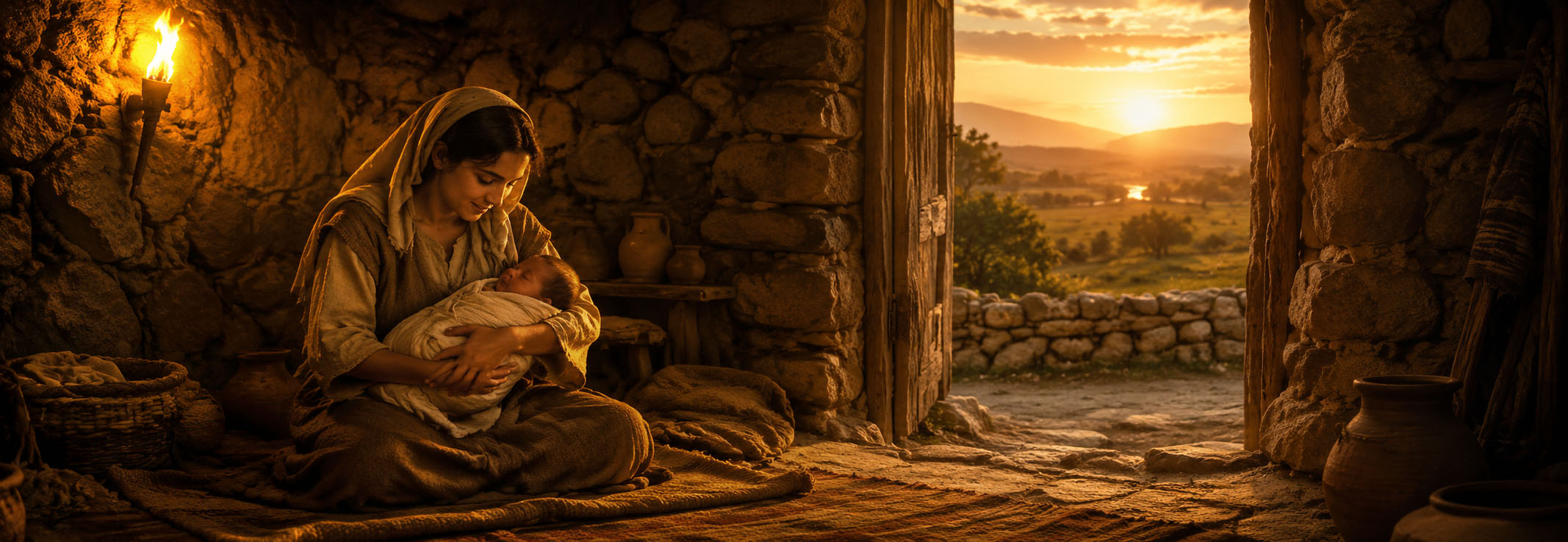
Open The Line of Seth
“Another Seed Instead of Abel”
The story does not end with Abel's blood in the field or Cain's departure to the east. Genesis returns to Adam and Eve and records the birth of another son. Eve does not describe Seth merely as another child. She uses the language of seed.
“For God, said she, hath appointed me another seed instead of Abel, whom Cain slew.”
Genesis 4:25, KJV
That word deserves attention because the language of seed has already appeared in Genesis. After the Fall, God speaks of enmity between the serpent and the woman, and between the serpent's seed and her seed (Genesis 3:15). Genesis 4:25 does not explicitly say that Seth fulfills Genesis 3:15, and this exhibit does not make that account. What the text does establish is that Eve herself understands Seth as an appointed continuation after the loss of Abel.
From this point forward Genesis follows Seth's descendants with extraordinary precision. Cain's line has already introduced city building, pastoral specialization, music, instruments, and metallurgy. Seth's line now becomes the chronological spine that carries the reader toward Jared, Enoch, Methuselah, Lamech, and finally Noah.
Men Begin to Call Upon the Name of the LORD
“And to Seth, to him also there was born a son; and he called his name Enos: then began men to call upon the name of the LORD.”
Genesis 4:26, KJV
The statement appears immediately after Seth's line is established. At minimum, Genesis deliberately places the birth of Enosh beside a statement concerning the name of the LORD. Many readers understand the verse as describing the beginning or expansion of public invocation and worship. The wording has also received other interpretations through history, so the museum should not make more of the verse than it says.
What matters narratively is the contrast. Cain has gone out from the presence of the LORD and his descendants are developing an increasingly organized material culture. Genesis now turns to Seth and records people calling upon the name of the LORD. The text does not say every Cainite was godless or every Sethite righteous. It does, however, place these themes side by side.
The Ten Generations
Genesis 5 repeatedly gives the age of each patriarch when the next named son was born, the years lived afterward, and the total lifespan. Using the KJV/Masoretic figures, those statements create an internal chronology from Adam to Noah. AM below means years counted from Adam as the starting point of this chart. It is not a BC date supplied by Scripture.
| Order | Patriarch | Born from Adam | Recorded lifespan | Calculated death |
|---|---|---|---|---|
| 1 | Adam | 0 AM | 930 years | 930 AM |
| 2 | Seth | 130 AM | 912 years | 1042 AM |
| 3 | Enosh | 235 AM | 905 years | 1140 AM |
| 4 | Kenan (Cainan) | 325 AM | 910 years | 1235 AM |
| 5 | Mahalalel | 395 AM | 895 years | 1290 AM |
| 6 | Jared | 460 AM | 962 years | 1422 AM |
| 7 | Enoch | 622 AM | 365 years | 987 AM |
| 8 | Methuselah | 687 AM | 969 years | 1656 AM |
| 9 | Lamech | 874 AM | 777 years | 1651 AM |
| 10 | Noah | 1056 AM | 950 years | 2006 AM |
The overlap is remarkable. In this chronology Methuselah is born while Adam is still alive, and Lamech, Noah's father, is born before Adam dies. The genealogy therefore describes a world in which long-lived generations overlap for centuries. The text itself does not tell us exactly what each patriarch taught the next, but the chronology makes direct multigenerational transmission possible within the narrative.
A Tradition of Knowledge Preserved by Seth's Descendants
Josephus gives Seth's descendants a much fuller cultural role than Genesis does. In Antiquities of the Jews, Book I, he portrays Seth as virtuous and his descendants as preserving that character for generations. He also attributes to them knowledge concerning the heavenly bodies and their order.
Josephus then tells a remarkable preservation story. According to his account, Adam had foretold destruction by fire and water, and Seth's descendants placed their discoveries upon two pillars, one of brick and one of stone, so that knowledge might survive catastrophe. This pillar tradition is not found in Genesis. It is valuable here because it shows that an ancient Jewish historian understood the line of Seth not merely as a list of names, but as a line through which knowledge was deliberately preserved.
The Quiet Generations Before Jared
Genesis gives relatively little narrative detail about Kenan (called Cainan in the KJV) and Mahalalel. That silence is itself useful. We should resist inventing biographies where Scripture gives only genealogy. Their importance in Genesis 5 is continuity: the line survives, fathers produce sons and daughters, and the chronological chain advances toward Jared.
The later work commonly printed in English as the Book of Jasher greatly expands these generations, portraying Kenan (Cainan) as wise and righteous and describing growing idolatry among humanity. Because the surviving English Jasher is not demonstrably the lost book cited in Joshua and 2 Samuel, its material must remain clearly labeled as a later extra-biblical tradition rather than biblical confirmation.
Jared: The World Is About to Change
“And Jared lived an hundred sixty and two years, and he begat Enoch... And all the days of Jared were nine hundred sixty and two years: and he died.”
Genesis 5:18, 20, KJV
Genesis itself records nothing supernatural about Jared. He is the father of Enoch, lives 962 years, has other sons and daughters, and dies. Yet later Jewish literature attaches extraordinary importance to his generation.
1 Enoch places the descent of the Watchers in the days of Jared. Jubilees likewise develops the pre-Flood angelic rebellion within this early patriarchal world. This is the first point in the gallery where those traditions should be introduced directly, because the visitor has now reached the generation to which the later writings attach them.
The distinction is essential: Genesis does not say that Watchers descended in Jared's lifetime. That chronological association comes from 1 Enoch and related traditions. From this point forward, however, the museum will have two records to compare: the concise canonical narrative of Genesis and the much more detailed supernatural narrative preserved in the non-canonical literature.
Enoch: The Repeated Formula Suddenly Breaks
Genesis 5 has established a rhythm: a patriarch lives, fathers the next named son, has additional sons and daughters, reaches a total age, and dies. With Enoch, that pattern changes.
“And Enoch walked with God: and he was not; for God took him.”
Genesis 5:24, KJV
Enoch lives only 365 years in a genealogy filled with lives approaching a millennium. Yet Scripture does not close his record with the normal words “and he died.” Instead, Enoch walks with God and is taken.
The New Testament Remembers Enoch
Hebrews 11:5 interprets the event explicitly: Enoch “was translated that he should not see death,” and before his translation “he had this testimony, that he pleased God.” Enoch therefore becomes one of the rare pre-Flood individuals discussed directly in the New Testament.
Jude 14–15 goes further and identifies “Enoch also, the seventh from Adam,” preserving a prophecy attributed to him concerning the Lord coming with “ten thousands of his saints” to execute judgment. Jude's wording closely parallels material known from 1 Enoch. This makes Enoch especially important to the museum: the New Testament itself preserves an Enochic prophecy while Genesis gives only a few sentences about the man.
1 Enoch: Witness to the Rebellion
In 1 Enoch, Enoch becomes a recorder, messenger, visionary, and witness to the Watcher rebellion and its consequences. The work describes rebellious heavenly beings, their unions with women, giant offspring, forbidden instruction, violence, judgment, and Enoch's journeys and revelations.
The museum does not treat every statement in 1 Enoch as though it were part of Genesis. But from this point onward, Enoch can no longer be treated as a minor genealogical name. Canonical Scripture itself marks him as exceptional, and later Jewish literature builds an enormous body of tradition around him.
Methuselah: His Lifespan Reaches the Flood Year
“And all the days of Methuselah were nine hundred sixty and nine years: and he died.”
Genesis 5:27, KJV
Using the Genesis 5 chronology in this exhibit, Methuselah is born in 687 AM and lives 969 years. His calculated death therefore falls in 1656 AM. Genesis 7 places the Flood in Noah's six-hundredth year, which is also 1656 AM in the same chronology.
That coincidence is striking, but the Source Context must remain firm: Genesis never says Methuselah died in the Flood. It says only that he lived 969 years and died. The chronology places his death in the same calculated year as the Flood.
Later traditions expand his role. The English Book of Jasher portrays Methuselah alongside Noah warning humanity and calling people to repentance before the catastrophe. Again, this is later tradition, not a detail supplied by Genesis.
Lamech: The Curse on the Ground Is Still Remembered
“This same shall comfort us concerning our work and toil of our hands, because of the ground which the LORD hath cursed.”
Genesis 5:29, KJV
This statement reaches all the way back to the beginning of the gallery. After Adam's sin, the ground is cursed and human labor becomes painful. Generations later, when Lamech names his son Noah, that curse is still part of the family's understanding of the world.
The line of Seth is therefore carrying more than biological descent. At least in this instance, the words spoken at Noah's birth preserve memory of the judgment pronounced in Eden. The ancient problem of the cursed ground remains present immediately before the Flood narrative begins.
Noah: The Genealogy Reaches the Man Who Will Cross the Divide
Genesis 5 ends by naming Noah's three sons, Shem, Ham, and Japheth. Genesis 6 then changes tone dramatically. The genealogy gives way to a world of multiplying humanity, the “sons of God,” the “daughters of men,” mighty men, escalating wickedness, corruption, and violence.
“But Noah found grace in the eyes of the LORD.”
Genesis 6:8, KJV
“Noah was a just man and perfect in his generations, and Noah walked with God.”
Genesis 6:9, KJV
The phrase “walked with God” deliberately recalls Enoch. Yet Noah's calling is different. Enoch is taken. Noah remains. He will be instructed to build, preserve life, enter the Ark with his family, survive the judgment, and become the father of the post-Flood human world.
By this point the visitor should feel the change. The Line of Seth began with Eve speaking of another seed. It passes through generations who overlap for centuries, reaches the exceptional Enoch, continues through Methuselah and Lamech, and arrives at Noah just as Genesis describes the earth as morally collapsing.
Noah and Methuselah as Preachers of Repentance
The work commonly called the Book of Jasher expands the final pre-Flood generations into a dramatic preaching narrative. It portrays Noah and Methuselah repeatedly warning the people and calling them to turn from evil during a 120-year period before judgment. The people refuse to listen.
This tradition is useful because it depicts the surviving righteous line as actively transmitting warning rather than silently waiting for destruction. But the museum should identify the source precisely. The English Jasher tradition available today cannot simply be equated with the lost “book of Jasher” cited in Joshua 10:13 and 2 Samuel 1:18.
What Did Noah Receive, and What Did He Pass On?
Here Jubilees preserves one of the most important traditions for the museum's theme of transmitted knowledge. In Jubilees 7, Noah tells his sons that the commandments he is giving them did not begin with him. He describes a chain of instruction running from Enoch to Methuselah, from Methuselah to Lamech, from Lamech to Noah, and from Noah to his sons.
Jubilees portrays Noah teaching his descendants to practice righteousness, honor father and mother, love their neighbor, avoid sexual immorality and uncleanness, bless the Creator, and reject the behaviors that the work says helped bring judgment upon the pre-Flood world.
This is not merely a story about genetic survival. In Jubilees, Noah carries a moral inheritance through the Flood and deliberately transmits it to the generations that follow.
Noah's Book and the Transmission to Shem
Jubilees later adds another extraordinary tradition. After the Flood, when Noah's descendants are afflicted by evil spirits, Noah prays for his grandchildren. The narrative says that Noah is taught remedies involving medicines and herbs. He then writes the knowledge in a book and gives what he has written to Shem.
For the museum, the importance is not whether this tradition can be independently verified. Its importance is what the ancient text accounts about knowledge transmission: instruction is received, recorded, preserved in writing, and intentionally handed to the next generation.
Jubilees also portrays Noah instructing his sons and grandsons, dividing inheritances among his sons, and warning later generations not to repeat the corruption that preceded the Flood. In that literary tradition, Noah becomes a bridge not only of bloodlines and animal life, but of memory, commandments, practical knowledge, and written record.
Even This Line Does Not Remain Untouched
Josephus provides a sobering counterpoint to any attempt to make Seth's descendants a permanently righteous bloodline. He says Seth's posterity honored God and practiced virtue for generations, but eventually became corrupted and abandoned the practices of their forefathers. He then moves directly into his account of angels joining themselves to women and producing violent offspring.
That is an important restraint for the museum. The story is not simply “good Sethites versus evil Cainites.” The larger pre-Flood world deteriorates. Whatever distinctions existed earlier, the crisis eventually reaches humanity broadly enough that Genesis can say the earth was corrupt before God and filled with violence.
The World Is No Longer Merely Developing. It Is Changing.
At the beginning of this gallery, humanity learned to live outside Eden. People cultivated fields, tended animals, built settlements, made music, worked metals, raised families, and carried knowledge across long overlapping generations.
Now the atmosphere has changed. Seth has been called “another seed.” Men have called upon the name of the LORD. Jared's generation becomes the setting for the Watcher tradition. Enoch walks with God and becomes the great witness of later literature. Methuselah's life reaches the Flood year. Lamech still remembers the curse upon the ground. Noah finds grace while the earth moves toward corruption and violence.
“And GOD saw that the wickedness of man was great in the earth...”
Genesis 6:5, KJV
“The earth also was corrupt before God, and the earth was filled with violence.”
Genesis 6:11, KJV
The genealogy has become a countdown. The next question is no longer simply how civilization developed. The question is what happened to humanity before the Flood, and why the world described in Genesis reached the point of judgment.
Exhibit VI · Longevity
The Long Lives
Genesis 5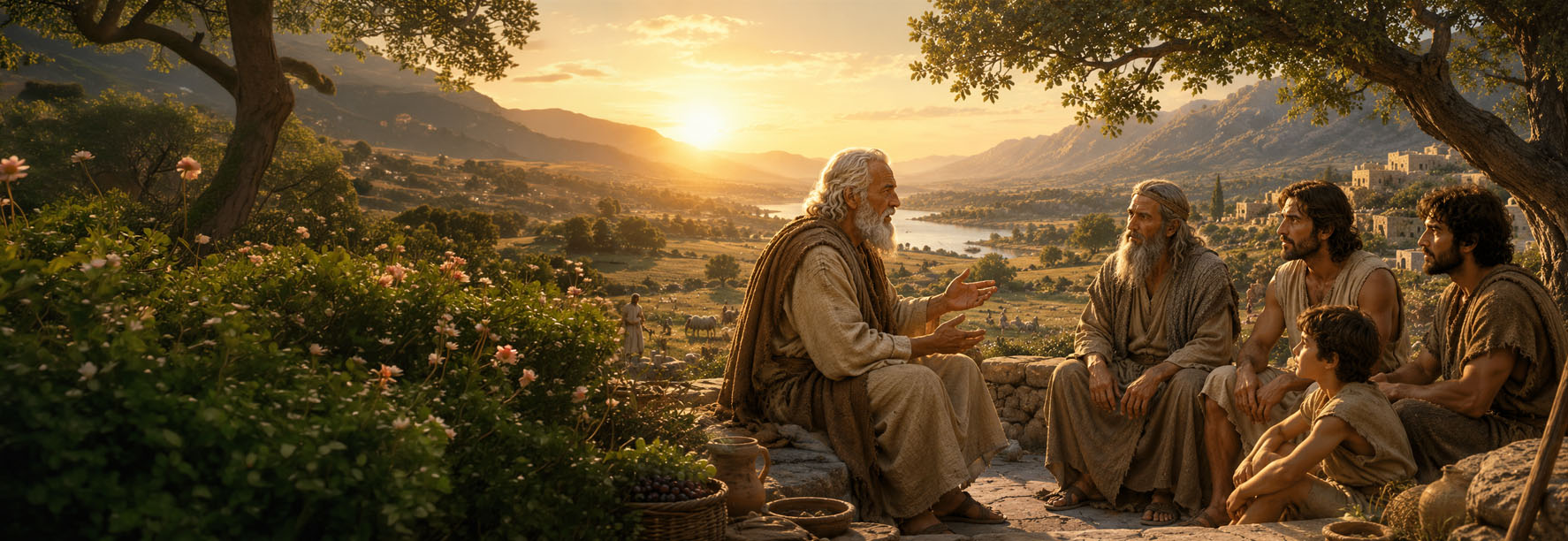
Open The Long Lives
A World Measured in Centuries
Genesis does not introduce the long lives as a theory. It records them as part of the genealogy. Adam lives 930 years. Seth lives 912. Enosh lives 905. Kenan (Cainan) lives 910. Mahalalel lives 895. Jared lives 962. Methuselah reaches 969, the greatest age stated in Scripture. Lamech lives 777 years, and Noah ultimately lives 950.
Whatever explanation a reader adopts, the narrative consequence is enormous. Genesis is describing a world in which fathers, sons, grandsons, and remote descendants could remain alive together for centuries. The genealogy is therefore more than a list of births and deaths. It describes the structure of human memory before the Flood.
“And all the days of Methuselah were nine hundred sixty and nine years: and he died.”
Genesis 5:27, KJV
| Patriarch | Born AM | Lifespan | Died AM | Chronological significance |
|---|---|---|---|---|
| Adam | 0 | 930 | 930 | Lives into Lamech's lifetime. |
| Seth | 130 | 912 | 1042 | Lives beyond Adam and into Lamech's lifetime. |
| Enosh | 235 | 905 | 1140 | Overlaps every named patriarch from Seth through Noah. |
| Kenan (Cainan) | 325 | 910 | 1235 | Lives 325 years into Noah's lifetime. |
| Mahalalel | 395 | 895 | 1290 | Lives 340 years into Noah's lifetime. |
| Jared | 460 | 962 | 1422 | Lives 472 years into Noah's lifetime. |
| Enoch | 622 | 365 | 987* | Genesis says God took him rather than recording the usual death formula. |
| Methuselah | 687 | 969 | 1656 | By the Masoretic chronology, his death falls in the Flood year. |
| Lamech | 874 | 777 | 1651 | Dies five years before the calculated Flood year. |
| Noah | 1056 | 950 | 2006 | Lives 350 years after the Flood. |
Chronology note: AM means “Anno Mundi,” years from Adam, calculated here from the ages in the Hebrew Masoretic text of Genesis 5 and 7. Ancient textual traditions differ in several genealogical numbers, so these AM calculations identify the textual chronology being used rather than accounting that every manuscript tradition yields the same dates.
The Generations Were Not Distant From One Another
Modern readers naturally hear ten generations and imagine ten largely separate eras. Genesis 5 produces something very different. Adam is still alive when Lamech, Noah's father, is born. Methuselah is alive during Adam's final 243 years. Noah is born while Enosh, Kenan (Cainan), Mahalalel, Jared, Methuselah, and Lamech are still alive.
That does not prove that every patriarch personally sat with every older ancestor or received instruction from him. Genesis does not describe those meetings. But the chronology makes such direct contact possible. A story about Adam did not necessarily need to pass through ten anonymous generations before reaching Noah's household. Within this chronology, remarkably few living links could bridge the beginning of humanity and the Flood.
Two Voices from Eden to the Ark
The long lifespans in Genesis create a possibility that is easy to miss when the genealogy is read only as a list of names. Within the Masoretic chronology used in this exhibit, Adam and Methuselah were alive at the same time for 243 years. Methuselah and Noah were then alive together for 600 years.
If those ages are read as straightforward chronology, the history of humanity's beginning did not necessarily have to pass through a long chain of anonymous storytellers before reaching Noah. A man who was Adam's contemporary for more than two centuries was also Noah's contemporary for six centuries.
What Could Adam Have Remembered?
Within the Genesis narrative, Adam did not receive the earliest history as tradition. He experienced it. Adam could personally remember Eden, God's command concerning the tree, Eve, the Fall, the judgments pronounced after the transgression, the expulsion from the Garden, life outside Eden, the births of Cain and Abel, Abel's death, Cain's judgment, and the beginnings of the generations that followed.
Genesis does not tell us that Adam sat with Methuselah and related these events to him. But the chronology shows that such direct transmission was possible for 243 years. Methuselah, in turn, remained alive throughout the first 600 years of Noah's life.
Adam → Methuselah → Noah. Within the Genesis chronology, only two acts of personal transmission could theoretically bridge the first man and the man who entered the Ark.
Methuselah at the Junction of Memory
Methuselah occupies an extraordinary position. He is the son of Enoch, the man Genesis says “walked with God.” He is a contemporary of Adam for 243 years. He becomes the grandfather of Noah. And his lifespan reaches the calculated year of the Flood in the Masoretic chronology.
That makes Methuselah a remarkable potential bridge within the narrative: Adam behind him, Enoch as his father, Noah before him, and the Flood at the end of his recorded lifespan. Scripture does not describe everything Methuselah knew or transmitted, but the chronology gives the visitor a very different picture of what “ancient memory” could mean in a world of extraordinary longevity.
Then Noah Crosses the Boundary
Noah survives the Flood with his sons. Whatever memories, commandments, family histories, skills, and traditions Noah possessed could therefore enter the post-Flood world with his household. This possibility becomes especially interesting beside the later tradition in Jubilees that depicts instruction passing through Enoch, Methuselah, Lamech, Noah, and then Noah's sons.
What Could a 900-Year Mind Accomplish?
Wolfgang Amadeus Mozart died at only thirty-five, yet left an extraordinary musical legacy. The comparison is not evidence for biblical longevity. It is a modern thought experiment that helps us grasp the scale of the account in Genesis.
Imagine a gifted musician, builder, farmer, metalworker, observer of the heavens, animal breeder, navigator, or craftsman possessing not several productive decades, but several productive centuries.
A master would not necessarily disappear after forty years of practice. One person could spend a century learning, centuries refining a discipline, and still have generations in which to teach it. Techniques could remain in the same memory while being tested repeatedly across changing seasons and generations.
Perhaps the most consequential feature of extraordinary longevity is not merely that life lasts longer. Knowledge can remain longer inside the same human mind.
This possibility matters to the First World narrative. Genesis has already introduced cultivation, animal husbandry, city building, musical instruments, and metallurgy. Extraordinary lifespan, if read literally, challenges the automatic assumption that the earliest people in the biblical narrative must therefore have been intellectually or technologically incapable.
Josephus Asked the Same Question
In the first century AD, Flavius Josephus explicitly defended the long lives of the ancients. His explanation is striking because it combines several ideas that still appear in discussions of Genesis: proximity to creation, food, divine favor, virtue, and the need for time to develop knowledge of the heavens.
Josephus argues that the ancients were newly made by God, that their food was better suited to prolonging life, and that God granted them longer lives for the useful employment of those years, particularly astronomical and geometrical discovery. Elsewhere he attributes knowledge of the heavenly bodies to Seth's descendants and says they preserved discoveries against future destruction.
Source boundary: Josephus is not Genesis. His explanation is an ancient Jewish interpretation written many centuries later. It is valuable here because it demonstrates that the relationship between longevity, environment, knowledge, and divine purpose was already being contemplated in antiquity.
Were Conditions Above the Earth Different?
Biblical Starting PointProposed MechanismNot Stated in GenesisGenesis 1 describes a firmament dividing waters below from “the waters which were above the firmament.” From this language came a modern creationist proposal commonly called the water canopy theory: that a substantial body of water or water vapor once existed above the pre-Flood world and contributed to environmental conditions unlike those experienced today.
“and divided the waters which were under the firmament from the waters which were above the firmament”
Genesis 1:7, KJV
Some versions of the theory propose that this canopy moderated climate or reduced exposure to harmful radiation, including ultraviolet radiation, thereby contributing to greater longevity. That mechanism is not stated anywhere in Genesis. Genesis identifies waters above the firmament; it never says they functioned as a radiation shield or caused people to live nine centuries.
The Physical Problem
A very massive vapor canopy also encounters serious physical difficulties. Enough atmospheric water to supply enormous rainfall would increase atmospheric pressure and create major heat problems as vapor condensed. For that reason, the canopy should be presented as one proposed model rather than as the museum's explanation of the long lives.
Was the Earliest Human Genome Closer to Its Original Condition?
Biblical ModelGenetic HypothesisUnproven MechanismWithin the Genesis creation model, humanity begins with Adam and Eve rather than with an already ancient population. That raises a theological and biological question: if the first human beings were created directly, could the earliest generations have possessed biological robustness that later generations progressively lost?
Modern genetics establishes that mutations arise and are inherited, DNA is damaged and repaired, and aging involves many interacting cellular processes. Those observations make biological deterioration a meaningful subject to discuss. They do not demonstrate that human beings once possessed a 900-year lifespan or that mutation accumulation caused the biblical decline in longevity.
The biblical pattern is itself interesting. The pre-Flood ages remain consistently enormous. The dramatic decline appears primarily among the generations after the Flood. If genetics contributed, the text gives us the pattern to investigate but not the molecular mechanism.
Did the First World Provide a Different Environment for Human Life?
Environmental HypothesisBiblical Dietary ChangeA third possibility looks not to a single canopy or a single genetic change, but to the total environment. The earliest Genesis diet is explicitly plant based. After the Flood, Genesis 9 expands the permitted diet to include animals. That is a genuine textual change, although Scripture never says the dietary change shortened human life.
“Behold, I have given you every herb bearing seed... and every tree... to you it shall be for meat.”
Genesis 1:29, KJV
“Every moving thing that liveth shall be meat for you; even as the green herb have I given you all things.”
Genesis 9:3, KJV
One can also ask about air, water, soil, pathogens, food quality, environmental stress, and contaminants. A world without industrial pollution, synthetic contaminants, combustion products, and highly processed food would differ substantially from modern industrial environments.
Yet the Source Context is important: cleaner food, water, and air do not provide a known scientific explanation for a 900-year human lifespan. Environmental quality could be considered as a possible contributing condition within the biblical model, but it cannot presently account for the recorded ages.
What If the Long Lives Were Allowed for a Purpose?
Theological InterpretationMuseum QuestionNot every explanation has to be biological. The long lives may also be considered within the purposes of the Genesis narrative. Early humanity had no libraries, universities, digital archives, or vast written historical record described in Genesis. A person who lived for centuries could become a living repository of family memory, skill, observation, and instruction.
That possibility connects directly with the traditions already encountered in the Line of Seth. Josephus depicts Seth's descendants preserving astronomical knowledge. Later literature greatly expands Enoch's role as a transmitter of knowledge. Noah is commanded to undertake the construction of the Ark, a project requiring planning, material knowledge, organization, and sustained obedience.
None of this proves that God granted 900-year lifespans specifically so that knowledge could be transmitted or the Ark could be built. Scripture never states that purpose. But the extraordinary ages would unquestionably make long-term accumulation and transmission possible within the narrative world.
The Darker Side of Longevity
The same capacity that permits centuries of wisdom could permit centuries of corruption. What happens when an individual can accumulate wealth, influence, resentment, specialized knowledge, alliances, and power for hundreds of years?
“every imagination of the thoughts of his heart was only evil continually.”
Genesis 6:5, KJV
Genesis eventually describes a world filled with violence. It does not say that God shortened life because men had too many centuries in which to sin. Nevertheless, the possibility creates a sobering theological question: could shorter human lives also limit the length of time in which a single corrupt person can accumulate and exercise power?
“His Days Shall Be an Hundred and Twenty Years”
“My spirit shall not always strive with man, for that he also is flesh: yet his days shall be an hundred and twenty years.”
Genesis 6:3, KJV
This verse has long generated two major readings. One understands the 120 years as a period of warning or countdown before the Flood. The other understands it as a limit associated with human lifespan.
The lifespan interpretation faces an immediate observation: after the Flood, Noah lives 950 years, Shem 600, Arphaxad 438, Eber 464, Abraham 175, and others remain above 120. If Genesis 6:3 announces a lifespan limitation, the biblical record portrays its realization as gradual rather than immediate. If it announces a countdown to judgment, the verse is functioning differently altogether.
The museum should therefore preserve both readings rather than forcing the verse to answer a biological question that the text itself does not explicitly settle.
Then the Lifespans Begin to Collapse
The most visually striking feature of the biblical longevity record may not be the pre-Flood ages alone. It is what happens afterward. Genesis 11 and the later patriarchal narratives preserve a pronounced downward pattern.
| Person | Lifespan | Relative to Methuselah |
|---|---|---|
| Methuselah | 969 | 100% |
| Noah | 950 | 98% |
| Shem | 600 | 62% |
| Arphaxad | 438 | 45% |
| Salah | 433 | 45% |
| Eber | 464 | 48% |
| Peleg | 239 | 25% |
| Reu | 239 | 25% |
| Serug | 230 | 24% |
| Nahor | 148 | 15% |
| Terah | 205 | 21% |
| Abraham | 175 | 18% |
| Isaac | 180 | 19% |
| Jacob | 147 | 15% |
| Joseph | 110 | 11% |
The decline is not perfectly smooth. Eber outlives the two generations immediately before him, and Terah outlives Nahor. But the overall trajectory is unmistakable within the biblical record: the extraordinary pre-Flood scale disappears over succeeding generations.
From Nine Centuries to Seventy or Eighty Years
Much later in the biblical story, Psalm 90 describes an ordinary human life in terms recognizable today:
“The days of our years are threescore years and ten; and if by reason of strength they be fourscore years...”
Psalm 90:10, KJV
The contrast is enormous. Genesis 5's world is not simply modern life with a few unusually old men. If the ages are read literally, it represents a fundamentally different human chronology. By the later biblical period, the expected span has contracted to something close to modern human experience.
Genesis Gives the Ages. It Does Not Give the Mechanism.
The four explanations explored here need not be treated as mutually exclusive, and none should be elevated to the status of a biblical statement. A reader working within the Genesis chronology could propose some combination of original created biology, environmental conditions, diet, ecological change, and divine purpose. The Flood itself marks an obvious boundary after which lifespans fall dramatically.
But the responsible conclusion is also the most interesting one: we do not know the mechanism. The text preserves the phenomenon and the chronology. It leaves later readers to ask why.
Long Life Did Not Produce a Better Humanity
Centuries of life could preserve memory. They could preserve skill. They could allow extraordinary mastery. They could permit generations to know one another directly. Yet Genesis does not move from longevity toward utopia.
It moves toward Genesis 6.
The tragedy is therefore profound. If humanity possessed long lives, accumulated knowledge, organized settlements, agriculture, music, metallurgy, and generations of living memory, the coming judgment cannot simply be explained as the failure of ignorant or primitive people. According to the narrative, civilization advanced while human corruption advanced with it.
“The earth also was corrupt before God, and the earth was filled with violence.”
Genesis 6:11, KJV
The question awaiting the next gallery is no longer how long they lived. It is what they became during all those years.
The Gallery's Final Threshold
Civilization grows. So does corruption.
By the end of this gallery, Genesis has introduced family lines, agriculture, animal husbandry, settlements, music, metallurgy, violence, worship, genealogy, and population growth.
The First World is not presented as primitive. It is a developing human civilization with skills, memory, specialization, and organized life.
The next gallery changes the character of the story. Genesis 6 introduces the sons of God, the daughters of men, the Nephilim, and the corruption that precedes the Flood.