Biblical Text
Genesis 2:8–17
“And the LORD God planted a garden eastward in Eden; and there he put the man whom he had formed. And out of the ground made the LORD God to grow every tree that is pleasant to the sight, and good for food; the tree of life also in the midst of the garden, and the tree of knowledge of good and evil. And a river went out of Eden to water the garden; and from thence it was parted, and became into four heads.”
Genesis 2:8–10, King James Version
Room I · Orientation Relief
The world narrows to one planted place
Genesis 1 surveys the ordered world. Genesis 2 moves inward. The focus progresses from earth, to Eden, to a garden, to one river, to two central trees, to one command given to one man.
Room II · Geography of Eden
Named features and levels of certainty
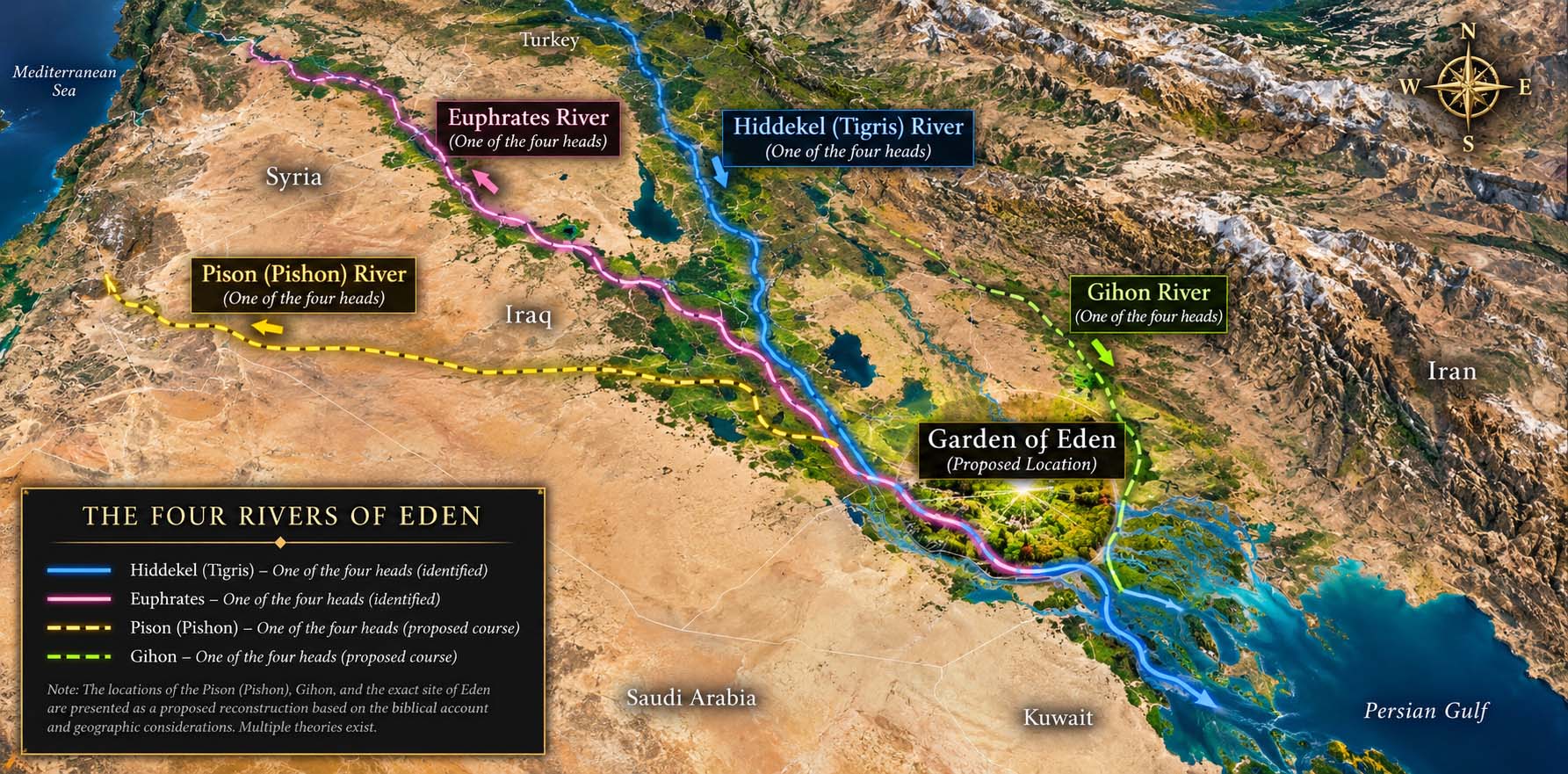
| River | Genesis description | Geographic association | Level of certainty |
|---|---|---|---|
| Pison | Compasseth the whole land of Havilah. | Havilah, where gold, bdellium, and onyx are named. | Location under study |
| Gihon | Compasseth the whole land of Ethiopia. | Cush / Ethiopia in the KJV wording. | Location under study |
| Hiddekel | Goeth toward the east of Assyria. | Traditionally identified with the Tigris. | Historically identifiable name |
| Euphrates | The fourth river is Euphrates. | The historically recognizable Euphrates name. | Historically identifiable name |
Eden and the garden
The garden is planted eastward in Eden. The man is placed there, and a river from Eden waters it.
Four river heads
The river divides after leaving Eden into Pishon, Gihon, Hiddekel, and Euphrates.
Hiddekel and Euphrates
Hiddekel is traditionally identified with the Tigris, while the Euphrates retains its ancient name. Their current courses do not by themselves locate the garden.
Pishon, Gihon, Havilah, and Cush
Multiple proposals exist, but no identification commands broad agreement across all textual and geographic details.
Room III · The River Room
One river leaves Eden and becomes four
The sequence matters: Genesis does not describe four rivers joining to create Eden’s river. It describes one river going out from Eden, watering the garden, and afterward dividing into four heads.
Pishon
Compasses the land of Havilah, associated in the text with gold, bdellium, and onyx stone.
Identification: under studyGihon
Compasses the whole land of Cush.
Identification: under studyHiddekel
Described as going toward the east of Assyria; traditionally identified with the Tigris.
Identification: historically strongEuphrates
Named without an additional geographic explanation, perhaps because the audience knew it well.
Identification: historically strongRoom IV · The Tree Court
Provision and boundary stand together

The Tree of Life
Placed in the midst of the garden. After the transgression, access is guarded so that humanity does not take and eat and live for ever.

The Tree of Knowledge of Good and Evil
The tree marks the specific boundary of the command. Genesis identifies the tree but does not name its fruit as an apple.
Interactive Experience
Walk Through Eden
 Interactive Museum Experience
Walk Through Eden
Follow the path through the garden, encounter the two trees, and make the choice that changes the world.
Enter the Garden →
Interactive Museum Experience
Walk Through Eden
Follow the path through the garden, encounter the two trees, and make the choice that changes the world.
Enter the Garden →
An interpretive visual experience based on the Genesis account. The scenery is an artistic reconstruction; the two named trees and the biblical events associated with them come from the Genesis record.
Room V · Humanity’s First Calling
Placed in the garden to serve and keep it
God puts the man in the garden
Human presence begins as a received place and responsibility, not a self-created account.
To dress it
The Hebrew verb is commonly associated with working, serving, or cultivating.
To keep it
The verb can carry the sense of keeping, watching, preserving, or guarding.
Every tree good for food
The command is set within abundant permission: the man may freely eat from the garden’s trees except one.
One prohibition
The command identifies the forbidden tree and attaches a consequence to disobedience.
Naming the animals
The man’s naming activity displays observation, distinction, and authority within creation.
Work, stewardship, provision, relationship, and moral responsibility appear before the Fall.
Room VI · The First Marriage
“It is not good that the man should be alone”
This is the first “not good” statement in the creation narrative.
The animal procession highlights the man’s unique lack of a human counterpart.
The woman is built from the man’s side and brought to him by God.
The man recognizes both sameness of nature and personal correspondence.
The narrative provides the foundational statement concerning leaving, cleaving, and marital union.
The man and woman are described as naked and not ashamed. The statement closes Genesis 2 in openness and innocence immediately before the serpent enters the narrative.
Room VII · Eden as Sacred Space
A significant interpretation, clearly labeled
Many biblical scholars observe that Eden shares themes later associated with sanctuary and temple imagery. Genesis does not call Eden a temple in a single explicit sentence, so the comparison should be presented as a cumulative interpretation.
God is portrayed as personally present and speaking within the garden narrative.
The garden is planted eastward in Eden; after exile, cherubim stand at the east of the garden.
Cherubim and a flaming sword guard the way to the Tree of Life.
Gold, bdellium, and onyx are named in the river geography and later appear in varied sacred and royal settings.
Living trees, water, fruitfulness, and divine presence recur in later prophetic and restoration imagery.
The verbs associated with Adam’s task are compared by some interpreters with later service and guarding language.
Room VIII · Questions Scholars Continue to Discuss
Geography, language, and interpretation
Was Eden a region, the garden itself, or both?
The wording distinguishes Eden from the garden planted within it, but ordinary usage often uses “Eden” as shorthand for the garden. The distinction matters when discussing the river and location.
Can the four rivers locate Eden today?
The Tigris and Euphrates provide recognizable names, but the Pishon and Gihon remain under study, and the described river arrangement does not correspond neatly to the present system.
Was Eden elevated?
Some reconstructions infer elevation because a river flows out and divides, and because later biblical texts use mountain-like sacred imagery. Genesis 2 itself does not state an elevation.
What lands are meant by Havilah and Cush?
Both names occur elsewhere in Scripture, but whether every occurrence refers to the same territory continues to be studied. Geographic names can shift or be reused over long periods.
How should the geography be related to the Flood?
Some readers expect major topographic change, while others seek continuity in ancient river names. Genesis does not provide a map of how pre-Flood geography corresponds to the post-Flood world.
Was Eden the first sanctuary?
The interpretation rests on multiple parallels—presence, cherubim, eastward access, precious materials, tree imagery, water, and vocation. The cumulative case is meaningful, but it remains interpretation rather than an explicit label in Genesis 2.
Why This Matters
Eden establishes themes that continue through Scripture
Humanity begins with presence
The first human setting is defined not only by environment but by relationship with God.
Work begins as vocation
Cultivation and guardianship are part of the good order before sin enters the story.
Abundance includes a boundary
Permission is broad, yet human freedom is not presented as independence from command.
Marriage precedes the Fall
The union of man and woman is introduced as part of the created order.
Life and access become central themes
The Tree of Life, guarded access, exile, and later restoration form a long biblical arc.
The setting prepares the test
Genesis 2 establishes the place, relationship, provision, and command needed to understand Genesis 3.
The Coming Test
The garden is ordered. The command is clear.
The man and woman are together, provided for, and unashamed. The next exhibit begins when another voice enters the garden and questions the boundary God has given.
Exhibit IV The Fall Continue to the next exhibit →