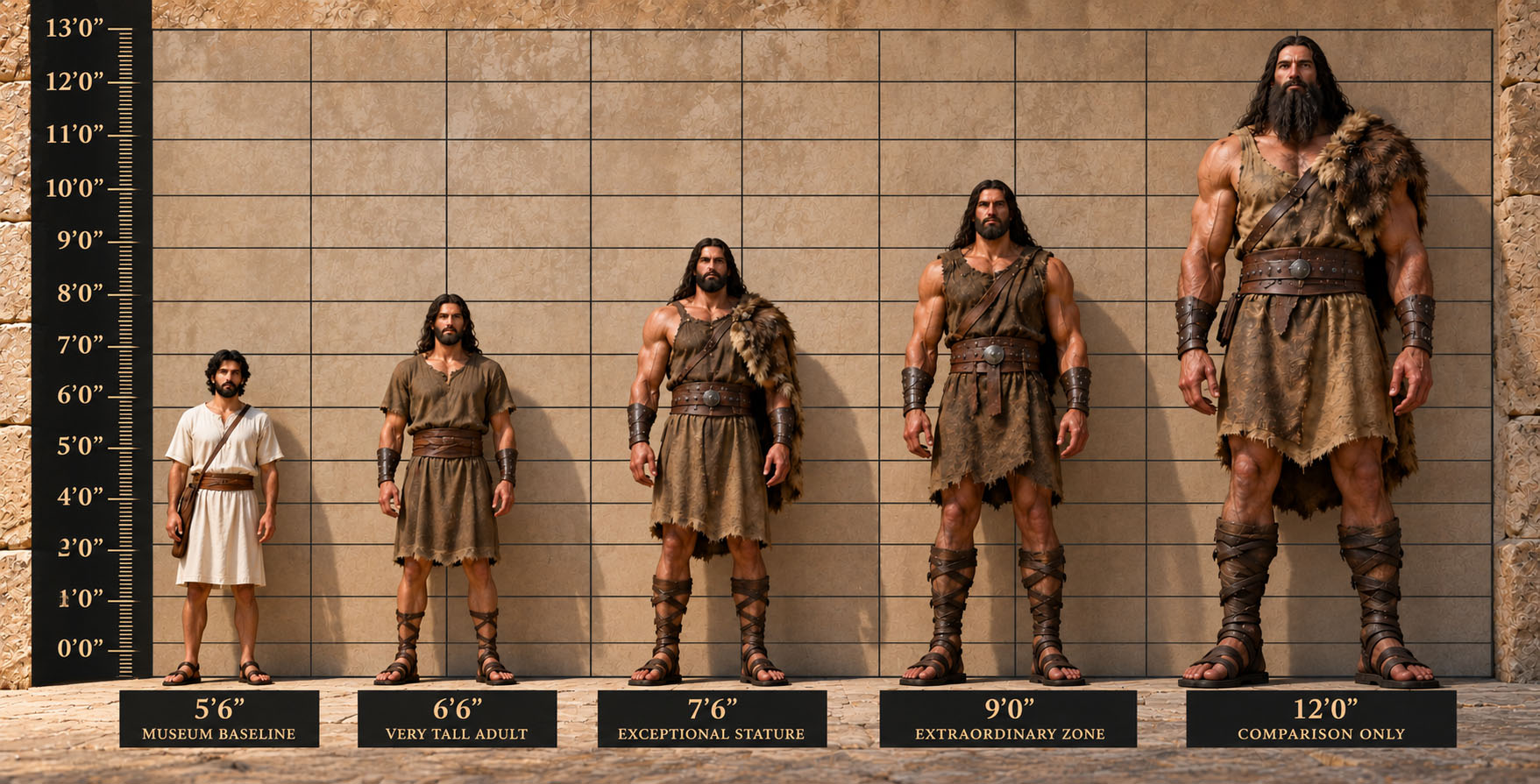
The museum baseline figure is 5′6″. The figures below provide proportional reference marks for comparing stature across the room.
Archoseum
Museum Exhibition
Preparing the exhibition
0%How large is large? A visual laboratory for separating measured stature, skeletal estimates, textual dimensions, and extraordinary claims.
← Return to The Giants ArchiveReports of unusually large people often collapse several different kinds of measurement into a single number. A standing height is not the same thing as the length of a skeleton. A long-bone estimate is not a direct measurement. The dimensions of a bed, weapon, grave, or coffin are not automatically the dimensions of the person associated with them.
This room keeps those categories separate so that a visitor can see exactly what a source does, and does not, establish.
Built to match the Promised Land exhibit behavior: opening one research section closes the previous one and brings the selected record to the top.
The museum baseline figure is 5′6″. The figures below provide proportional reference marks for comparing stature across the room.
A living or recently deceased person measured from the standing surface to the top of the head. This is the clearest stature measurement when procedure and provenance are known.
An articulated skeleton can be reconstructed anatomically, but missing soft tissue and incomplete elements require correction. The result should be presented with its method.
Forensic anthropologists commonly estimate stature from long bones using regression equations. Population, sex, temporal cohort, bone condition, and statistical uncertainty matter.
An associated object's dimensions can provide context but do not equal body height. Og's bedstead, for example, is an object measurement in the biblical text, not a direct measurement of Og's body.
A newspaper or field report may preserve a number without preserving the specimen, measuring procedure, or independent verification. The number remains part of the historical record but carries those limitations.
Cubits, spans, and other ancient units require translation into modern units. Manuscript variation and the assumed length of the unit must be stated before a modern equivalent is offered.
The KJV remains the museum's display text. Biblical measurements are shown first in their original units, followed by modern equivalents so visitors can see how the conversion changes with the unit assumed.
KJV, 1 Samuel 17:4: Goliath's height is given as “six cubits and a span.” Converting that phrase to feet requires choosing a cubit length, so the museum should display the biblical unit first and any modern conversion as an approximation.
Research caution: ancient textual witnesses differ on Goliath's numerical height. The Measurement Room records the KJV reading while flagging the textual question for visitors who want to investigate further.
KJV, Deuteronomy 3:11: the text gives the dimensions of Og's iron bedstead as nine cubits long and four cubits wide.
A cubit is an arm-based measure, commonly described as the distance from the elbow to the tip of the middle finger. Ancient cubits were not all identical, so the table gives several useful comparison lengths rather than pretending there was one universal value.
| Reference unit | Approx. inches | Approx. centimeters | 6 cubits + 1 span | 9 cubits |
|---|---|---|---|---|
| 17.5-inch cubit | 17.5 in | 44.5 cm | 9 ft 5.75 in | 13 ft 1.5 in |
| 18-inch cubit | 18 in | 45.7 cm | 9 ft 9 in | 13 ft 6 in |
| 20-inch cubit | 20 in | 50.8 cm | 10 ft 10 in | 15 ft 0 in |
| 20.6-inch long / royal cubit | 20.6 in | 52.3 cm | 11 ft 1.9 in | 15 ft 5.4 in |
The shekel was a unit of weight as well as a monetary standard. Surviving standards and modern Bible conversions vary, so displaying a range makes the underlying assumption visible. In 1 Samuel 17:7 the KJV says Goliath's spear staff was “like a weaver's beam”; the part actually assigned a weight is the iron spearhead, at 600 shekels.
| Shekel standard used | 1 shekel | 600 shekels, spearhead | 5,000 shekels, coat of mail |
|---|---|---|---|
| 10 g comparison | 10 g / 0.35 oz | 6.0 kg / 13.2 lb | 50.0 kg / 110.2 lb |
| 11 g comparison | 11 g / 0.39 oz | 6.6 kg / 14.6 lb | 55.0 kg / 121.3 lb |
| 11.34 g comparison | 11.34 g / 0.40 oz | 6.80 kg / 15.0 lb | 56.7 kg / 125.0 lb |
| 14.17 g heavier comparison | 14.17 g / 0.50 oz | 8.50 kg / 18.7 lb | 70.9 kg / 156.2 lb |
Ancient units are easier to grasp when they are placed beside familiar modern dimensions and weights. The comparisons below use the same conversion ranges shown above and keep object size separate from body height.
| Biblical example | Textual measurement | Modern equivalent | Everyday scale comparison |
|---|---|---|---|
| Goliath's height 1 Samuel 17:4 | 6 cubits + 1 span | About 9 ft 5¾ in to 11 ft 1.9 in, depending on cubit standard | Roughly the height of a regulation basketball rim (10 ft), with the longer-cubit conversion extending more than a foot above it. |
| Og's iron bedstead Deuteronomy 3:11 | 9 cubits long × 4 cubits wide | At an 18-in cubit: 13 ft 6 in × 6 ft. At a 20.6-in cubit: about 15 ft 5 in × 6 ft 10 in. | The shorter conversion is about 5½ feet longer than a modern king-size mattress; the longer conversion approaches twice a king mattress's 80-in length. |
| Egyptian warrior 1 Chronicles 11:23 | 5 cubits tall | About 7 ft 3½ in to 8 ft 7 in across the cubit range above | From exceptionally tall human stature to well above a standard 8-ft residential ceiling. |
| Goliath's coat of mail 1 Samuel 17:5 | 5,000 shekels of brass | About 110–125 lb using 10–11.34 g shekels | Approximately the weight of two 50-lb bags plus another 10–25 lb, carried as body armor. |
| Goliath's iron spearhead 1 Samuel 17:7 | 600 shekels | About 13.2–15.0 lb using 10–11.34 g shekels | Comparable in weight to a medium bowling ball, before adding the wooden spear shaft. |
| Ishbi-benob's brass spear 2 Samuel 21:16 | 300 shekels | About 6.6–7.5 lb using 10–11.34 g shekels; some modern translations round this to roughly 6–8 lb | A little lighter than a U.S. gallon of water, which weighs about 8.3 lb. |
| Weaver's-beam spear shaft 1 Samuel 17:7; 2 Samuel 21:19; 1 Chronicles 11:23 | “Like a weaver's beam” | No numerical length, diameter, or weight is supplied by the biblical text | The comparison describes an unusually massive loom-beam-like shaft. Its exact modern dimensions should not be invented. |
Measurements from multiple skeletal elements are summed and corrected for missing soft tissue. It requires relatively complete remains but reduces dependence on a single population-specific long-bone equation.
A complete long bone, often a femur or tibia, is entered into an equation derived from a reference sample. The result is an estimate with uncertainty, not an exact recovered height.
Modern Olympic weightlifting provides a documented upper benchmark for exceptional human strength. At approximately 6′6″, Olympic champion Lasha Talakhadze has successfully clean-and-jerked 267 kg, or about 589 lb, in competition. That gives the Measurement Room a real elite-human reference point before moving into theoretical scaling.
Lasha Talakhadze · Georgia
| Height | ≈6′6″ (1.97 m) |
|---|---|
| Born | October 2, 1993 |
| Age at 589-lb lift | 28 years old |
| Body weight at 2021 Worlds | ≈182.5 kg (≈402 lb) |
| Snatch | 225 kg (496 lb) |
| Clean & Jerk | 267 kg (589 lb) |
| Combined total | 492 kg (1,085 lb) |
Why this matters: Talakhadze was not an average 6′6″ man. He was an exceptionally massive, highly trained super-heavyweight Olympic champion. His 589-lb clean and jerk therefore gives this exhibit a documented example of what an extraordinarily large and powerful human body can actually accomplish before the comparison is extended mathematically to 7, 8, 9, or 12 feet.
| Height | Relative strength vs. 6′6″ | Theoretical lift equivalent | Modern comparison |
|---|---|---|---|
| 6′6″ | 1.00× | 589 lb | Documented elite clean-and-jerk benchmark |
| 7′0″ | 1.16× | ≈684 lb | About 95 lb beyond the elite-human benchmark |
| 7′6″ | 1.33× | ≈784 lb | Approaching 800 lb |
| 8′0″ | 1.51× | ≈892 lb | Nearly 900 lb |
| 9′0″ | 1.92× | ≈1,129 lb | More than half a U.S. ton |
| 10′0″ | 2.37× | ≈1,394 lb | Nearly 1,400 lb |
| 11′0″ | 2.86× | ≈1,686 lb | More than three-quarters of a U.S. ton |
| 12′0″ | 3.41× | ≈2,007 lb | Approximately one U.S. ton |
The table uses the 6′6″, 589-lb elite benchmark and a simplified geometric model in which muscular force increases approximately with muscle cross-sectional area. If proportions and muscle quality remained broadly similar, cross-sectional area would increase approximately with the square of the change in height. The figures above therefore illustrate comparative force, rather than documented lifts by people of those extraordinary statures.
As height increases, muscle cross-sectional area grows roughly with height squared, while body volume and mass can grow roughly with height cubed. A larger body may therefore possess much greater absolute strength while simultaneously carrying much greater skeletal, joint and muscular loads. Extremely robust bones, unusually large muscle mass and different body proportions would materially change the comparison.