Archoseum

Museum Exhibition

Preparing the exhibition

0%
← Museum Home ← Historical Case Files
Case File 004 · Newspaper & Source-Chain Investigation

The Shoshone Cave Skeleton

A 1910 Idaho report describing a purported ten-foot human skeleton deep inside a cave north of Shoshone, accompanied by an unusually heavy old firearm barrel and a proposed Smithsonian transfer.

MuseumGiants CollectionCase FilesIdaho 1910
Surviving newspaperThe Rathdrum Tribune
PublicationMar. 18, 1910
Reported siteNorth of Shoshone, Idaho
Documentation4 / 8 markers
Source creditInland Herald
01

The Surviving Report

The Rathdrum clipping is a traceable historical source, but its own wording shows that it is downstream from earlier reporting.

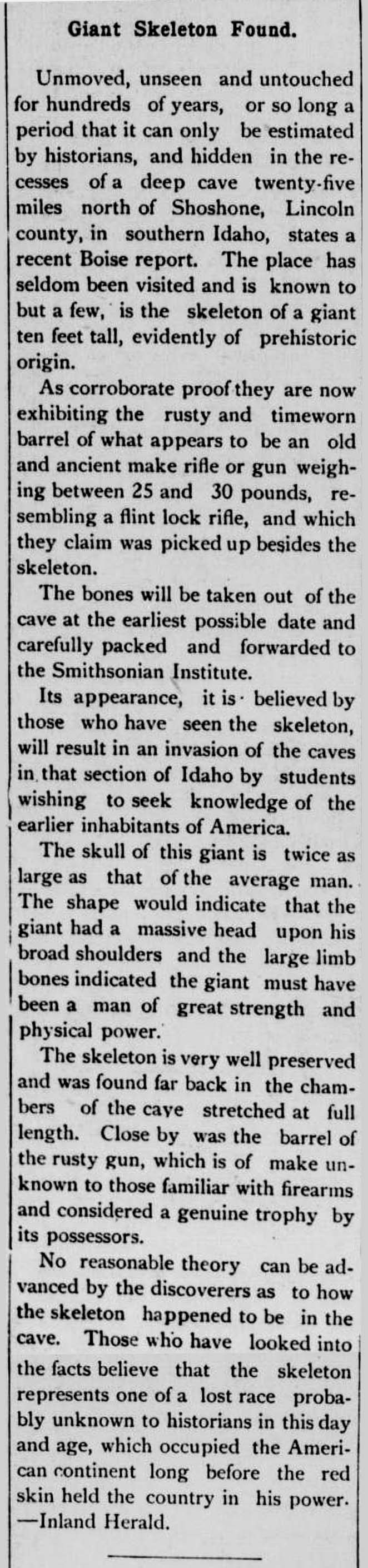
Preserved archive scan · “Giant Skeleton Found” · The Rathdrum Tribune · March 18, 1910 · credited at the end to the Inland Herald.
Report Summary

A ten-foot skeleton in a cave

The article reports that a remarkably well-preserved skeleton, described as ten feet tall and “evidently of prehistoric origin,” was present in a deep cave approximately twenty-five miles north of Shoshone in Lincoln County, southern Idaho.

Beside the skeleton, the report describes the rusty barrel of an old firearm weighing between twenty-five and thirty pounds and resembling a flintlock rifle. The skull was said to be twice the size of an average man's skull, with large limb bones interpreted as evidence of exceptional strength.

The article states that the bones would be removed from the cave, carefully packed, and forwarded to the Smithsonian Institution.

The skeleton was reportedly found stretched at full length far back in the cave chambers. The article closes with exploration that the remains belonged to a “lost race” that preceded later inhabitants of the continent.

Source-chain caution: The clipping itself says the information “states a recent Boise report” and ends with the credit “—Inland Herald.” The Rathdrum Tribune therefore should not be treated as the original reporting source.
02

Documentation Strength

The rating reflects what can be traced in the surviving record—not the truth of the reported ten-foot measurement.

4 / 8Documentation markers
Moderate documentation
✓
Source identifiedThe Rathdrum Tribune, March 18, 1910; article credit to Inland Herald.
✓
Specific locationA cave about twenty-five miles north of Shoshone, Lincoln County, southern Idaho.
Named people / witnessesThe discoverers and those who reportedly viewed the skeleton are not named.
✓
Measurements / concrete detailsTen-foot stature, firearm weight, skull comparison, cave position and preservation are described.
✓
Institution / organization namedThe Smithsonian Institution is identified as the intended recipient.
Near-primary reportingThe Rathdrum version openly attributes the story to earlier reporting.
Independent corroborationAdditional printings may descend from the same Boise/Inland Herald report rather than independent witnesses.
Documented follow-upNo institutional record confirming removal, transfer or examination of the reported remains has yet been established.
03

Physical accounts in the Report

The article supplies unusually vivid details, but none of these descriptions presently has a surviving professional examination attached to it.

Reported Stature

Ten Feet Tall

The article explicitly describes a skeleton ten feet in length. No named measurer or measurement record accompanies the account.

Skull

Twice Average Size

The skull is described as twice as large as that of an average man and as indicating a massive head.

Associated Object

Heavy Gun Barrel

A rusty old firearm barrel, reportedly twenty-five to thirty pounds and resembling a flintlock, was said to have been found beside the skeleton.

Preservation

Very Well Preserved

The skeleton was described as very well preserved and stretched at full length far back in the cave.

Reported Destination

Smithsonian Institution

The article states that the bones would be packed and forwarded to the Smithsonian, but the transfer itself has not yet been documented.

Interpretation

“Lost Race” exploration

The article's closing interpretation is historical exploration from the period and is preserved as part of the source rather than treated as an established conclusion.

04

The Source Trail

The wording of the clipping itself provides clues that the Rathdrum article is part of a longer reporting chain.

Before Mar. 18
“Recent Boise report”

The Rathdrum text explicitly says the story was stated in a recent Boise report. The precise original Boise publication or correspondent remains under continued study.

Before / by Mar. 18
Inland Herald

The surviving clipping ends with “—Inland Herald,” indicating an immediate source or credit in the reprint chain.

Mar. 18, 1910
The Rathdrum Tribune

The traceable surviving issue preserves the complete article under the headline “Giant Skeleton Found.”

under continued study
Smithsonian follow-up

The stated plan to forward the bones has not yet been connected to an accession, correspondence file or later examination record.

05

areas for further study

The strongest next steps are concrete source-chain and institutional questions rather than exploration about disappearance.

Original Source

What was the Boise report?

Identifying the earlier Boise account could reveal the discoverers, exact cave location, or names of people who examined the skeleton.

Inland Herald

Which issue carried the story?

Locating the credited Inland Herald version may move the source chain one step closer to its origin.

Disposition

Were the bones actually sent?

The newspaper's future-tense Smithsonian statement is not proof of transfer. An accession or correspondence record would materially strengthen the case.