Archoseum

Museum Exhibition

Preparing the exhibition

0%
← Museum Home ← Historical Case Files
Case File 001 · Historical Newspaper Investigation

The Salmon River Skeleton

A 1924 Idaho report describing an unusually large human skeleton, named highway personnel and physicians, anatomical observations, and a proposed Smithsonian examination.

MuseumGiants CollectionCase FilesIdaho 1924
Primary surviving reportSpokane Daily Chronicle
DateFeb. 16, 1924
DatelineLewiston, Idaho
Documentation6 / 8 markers
Curator rating4 / 5
01

The Surviving Report

The museum preserves the wording of the historical source while distinguishing what the newspaper reported from what has been independently established.

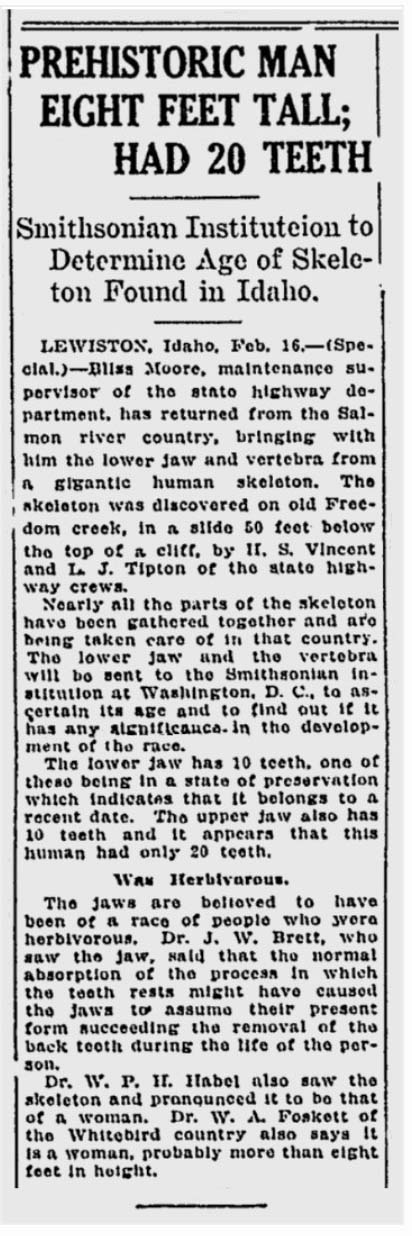
Preserved archive scan · “Prehistoric Man Eight Feet Tall; Had 20 Teeth” · Spokane Daily Chronicle · February 16, 1924 · page 16.
Report Summary

What the article says

The article reports that Bliss Moore, identified as a maintenance supervisor with the Idaho State Highway Department, returned from the Salmon River country with the lower jaw and vertebrae of what the newspaper called a gigantic human skeleton.

The discovery was attributed to H. S. Vincent and L. J. Tipton, members of the state highway crew. The reported location was old Freedom Creek, in a slide approximately fifty feet below the top of a cliff.

The paper reports that the lower jaw and vertebrae were to be sent to the Smithsonian Institution in Washington, D.C., for age determination and study.

The article further reports that physicians examined the remains. Dr. W. A. Foskett of the White Bird country was quoted as regarding the skeleton as female and probably more than eight feet in height.

Historical caution: The case file documents what the surviving newspaper reports and what can be traced about the named people and institutions. It does not treat the reported height as independently proven by the newspaper alone.
02

Documentation Strength

The rating measures the quality and traceability of the historical documentation, not whether the extraordinary account itself is true.

6 / 8Documentation markers
4 / 5 Strong Circumstantial Report
✓
Source identifiedPublication, date and page are traceable.
✓
Specific locationLewiston/Salmon River country and old Freedom Creek.
✓
Named people / witnessesHighway personnel and physicians are named.
✓
Measurements / concrete detailsHeight, cliff depth, jaw and vertebral details are reported.
✓
Institution / organization namedIdaho State Highway Department and Smithsonian Institution.
✓
Near-primary reportingContemporary “Special” report naming individuals associated with the event.
Independent corroborationLater newspaper versions may descend from the same underlying report.
Documented follow-upNo institutional record confirming receipt or examination of the remains has yet been located.
03

People in the Record

Named people are treated as research entities. Their documented existence and relevance can strengthen traceability without independently proving every statement attributed to them.

State Highway Department

Bliss Moore

Identified by the article as maintenance supervisor. The report states that Moore returned from the Salmon River country carrying the lower jaw and vertebrae.

Reported Discoverers

H. S. Vincent & L. J. Tipton

Named as members of the state highway crew credited with discovering the skeleton at old Freedom Creek.

Physician · White Bird

Dr. Wilson A. Foskett

Independently documented as a physician serving the White Bird and Salmon River region in 1924. The article attributes to him the opinion that the skeleton was female and probably more than eight feet tall. Foskett died in an automobile accident approximately two months later.

Physician

Dr. J. W. Brett

The article reports that Brett examined the jaw and discussed its unusual dental formation.

Physician

Dr. W. P. H. Habel

Named as another physician who reportedly saw the skeleton and pronounced it female.

Research Note

Named does not equal verified

The presence of identifiable names improves source traceability. Separate first-person notes, affidavits, medical records or correspondence from these individuals have not yet been located for this case.

04

Source Trail

Later newspaper appearances are preserved as related reports rather than automatically counted as independent corroboration.

Feb. 16, 1924
Spokane Daily Chronicle — “Special”

The most detailed surviving version presently cataloged: named highway personnel, named physicians, specific location, anatomical details and proposed Smithsonian examination.

Mar. 16–17, 1924
Associated Press national version

A later version circulated nationally. It preserved the core discovery but omitted several names and local details found in the February account.

Mar. 20, 1924
Further national reprinting

The same incident continued appearing in newspapers outside Idaho, demonstrating circulation of the report but not necessarily a new independent source.

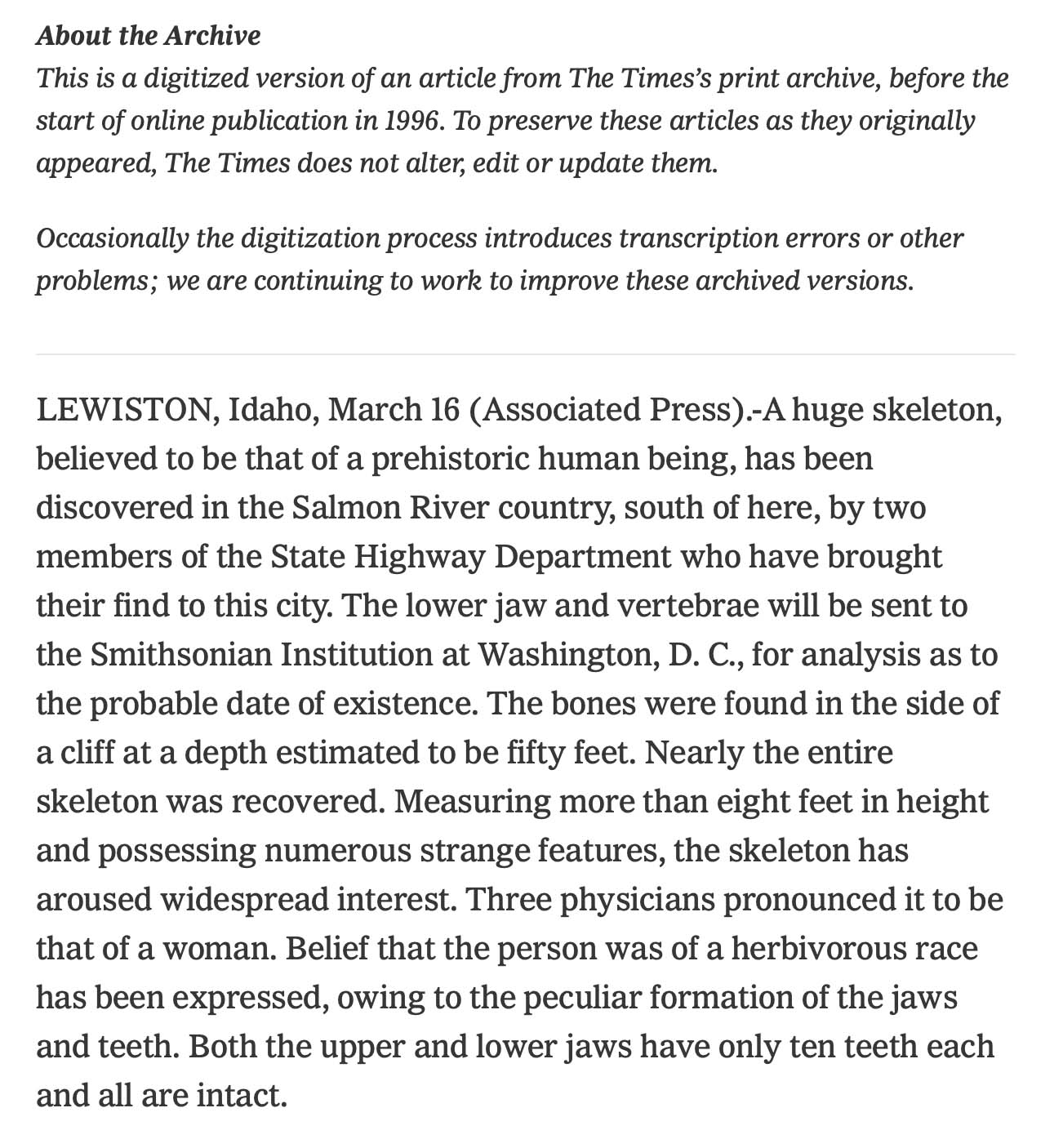
Related contemporary report · New York Times archive clipping · March 17, 1924 · Associated Press dispatch dated March 16.
Related Contemporary Report

The story changes as it travels

About one month after the detailed Spokane “Special,” an Associated Press version circulated nationally. The central features remain recognizable: Salmon River country, State Highway Department personnel, a cliff recovery, an eight-foot-plus skeleton, unusual dentition, and a proposed Smithsonian analysis.

But several details present in the February report disappear. The later AP account does not name Bliss Moore, H. S. Vincent, L. J. Tipton, or the individual physicians. Freedom Creek is also omitted.

This is why the Museum treats multiple newspapers from the same event as a source trail rather than automatically counting each reprint as independent corroboration.

The later article is valuable because it demonstrates national circulation of the account and preserves substantially the same anatomical story, while also showing how specificity can be lost as a report moves through the press network.

05

Institutional Trail

The newspaper establishes an intended destination for part of the remains. The critical follow-up question is whether that transfer can be documented.

Reported discoveryFreedom Creek
Local handlingHighway personnel
Reported examinationNamed physicians
Intended destinationSmithsonian
Present documentationunder continued study
Current finding: No Smithsonian accession record, examination report, correspondence or other institutional document confirming receipt of the reported lower jaw and vertebrae has yet been located in this investigation.
06

areas for further study

Gaps are preserved as research targets rather than filled with exploration.

Did the Smithsonian receive the remains?

The article states that the lower jaw and vertebrae would be sent to Washington. A documented receipt or accession has not yet been found.

Is there a local excavation or highway record?

Records from the Idaho State Highway Department or local authorities could potentially clarify the discovery and disposition of the remains.

Do first-person medical notes survive?

No medical notes, diary entries, affidavits or correspondence from the named physicians concerning the skeleton have yet been located.

What was the earliest underlying report?

The February “Special” is currently the strongest detailed newspaper account in the case file, but an even earlier local source has not been ruled out.