Archoseum

Museum Exhibition

Preparing the exhibition

0%
← Museum Home ← Historical Case Files
Case File 002 · Archaeological & Newspaper Investigation

The Morhiss Skull

A 1939–1940 Texas archaeological case in which an unusually large reconstructed cranium became a newspaper sensation, was later listed as missing, and was ultimately relocated and re-examined.

MuseumGiants CollectionCase FilesTexas 1939–1940
Primary newspaperSan Antonio Express
PublicationJan. 7, 1940
Discovery siteMorhiss Mound, Texas
Documentation7 / 8 markers
Present statusRemains located
01

The Newspaper Report

The 1940 article is preserved as a historical source. Its dramatic language is separated from the archaeological record and later physical examination.

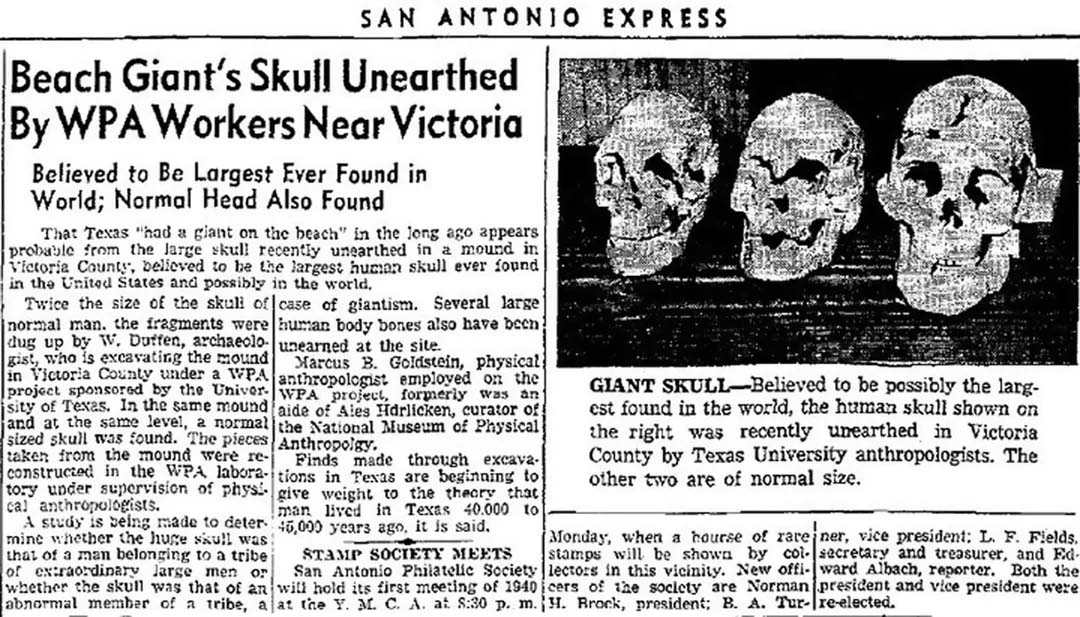
Preserved archive scan · “Beach Giant's Skull Unearthed By WPA Workers Near Victoria” · San Antonio Express · January 7, 1940.
Report Summary

What the article says

The San Antonio Express reported that fragments of an unusually large human skull had been excavated in Victoria County during a WPA archaeological project sponsored by the University of Texas. Archaeologist William A. Duffen and physical anthropologist Marcus S. Goldstein were identified with the work.

The newspaper described the reconstructed cranium as approximately twice the size of a normal skull and pictured it beside two smaller crania. It raised two possibilities: an extraordinarily large population or an abnormal individual.

The sensational newspaper description and the existence of an unusually large, robust cranium are not the same account. Later professional assessments are essential to this case.

Goldstein's contemporary analysis described the cranium as unusually large but reported that the associated postcranial bones did not indicate excessive stature.

Current finding: Later examination at the Texas Archeological Research Laboratory identified the individual as a very robust male within normal human variation. The remains are not presently considered evidence of a human giant.
02

Documentation Strength

The score measures traceability of the historical record, not the truth of the newspaper's “giant” interpretation.

7 / 8Documentation markers
Strong documentary trail
✓
Source identifiedSan Antonio Express, January 7, 1940.
✓
Specific locationMorhiss Mound / Victoria County, Texas.
✓
Named people / witnessesWilliam A. Duffen and Marcus S. Goldstein are identified.
✓
Measurements / concrete detailsComparative skull size, reconstruction, associated remains and excavation context are described.
✓
Institution / organization namedWPA, University of Texas and later TARL records.
✓
Near-primary reportingContemporary report names professionals directly involved in the excavation.
Independent corroborationNo clearly independent contemporary observer has yet been established outside the excavation/reporting chain.
✓
Documented follow-upGoldstein's manuscript, TARL correspondence and a later osteological re-examination create a follow-up trail.
03

People & Institutions

The Morhiss case is unusually valuable because the newspaper story connects to identifiable archaeological personnel and surviving institutional records.

Archaeologist

William A. Duffen

Led the 1938–1940 Morhiss excavation. His field documentation reportedly described the individual as large and the skull as seeming large.

Physical Anthropologist

Marcus S. Goldstein

Described one Morhiss cranium as extraordinary in size, but wrote that the associated bones did not indicate excessive stature and did not support an endocrine explanation.

Institution

University of Texas / WPA

The large-scale excavation was a University of Texas archaeological project employing WPA workers. The remains entered the university's archaeological collections.

Repository

Texas Archeological Research Laboratory

TARL later held the Morhiss collection. In 2010 the specimen was reported missing from collection inventories; in 2016 staff located the accession records and physical remains.

2016 Re-examination

Stacy Drake

A TARL osteologist and NAGPRA coordinator reported locating the remains and assessed the individual as a very robust male, but not outside normal human variation.

Museum Finding

Real specimen, under continued study interpretation

The historical record supports an unusually large reconstructed cranium and robust individual. The later osteological assessment does not support identifying the individual as a giant.

04

The Disposition Trail

This case demonstrates why a museum case file should preserve changing evidence rather than freezing an investigation at one moment in time.

1939
Morhiss Mound excavation

The unusually large reconstructed cranium is associated with the University of Texas/WPA excavation in Victoria County.

Jan. 7, 1940
San Antonio Express

The newspaper publishes the dramatic “Beach Giant's Skull” story and a photograph comparing the reconstructed cranium with smaller skulls.

Contemporary analysis
Marcus S. Goldstein

Goldstein describes an unusually large cranium but notes ordinary stature and unusually robust postcranial remains.

Feb. 10, 2010
TARL records inquiry

Head of Records Carolyn Spock reports that paperwork lists the large skull but that it had not appeared in inventories since the collection arrived at TARL.

Sept. 16, 2016
Specimen relocated

TARL osteologist Stacy Drake reports locating both accession records and the physical remains. Her examination describes a very robust male within normal human variation and notes poor skull reconstruction.

05

What Changed?

The strongest part of the Morhiss case is not a mystery disappearance. It is the documented evolution of the evidence.

Excavated1939
Publicized1940
Listed missing2010
Relocated2016
Current assessmentRobust male
Important correction to the earlier research trail: A 2010 records search genuinely reported the specimen missing. A later 2016 TARL investigation located the remains. The museum therefore preserves both stages rather than continuing to describe the skull as missing.
06

Questions That Remain

Resolving the location of the specimen answers one major question while leaving useful historical questions open.

Reconstruction

How much did reconstruction affect the appearance?

The cranium was fragmentary and reconstructed. Later examination specifically raised poor reconstruction as a possible contributor to its apparently extraordinary size.

Newspaper Comparison

What exactly was photographed?

The 1940 photograph provides a striking visual comparison, but scale, perspective, reconstruction and selection of comparison skulls all matter when interpreting it.

Primary Records

Can the complete Goldstein and Duffen documentation be assembled?

Bringing the surviving field forms, manuscript passages, accession data and photographs together would provide the strongest reconstruction of the case.