Archoseum

Museum Exhibition

Preparing the exhibition

0%
← Museum Home ← Historical Case Files
Case File 005 · Newspaper & Testimony Investigation

The Mexico Cave Skeletons

A 1908 report attributed to Boston broker and mining representative Charles C. Clapp, describing a Mexican cave containing numerous unusually large human skeletons and one reconstructed specimen measuring 8 feet 11 inches.

MuseumGiants CollectionCase FilesMexico 1908
Authenticated reportNew York Times
PublicationMay 4, 1908
Named witnessCharles C. Clapp
Reported specimen8 ft 11 in
Documentation5 / 8 markers
01

The Authenticated Newspaper Report

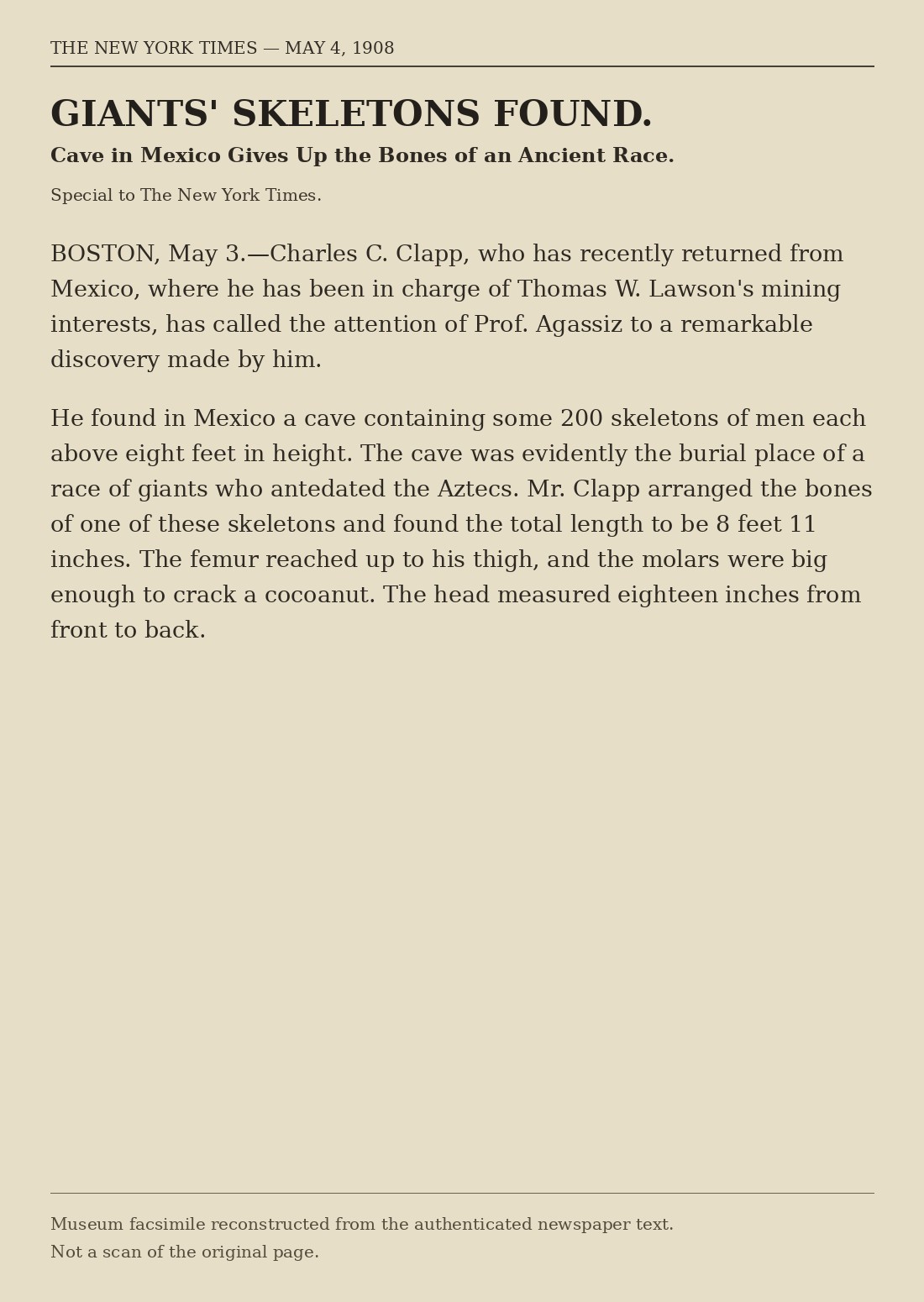
The May 4, 1908 New York Times report is the firm documentary anchor for this case. The display below is a museum facsimile of its verified text, not an original page scan.

Museum facsimile · “Giants' Skeletons Found” · The New York Times · May 4, 1908 · Boston dispatch dated May 3. This is not an original clipping scan.
Authenticated Account

Clapp's reported discovery

The New York Times identified Charles C. Clapp as recently returned from Mexico, where he had been in charge of Thomas W. Lawson's mining interests. The newspaper said Clapp had called Professor Agassiz's attention to a remarkable discovery.

The report states that Clapp found a cave containing approximately 200 skeletons of men, each said to exceed eight feet in height. He reportedly articulated one skeleton and measured it at 8 feet 11 inches.

The same account describes a femur reaching to Clapp's thigh, unusually large molars, and a head measuring eighteen inches from front to back.
02

The Expanded Clapp Account

A substantially longer version supplied to the Museum contains additional narrative details. Its publication source has not yet been authenticated, so it is preserved as a research lead rather than merged silently into the New York Times transcription.

Location Detail

State of Jalisco

The expanded account places the events in Jalisco. The authenticated Times report identifies only Mexico.

Discovery Narrative

Mountain Lion & Cave Entrance

The longer account says a wounded mountain lion was tracked to a cave whose stone-blocked entrance had been clawed open. This episode is absent from the Times version.

Associated Artifact

30-Pound Stone Hatchet

The expanded text reports a massive stone hatchet weighing thirty pounds among the relics. The Times report does not mention it.

Proposed Scientific Contact

Alexander Agassiz

Both versions connect Clapp's account with Professor Agassiz, making this one of the most concrete follow-up leads in the case.

Additional Lead

Roland Thomas

The expanded text says magazine writer Roland Thomas had been interested in the discovery and was expected to visit the site. This detail is not present in the Times report.

Major Discrepancy

100 vs. 200 Skeletons

The expanded account says there were enough bones for roughly 100 complete skeletons; the Times report says approximately 200 skeletons. The discrepancy is preserved rather than reconciled.

Source status: Until the longer text can be tied to a named publication, issue and date, its unique details remain unverified leads. They should not be attributed to the New York Times.
03

Documentation Strength

The score measures traceability and specificity of the historical record—not whether the reported giant interpretation is correct.

5 / 8Documentation markers
Promising source trail
✓
Source identifiedThe New York Times, May 4, 1908; Boston dispatch dated May 3.
Specific discovery locationThe authenticated report says Mexico but does not provide the cave's exact location. Jalisco appears only in the unauthenticated expanded account.
✓
Named accountant / witnessCharles C. Clapp is identified by name and occupational connection.
✓
Measurements / concrete details8 ft 11 in articulated skeleton, 18-inch head dimension, femur comparison and unusually large molars.
✓
Named outside figuresThomas W. Lawson and Professor Agassiz provide traceable historical leads.
✓
Near-primary reportingThe Times labels the Boston item a special report and directly attributes the discovery to Clapp.
Independent corroborationNo independently sourced contemporary eyewitness account has yet been established.
Documented scientific follow-upNo Agassiz correspondence, specimen accession, field report, or later professional examination has yet been tied to the account.
04

People & Research Leads

The named individuals make this case unusually suitable for archival follow-up.

accountant

Charles C. Clapp

The Times identifies Clapp as recently returned from Mexico and connected him with Thomas W. Lawson's mining interests.

Mining Connection

Thomas W. Lawson

The authenticated newspaper account provides Lawson's name as the business connection that placed Clapp in Mexico.

Scientific Lead

Professor Agassiz

The Times states that Clapp called Agassiz's attention to the discovery. Surviving correspondence or institutional papers could provide a decisive follow-up.

Expanded-Account Lead

Roland Thomas

The longer, presently unauthenticated account says Thomas was expected to visit the discovery site and prepare a public report.

05

The Source Trail

The Museum keeps authenticated reporting and under continued study testimony visibly separate.

Before May 1908
Reported cave discovery in Mexico

According to Clapp's later account, the skeletal material was encountered during his time in Mexico.

May 3, 1908
Boston report

The New York Times story carries a Boston dateline and identifies itself as a special report.

May 4, 1908
The New York Times

“Giants' Skeletons Found” publishes the compact authenticated version of Clapp's account.

under continued study
Expanded Clapp narrative

The longer account preserves Jalisco, the mountain lion, stone hatchet and Roland Thomas details, but its original publication remains unidentified.

under continued study
Agassiz / institutional follow-up

No surviving correspondence or specimen record has yet been attached to the case.

06

Open Research Questions

These are the specific discoveries that could materially strengthen—or weaken—the case.

Source Identification

Where was the expanded account published?

Finding the original long-form article would establish whether Jalisco, the mountain-lion narrative, the stone hatchet and Roland Thomas are contemporary additions.

Correspondence

Did Agassiz record Clapp's approach?

A letter, diary entry, institutional note or reply would independently establish that Clapp actually brought the account to a scientist.

Mining Records

Can Clapp's Mexican work be documented?

Lawson business papers may help establish Clapp's role, location and dates in Mexico.

Physical Evidence

Were any bones ever removed?

No specimen, accession record or professional osteological examination has yet been connected to the reported cave.