Archoseum

Museum Exhibition

Preparing the exhibition

0%
← Museum Home ← Historical Case Files
Case File 003 · Newspaper Investigation

The Bromley Sand-Pit Skeletons

A 1902 Cincinnati-datelined report describing three unusually tall human skeletons uncovered in sand pits just east of Bromley, Kentucky.

MuseumGiants CollectionCase FilesKentucky 1902
Surviving newspaperAkron Daily Democrat
PublicationAug. 15, 1902
Discovery siteBromley, Kentucky
Documentation4 / 8 markers
DispositionUnknown
01

The Newspaper Report

The surviving clipping gives a named discoverer, a specific location, a count of the skeletons, reported measurements, preservation details, and excavation depth.

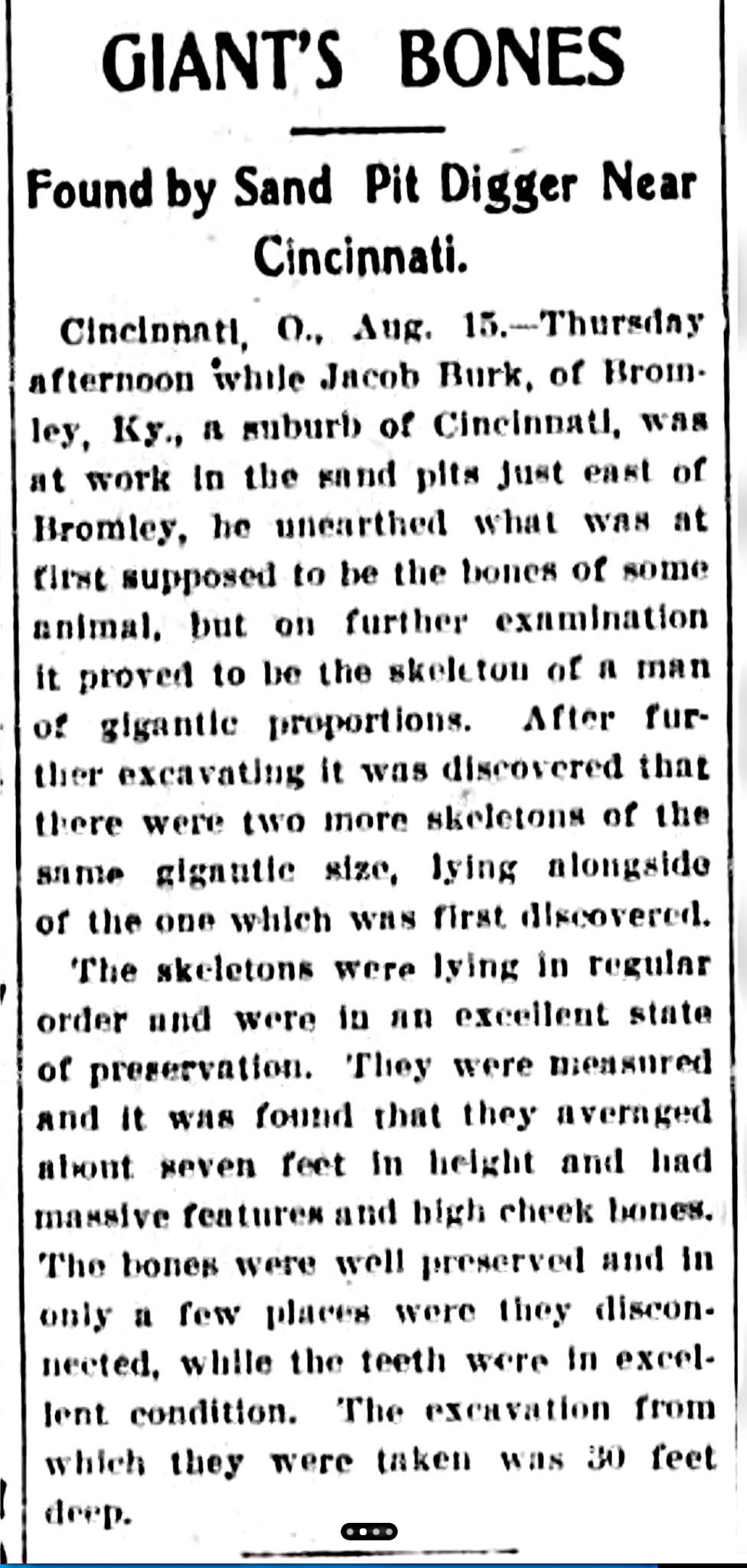
Preserved archive scan · “GIANT'S BONES — Found by Sand Pit Digger Near Cincinnati” · Akron Daily Democrat · August 15, 1902.
Report Summary

Three skeletons in a sand excavation

The article reports that Jacob Burk of Bromley, Kentucky, was working in sand pits just east of Bromley when he uncovered bones first thought to belong to an animal. Further examination was said to reveal a human skeleton of “gigantic proportions.”

Continued excavation reportedly exposed two additional skeletons lying alongside the first. The three were described as lying “in regular order,” averaging approximately seven feet in height, with massive features and high cheekbones.

Unlike many giant-skeleton stories, this report describes not one isolated set of remains but three skeletons said to have been found together at the same excavation.

The clipping further states that the bones were well preserved, the teeth were in excellent condition, and the excavation from which the remains were taken was approximately 30 feet deep.

Research limitation: The surviving report does not identify a physician, archaeologist, coroner, museum, university, or other professional institution that examined the remains. Their subsequent disposition is presently unknown.
02

Documentation Strength

The score measures the traceability and specificity of the surviving documentation—not whether the reported interpretation is true.

4 / 8Documentation markers
Moderate documentation
✓
Source identifiedAkron Daily Democrat, August 15, 1902; Cincinnati dateline.
✓
Specific locationSand pits just east of Bromley, Kentucky, near Cincinnati.
✓
Named people / witnessesJacob Burk of Bromley is specifically named as the discoverer.
✓
Measurements / concrete detailsThree skeletons; average height about seven feet; 30-foot excavation; arrangement, features, bones and teeth described.
Institution / organization namedNo museum, university, physician, archaeological body, coroner or other examining institution is identified.
Near-primary reportingThe article carries a Cincinnati dateline, but the reporter, witness interview, local original or underlying dispatch has not been established.
Independent corroborationNo genuinely independent contemporary account has yet been established.
Documented follow-upNo later examination, institutional record or traceable disposition of the skeletons has yet been located.
03

People, Place & Physical Details

The strongest features of the report are its concrete details. They make the story researchable even though the later evidence trail is currently thin.

Named Discoverer

Jacob Burk

Identified as a resident of Bromley, Kentucky, and the sand-pit worker who first uncovered the remains.

Discovery Site

East of Bromley

The report places the discovery in sand pits just east of Bromley, a Kentucky community across the Ohio River from Cincinnati.

Number Reported

Three Skeletons

One skeleton was reportedly found first; two more of the same general size were subsequently uncovered alongside it.

Reported Height

About Seven Feet

The article states that the skeletons were measured and averaged approximately seven feet in height.

Burial / Arrangement

“Lying in regular order”

The wording suggests an orderly placement rather than scattered isolated bones, although the article provides no archaeological interpretation of that arrangement.

Excavation

30 Feet Deep

The article reports that the excavation from which the skeletons were taken was approximately 30 feet deep.

04

The Source Trail

The next major research objective is to move backward from the Akron publication to the source of its Cincinnati-datelined account.

Thursday afternoon
Reported discovery near Bromley

Jacob Burk reportedly uncovers the first skeleton while working in the sand pits. Further excavation is said to reveal two more.

Aug. 15, 1902
Akron Daily Democrat

The surviving article appears with a Cincinnati, Ohio dateline and describes the discovery in detail.

under continued study
Original Cincinnati / Kentucky source

The dateline suggests a Cincinnati reporting or wire source, but the underlying local newspaper, correspondent or dispatch has not yet been identified.

under continued study
Disposition of the remains

The surviving clipping does not state who took custody of the skeletons, where they were examined, or where they ultimately went.

05

Why This Case Matters

The Bromley report is a useful example of strong descriptive detail paired with a weak institutional trail.

Discoverer namedJacob Burk
Skeletons reportedThree
Average height~7 feet
Professional examUnknown
Present locationUnknown
Museum assessment: The report contains enough names, geography and physical detail to justify continued investigation. Its weakness is not a lack of detail in the newspaper account, but the absence—so far—of a traceable professional examination, independent corroboration, or documented chain of custody.
06

Open Research Questions

These are the questions most likely to strengthen—or weaken—the historical case if additional records are found.

Source

What was the original local report?

Finding the Cincinnati or northern Kentucky source behind the Akron article could reveal a reporter, witnesses, additional names, or a more precise sand-pit location.

Examination

Who measured the skeletons?

The article says the remains “were measured,” but does not identify who performed the measurements or what method was used.

Disposition

Where did the three skeletons go?

No destination is given. Local coroner, cemetery, historical society, museum, medical-school or newspaper records may provide a follow-up trail.